Most of the World's Land Loses More Water as the Air Dries
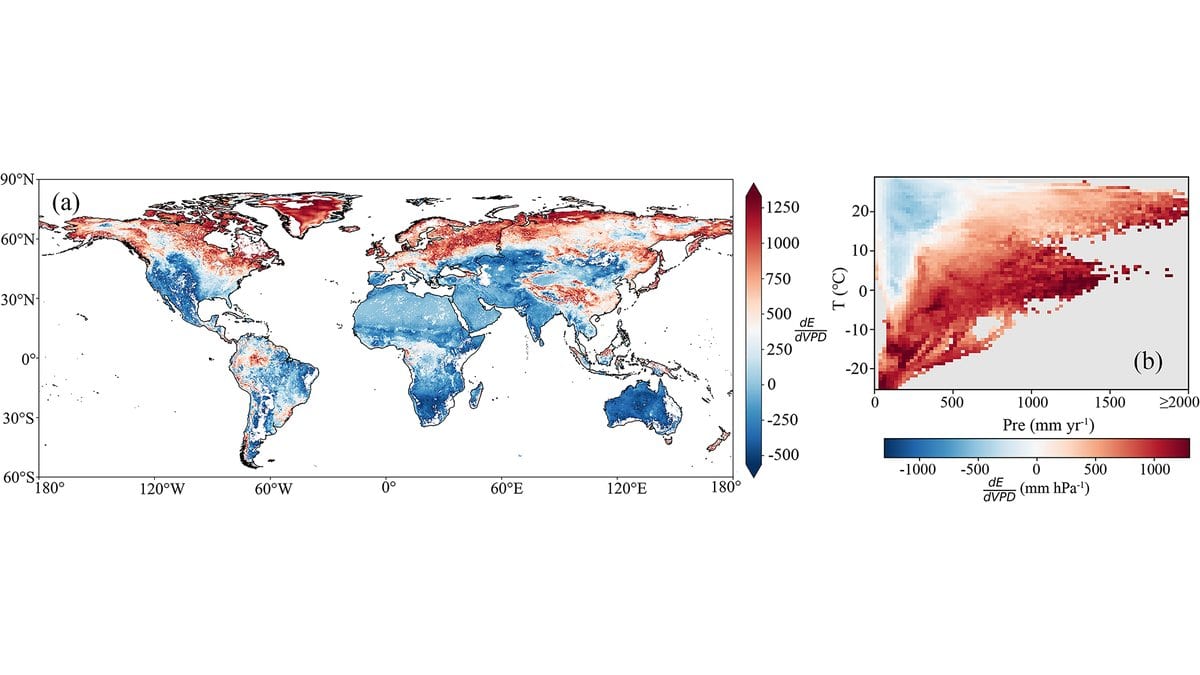
A global analysis published Oct. 9, 2026, in Hydrology and Earth System Sciences reports that across 60.7% of the world's land area, the water leaving soil and plants for the atmosphere rose and fell with the dryness of the air between 1981 and 2020.
Vapor pressure deficit is the gap between the water the air could hold and the water it holds; the wider the gap, the harder the air pulls moisture from soil and leaves. Yuxin Miao, Guofeng Zhu and colleagues at Northwest Normal University in Lanzhou, China, describe it as a key source of uncertainty in projections of future water loss from land, and say their results are meant to supply a measured constraint for those projections.
Evapotranspiration is the technical name for that loss. The team took its estimates from the satellite-based GLEAM product and calculated air dryness from ERA5-Land reanalysis temperature and dew-point data, produced by the Copernicus Climate Change Service. They report that land vapor pressure deficit rose by about 0.002 kPa a year over that period, with the sharpest increases in southwestern North America, central Africa, parts of Central Asia and eastern Australia.
The authors also find a turning point in the relationship, and it sits higher where the climate is drier: 1.90 kPa in arid zones against 0.47 kPa in humid ones. The link was positive overall for water moved by plants, strongest in the northern mid and high latitudes, and weaker (sometimes negative) for evaporation from bare soil where water is short.
That share is what the authors call an apparent sensitivity, the relationship as it appears in the data. A path analysis in the same paper, which also accounts for soil moisture, plant physiology and energy supply, finds the net effect of vapor pressure deficit on water loss to be negative.
The authors also ran the analysis with independent air-dryness and evapotranspiration datasets as a robustness check. The paper is open access under a CC BY 4.0 license.