A Slow Pulse in the Air Weighed Shishaldin's Biggest Explosion

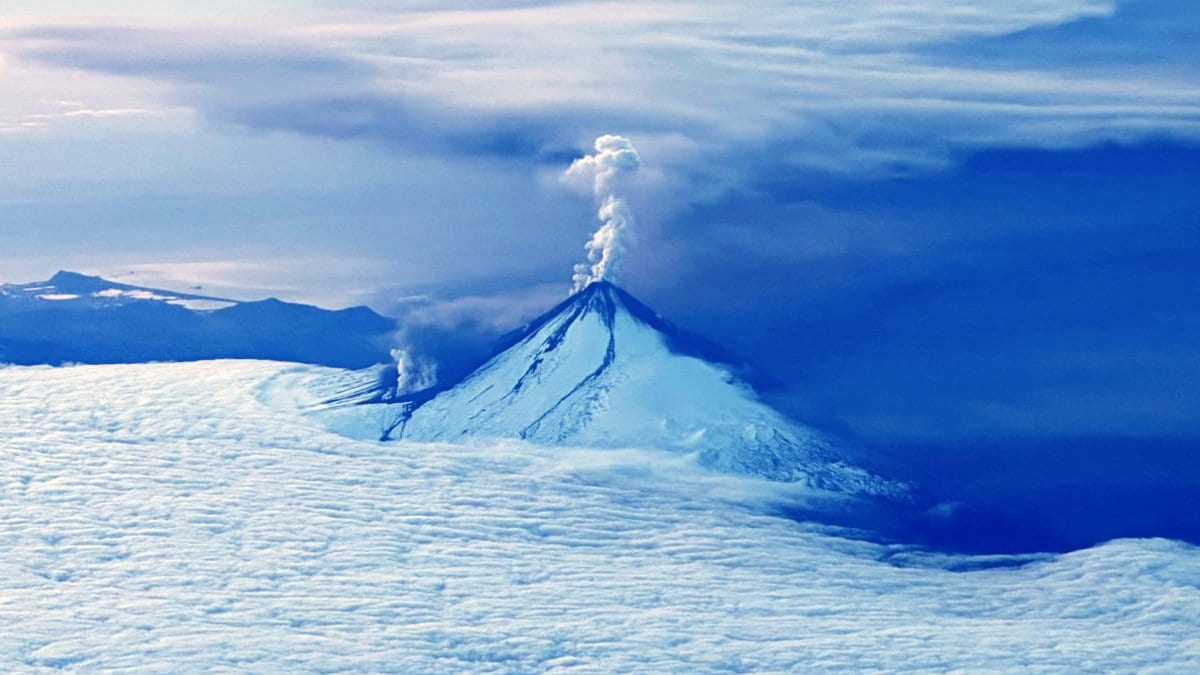
On Sept. 25, 2023, the repetitive popping that had been building for two hours at Shishaldin Volcano gave way to something much slower. Two infrasound sensors about 6 km from the vent, on Unimak Island at the eastern end of the Aleutians, recorded the air pressure sag and then swell back in one slow breath roughly 11 minutes long.
Writing Nov. 27, 2026, in Bulletin of Volcanology, Matthew M. Haney and John J. Lyons of the U.S. Geological Survey's Alaska Volcano Observatory, with David Fee of the Geophysical Institute at the University of Alaska Fairbanks, turn that single swing into an estimate of how much mass was leaving the mountain, second by second, during the largest explosion of a months-long eruption.
A pulse that slow is barely sound. Volcanoes radiate infrasound below the limit of human hearing all the time, but at periods of ten minutes or more, buoyancy joins compression as a restoring force, and the resulting waves travel far more slowly than sound. Weather-balloon soundings from Cold Bay, 94 km to the east-northeast, put the Shishaldin pulse "at or below the atmospheric buoyancy frequency", the rate at which displaced air bobs up and down, so the team modeled it with acoustic-gravity theory rather than with ordinary acoustics.
The modeling is a search, not a reading. The authors assume a point source injecting mass into the air, give it a smooth rise and fall in time, then scan over its height, its duration and its position until a synthetic pressure trace matches what the two sensors recorded. The best fit sits 1.2 km above the summit and 500 m to the north-northeast of the crater, with a peak rate of about 22,500 metric tons a second and, over the whole pulse, a total of about 7.9 million metric tons.
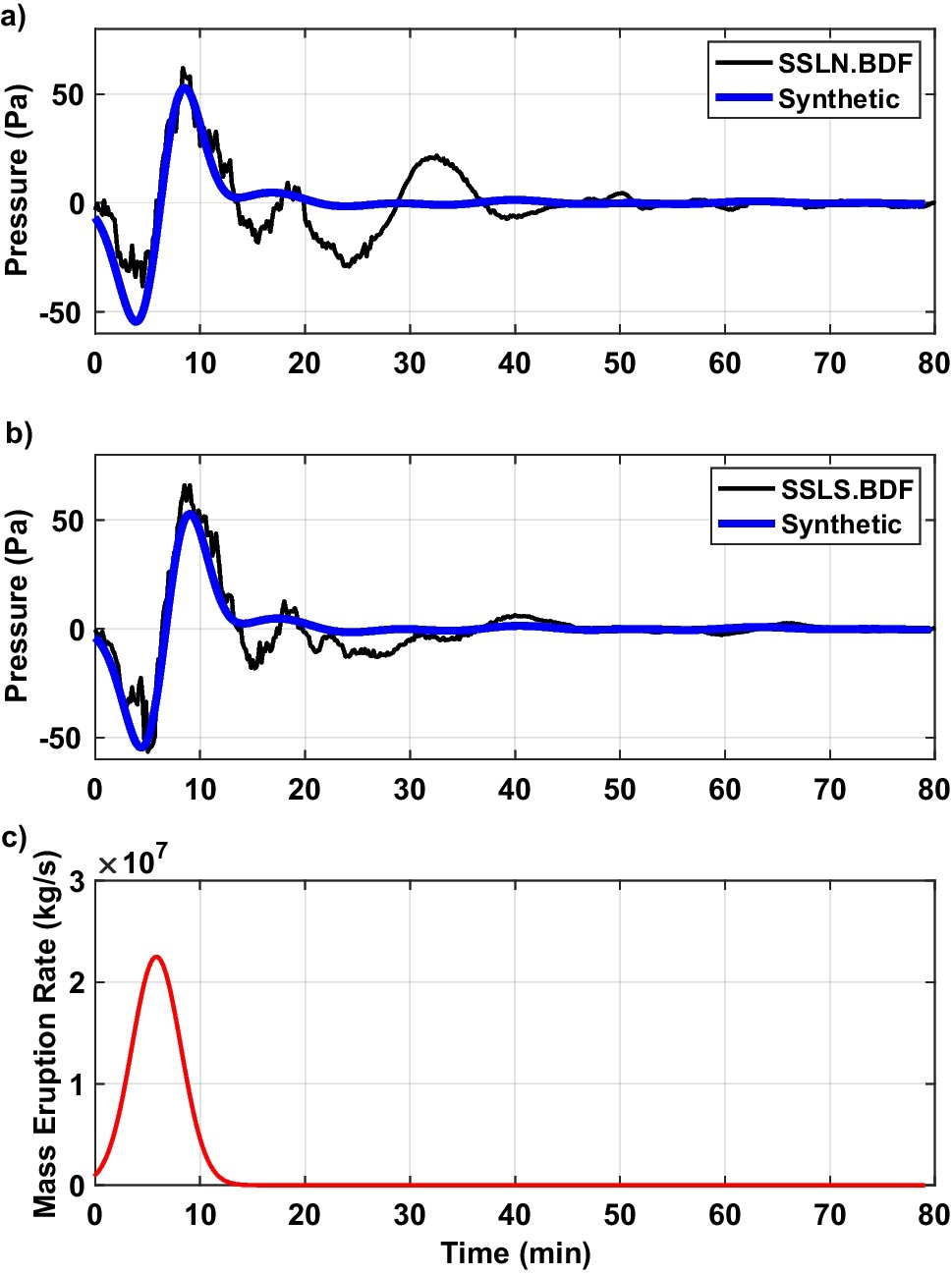
The authors read the height as the top of the gas-thrust region, the level at which the initial upward shove runs out and the plume keeps climbing only because it is hot. The sideways offset is less settled: winds that afternoon came from the south-southwest and would have tilted the plume toward the north-northeast, but the equations used here contain no wind at all, so those same winds would also drag a fitted position that way by changing the effective speed of the waves. The paper offers both explanations and picks neither, which makes the 500 m a property of the best-fitting model rather than a claim about where the plume stood.
Set against the eruption's other measurements, the mass comes out low. Three independent estimates exist for this explosion; the infrasound figure matches the lowest and sits a factor of two to three below the other two, one built on satellite measurements of sulfur dioxide, the other on modeling of the ash plume. The authors offer two reasons. An infrasound inversion recovers the volume of air a plume displaces, so converting back to erupted mass needs a plume density, a step that can raise the answer severalfold; and much of the sulfur dioxide left the vent before the climax that the pressure pulse records. All of these numbers are single best fits with no error bars: the paper notes that source height and pulse duration trade off, so that "a range of values near the optimal value would lead to an acceptable data fit", and that with one sensor north of the volcano and one south, the east-west position is the weakest of the three coordinates.
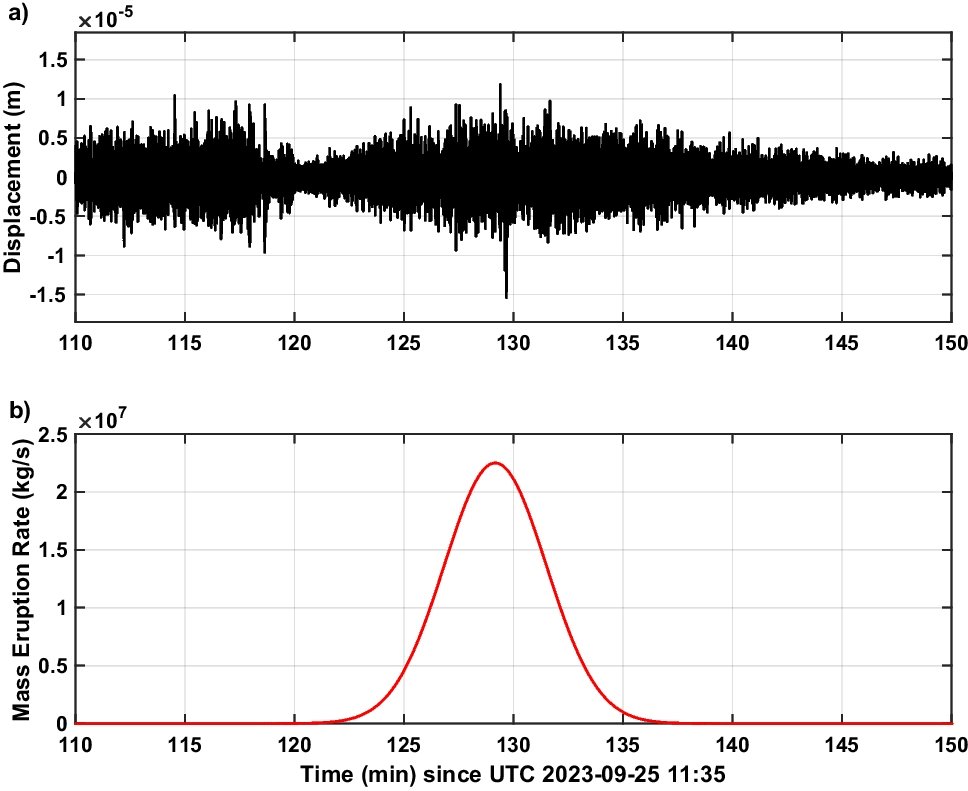
The firmest result in the paper is not about the air at all. Shishaldin's seismometers recorded high-frequency tremor, the continuous shaking of an erupting volcano, through the climax, and when the authors set the tremor's envelope beside the eruption-rate history recovered from the pressure pulse, the two swell and peak at virtually the same moment. Volcano seismologists have worked for decades on reading eruption rate off tremor, because tremor is what most observatories have in quantity and in real time. Here two instruments measuring entirely different physics, ground motion and air pressure, produce the same shape, which the authors say "demonstrates convincingly that the high-frequency eruption tremor is proportional to the mass eruption rate".
What the method is not yet is routine. Waves this slow appeared for only two of the eruption's 13 major explosive events, and only the cleaner of the two was modeled; the authors devote the rest of the paper to what needs to be done to generalize the methodology. Stations farther out "did not detect acoustic-gravity waves owing to their relatively rapid decrease in amplitude with range", so this needs sensors as close as these two. The atmosphere the equations assume has a single temperature and no wind, and its real values came from a balloon released twice a day, 94 km off. Only one volcano has been studied this way before, Soufrière Hills on Montserrat in 2016; Shishaldin is the first basaltic one, and because it builds no summit dome its source had to be smooth and symmetric where Montserrat's called for a sharp pulse.
On near-real-time use the authors write in the conditional. It "should be possible to create automated, near real-time quantitative tools to infer mass eruption rate" along the lines demonstrated here, they argue, and in the next sentence that "Near real-time detection and modeling will be challenging". The work in this paper is retrospective: an explosion from 2023, an inversion run by hand in two stages, atmospheric values from whichever balloon flight was nearest. What already runs continuously is the data, digitized at the stations and "transmitted to AVO in real-time" — and the physics at the two near stations, where the leading wave arrives at close to the speed of sound, not at the crawl expected of an internal gravity wave.
Shishaldin's biggest explosions gave no obvious precursors, which the authors call a challenge for real-time monitoring at basaltic volcanoes; whether these slow waves appear at all, they note, is already a fast read on which explosions were the big ones. For one explosion at one volcano, a swing in the air and a shaking in the ground told the same story about how fast the mountain was emptying.
Sources
- Bulletin of VolcanologyPeer-reviewed
- Bulletin of Volcanology