Listening to a Volcano That Never Erupted: Seismic-Noise Imaging of Ruapehu's 2022 Unrest

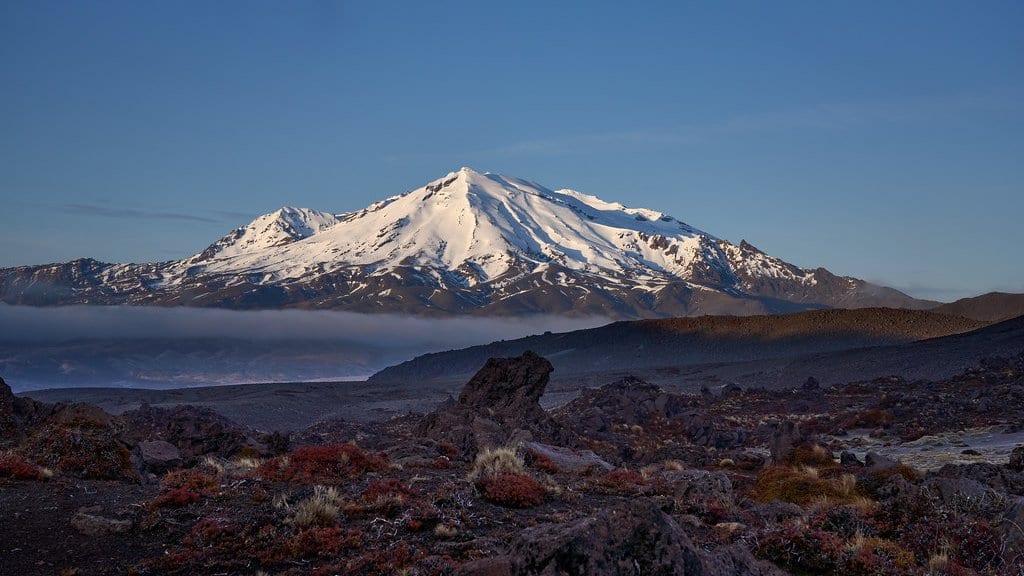
Through the autumn of 2022, Ruapehu did everything a volcano does before it erupts — except erupt. Its summit crater lake, Te Wai a-moe, warmed through the year. Volcanic tremor climbed. Monitoring agencies watched closely, alert levels shifted, and hikers were kept clear of the summit. Then the fever broke. No ash, no explosion, no lava. The mountain simply settled back down.
For volcano scientists, an episode like that is both a relief and a puzzle. Something clearly stirred beneath the crater, yet the instruments that usually track a rising magma body (GPS receivers measuring how the ground swells and tilts) saw very little. If magma or its fluids moved, they moved without visibly deforming the surface. So what, if anything, actually happened underground?
That is the question a team led by researchers from GNS Science and New Zealand's Massey University set out to answer, in a paper published on 10 July 2026 in the Bulletin of Volcanology (Almassri, Lamb, Mead and Zellmer). Rather than look for the big, obvious signals, they listened to the noise.
Seismometers never record silence. Even with no earthquake shaking the ground, they pick up a faint, ceaseless hum: ocean waves pounding distant coasts, wind, rivers, the low churn of a planet that is never quite still. For decades that hum was treated as clutter to be filtered out. Then seismologists realised it carried information. By comparing the background wobble recorded at two stations over time, they can measure tiny changes in how fast seismic waves travel through the rock between them. And the speed of those waves is sensitive to what the rock is doing: cracks opening or closing, fluids seeping into pore spaces, pressure building or easing. A drop in wave speed can flag a subsurface change that leaves no mark at the surface.
Applying that idea to Ruapehu's 2022 episode, the study reports that seismic wave speeds did change during the unrest; tellingly, they did not change everywhere at once. According to the authors, a velocity drop appeared on one flank of the volcano roughly 20 days after a change registered nearer the summit, a staggered pattern they read as fluids working their way through the edifice at depths of about two to six kilometres. (Those specific figures come from the study itself; the full paper sits behind a paywall, and the editor should confirm the exact lag and depth values against the complete text.)
The interpretation is cautious by design. Ambient-noise methods have a history at Ruapehu (researchers used the technique to probe the volcano's interior more than a decade ago), so this is less a debut than an extension: turning the same tool onto an unrest crisis that never tipped into eruption, and showing it can register movement that deformation sensors miss. That distinction matters more than it sounds. Most volcano-monitoring playbooks lean heavily on the ground physically bulging as magma rises. When it doesn't bulge, as at Ruapehu in 2022, a monitoring network can be left with tremor and a warm lake but little sense of what is driving them.
A method that reads the background hum offers a second, independent line of sight, one that keeps working when the ground stays stubbornly flat. That is not the same as a forecast; catching a change is not the same as knowing whether it will build toward an eruption or fade, as this one did. But for the people who have to make alert-level calls in real time, another honest signal is worth having.
Ruapehu is not a quiet neighbour. It sits above a busy alpine playground and has erupted repeatedly in living memory, including a deadly lahar in 1953 and dramatic eruptions in the mid-1990s. Learning to read its subtler moods, the ones that stop short of an eruption, is part of the long, unglamorous work of not being caught off guard.
Sources
- Bulletin of VolcanologyPeer-reviewed