The Rocks That Never Fell: How a Physics Engine Turned Balanced Boulders Into Fast Earthquake Gauges

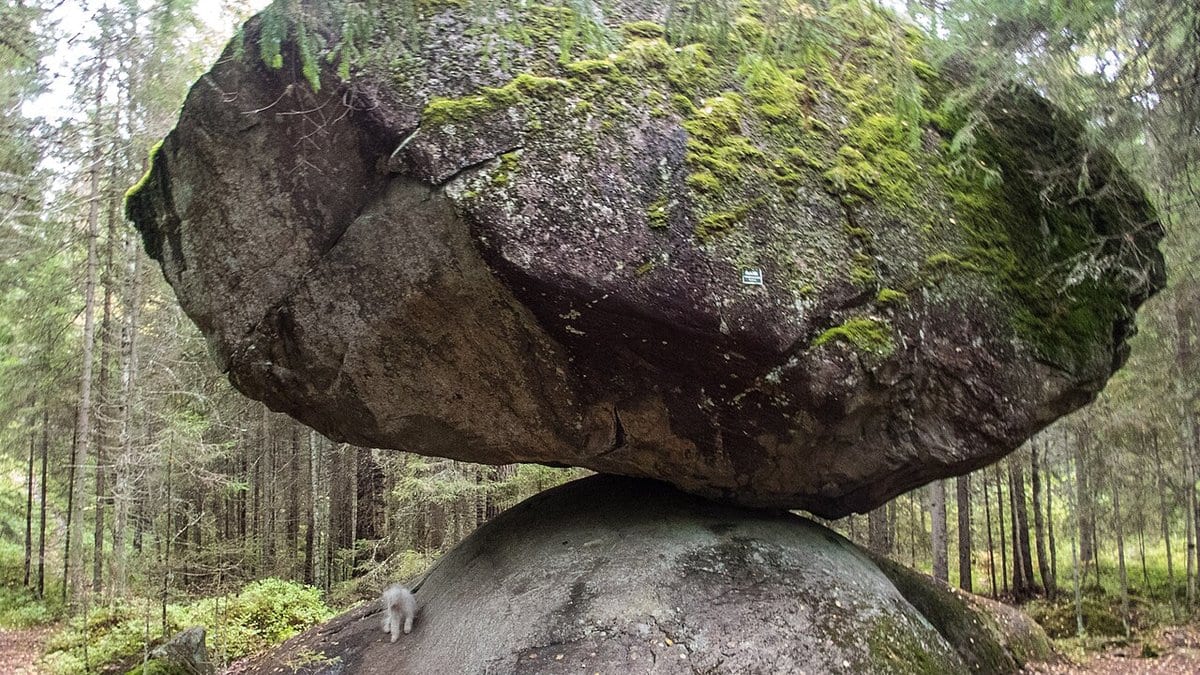
Balance a boulder on a narrow pedestal and leave it alone for ten thousand years, and it becomes a strange kind of instrument. Every big earthquake that shook the ground beneath it was a test the rock passed. It is still standing, so none of those quakes shook hard enough to tip it over. Read that way, a precariously balanced rock is a receipt for shaking that never happened, and that absence is exactly what seismologists want to measure.
The trouble has always been turning a standing rock into a number. To know how strong an earthquake would have to be to topple a given boulder, you have to model the rock's teetering, rocking, sliding behavior under shaking, and that behavior is stubbornly hard to compute. The most trusted approach, the discrete element method, treats the contact between rock and pedestal in fine mechanical detail and gets answers researchers believe. It is also slow enough that running the thousands of scenarios a real hazard study needs becomes impractical.
A study published July 15 in the peer-reviewed journal Seismica offers a way around that bottleneck. Zhiang Chen and colleagues at Arizona State University, working with researchers from the University of Nebraska–Lincoln, the seismic-instrument company Kinemetrics, and Pacific Gas and Electric Company, built a simulation platform on a physics engine, the same class of software that powers realistic collisions in video games and robotics. The question was whether something built for speed could also be trusted for science.
To find out, they held it against the hardest evidence available. The team calibrated their virtual shake table using large-scale physical shake-table experiments on an actual precariously balanced rock, then tested it against 582 recorded earthquake displacement histories, real ground motions pulled from the seismological record. Their physics engine reproduced the overturning predictions with reliability comparable to the discrete element method, the established benchmark. The difference was the clock. The physics-engine approach cut computation time by roughly 10² to 10⁵ times, somewhere between a hundredfold and a hundred-thousandfold speedup, depending on the case.
That speed is not a convenience. It is what makes a whole class of question answerable. When you can only afford a handful of simulations, you model one plausible version of a rock and report a single fragility estimate. When you can run thousands cheaply, you can ask a harder and more honest question: how much does the answer wobble when the inputs are uncertain?
Rocks resist that kind of certainty. The contact between a boulder and its base involves friction, damping, and stiffness values that no one can measure exactly for a specimen that has sat in the desert for millennia. Each of those parameters is a guess with error bars around it. The fast method let the team run large ensembles, sweeping through the plausible range of contact physics to see which unknowns actually matter.
One did, more than the rest. Among the contact parameters, lateral friction exerted the strongest influence on whether a modeled rock stood or toppled. Restitution and spinning friction mattered comparatively little; contact damping and stiffness behaved in more complicated ways. That is a useful piece of triage. It tells future studies where to spend their effort: nail down the lateral friction and the rest is second-order.
The stakes reach past academic curiosity. Precariously balanced rocks are among the few tools that can check seismic-hazard forecasts against thousands of years of real ground behavior rather than the few decades of instrument records. Where such rocks sit near critical infrastructure, a nuclear plant, a dam, a major fault, they offer an independent upper bound on how hard the ground can shake. That the utility PG&E helped fund and staff the work, and disclosed that support, reflects how directly this bears on real hazard decisions. It also means the result deserves the same scrutiny any industry-supported study does; the method's calibration against physical experiments and hundreds of recorded motions is what gives it standing beyond a single interested party.
A virtual shake table is still a model, and a model calibrated on one experimental rock has to prove itself on many more. What the study establishes is narrower and genuinely useful: a fast, benchmarked way to ask how uncertainty in a rock's physics propagates into a hazard estimate, and a clear signal about which uncertainty to chase first. The boulders have been keeping their records for millennia. This is a quicker way to read them.
Sources
- SeismicaPeer-reviewed