On the Dead Sea's Eastern Shore, the First Annual Odds That the Ground Opens Again

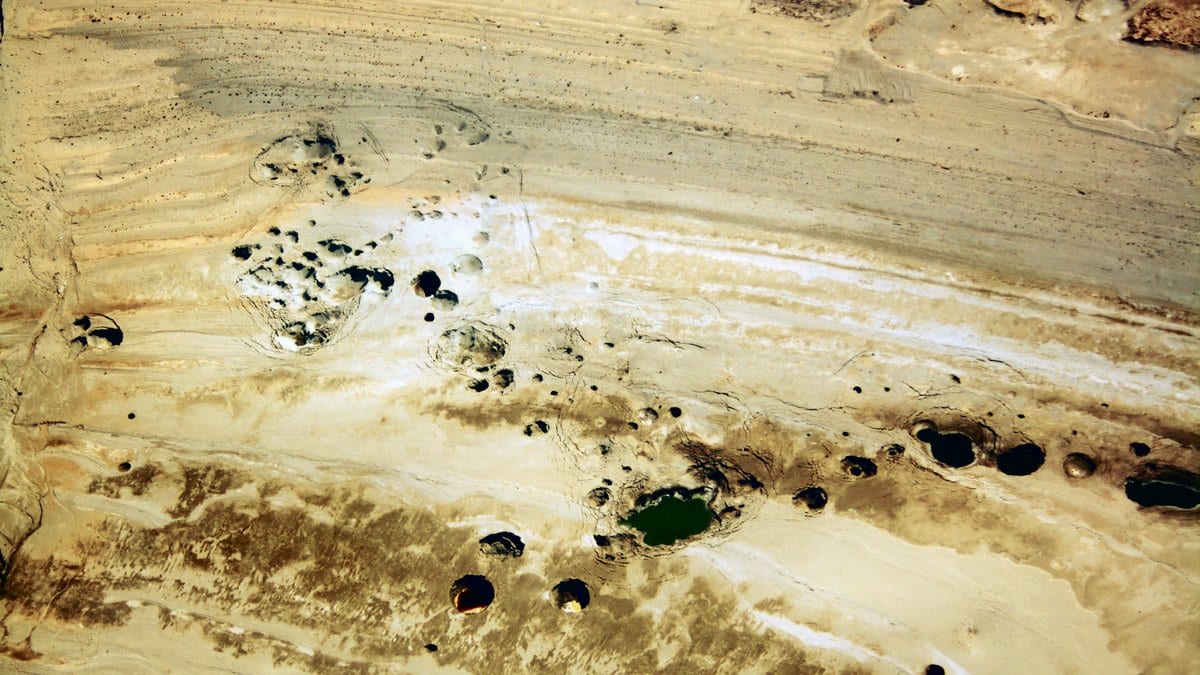
The village of Ghor Al-Haditha sits on the Jordanian side of the Dead Sea, at the foot of a 7-kilometer strip of coast that has been coming apart for four decades. Fields drop away without warning. Ground cracks run through farmland and toward the highway. What is unusual is not that this happens but that it happens so regularly, and for long enough, that the hazard can now be counted.
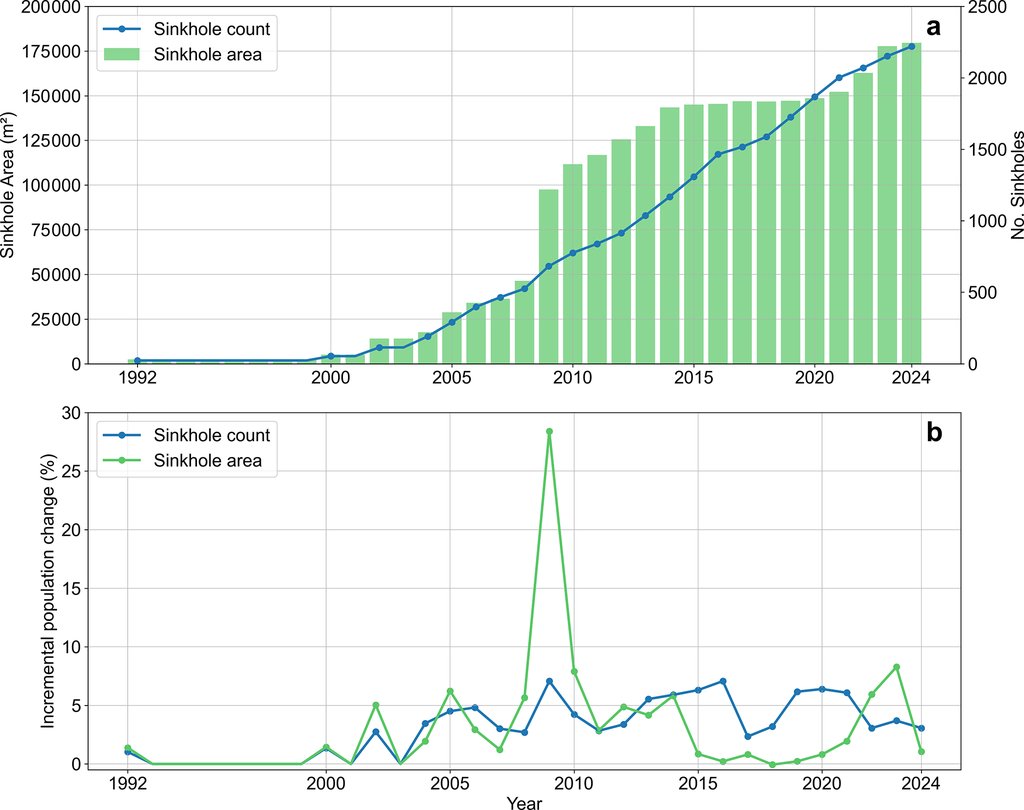
A study published open access on Nov. 13, 2026, in Natural Hazards and Earth System Sciences puts the count at 2,247 holes in 2024, up from 1,565 in 2018, a rise of 43%. Hanna Z. Schulten and Eoghan P. Holohan of University College Dublin and colleagues measured each one from Pléiades and Pléiades Neo satellite images, folded into mapping of the same coast going back three decades, and then asked what the resulting spread of sizes says about next year.
The reason the ground opens here is neither local nor new. The Dead Sea has no outlet, and most of the fresh water that once reached it down the River Jordan is now taken upstream for drinking and irrigation. The lake surface has dropped more than 40 meters since 1970, a decline the paper takes from a body of earlier work rather than measuring itself. As the lake falls, the water table under the shore falls with it, and less salty groundwater pushes into sediments that hold beds of rock salt near their base. Salt dissolves far faster than the limestone of ordinary cave country. Cavities open in years rather than millennia, and the loose cover above them eventually drops in.
The odds, and the three conditions on them
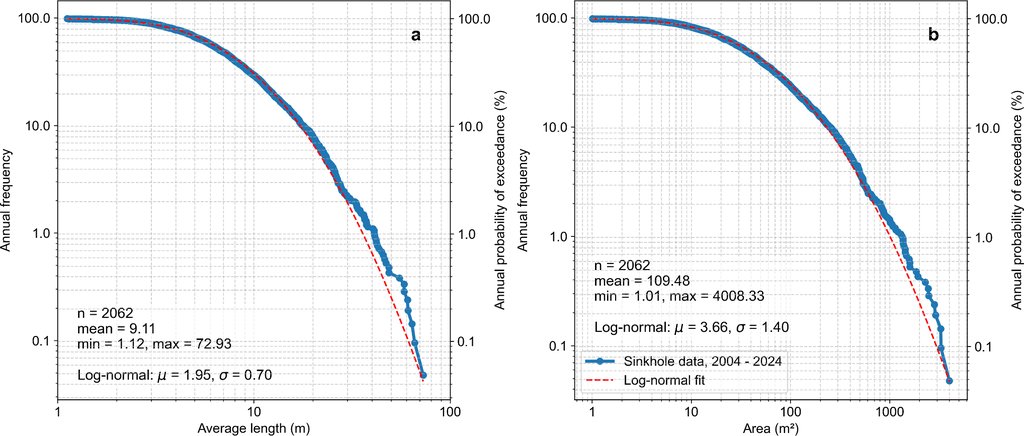
What is new is the arithmetic of size. The authors report what they call representative annualized exceedance probabilities for the strip: in any given year, the chance that a sinkhole of more than 5 meters average diameter opens somewhere along it is about 70%; more than 10 meters, about 30%; more than 50 meters, about 0.5%.
Three conditions travel with those numbers. They are area-wide: the odds are for a hole of that size opening somewhere on the whole strip, not for any one field, house, or stretch of road, and the paper offers no way to convert one into the other. They are conditional: every probability assumes a continuation of the behavior already in the record, which means the roughly 100 new holes a year counted between 2004 and 2024. And they shift slightly with how often the satellite imagery was sampled and with the material a hole forms in, which is why representative is the word the authors chose.
They are also a first for this shore, and only for this shore. Annual probabilities for Dead Sea sinkholes were published in May 2024 by Sevil and Gutiérrez in Natural Hazards, drawn from six inventories of the lake's western side; the new paper cites that work and frames its own claim as a first quantitative hazard assessment on the eastern shore. The eastern population is smaller and far more concentrated: almost all of it sits on this single strip, and by the team's own earlier count it made up about a fifth of the sinkholes around the whole lake.
The holes have an upper size limit
The second result is about shape rather than count, and it decides whether this hazard has a ceiling. Sorted by size, the Ghor Al-Haditha holes follow a log-normal distribution, a curve that thins out at the large end as well as the small one. The alternative shape, a power law, does not thin out: under it there is no characteristic size, and nothing in the statistics rules out a collapse far larger than any yet seen. Measured average diameters at Ghor Al-Haditha run from 1.1 to 72.9 meters, and those bounds are physical ones, among them the thickness of the salt-rich layer at the base of the sediments and the strength of the ground lying over it. The collapses are scale-bound, in the paper's word: limited by the plumbing, not open-ended.
That had been contested on the other shore. One earlier analysis of western-shore sinkholes preferred a power law; two later reanalyses of western data preferred a truncated log-normal, which does have a ceiling. The eastern inventory lands on the bounded side, and the fit holds across the whole observed size range rather than only its largest holes.
Quiet ground is not finished ground
The third finding cuts against the tidy picture. New collapses have kept moving north and seaward, tracking the retreating lake, which is what a falling base level predicts. But the team also recorded a localized revival in 2021–2022 in ground that had appeared inactive since 2002, and presents it as an exception to that advance rather than an instance of it. Two explanations are on the table and the paper picks neither: farmers may have filled in holes during the quiet years before a satellite passed over, or the revival may be real, driven by shifts in local groundwater that nobody has yet mapped. Either way, ground that has stopped collapsing is not necessarily finished.
The practical edge of that is close at hand. More than 240 new sinkholes have opened since 2017 within 250 meters of Highway 65, the road running down the Jordan Valley, and the paper works that stretch through as its own example: in any given year, roughly a one-in-three chance that a hole more than 10 meters across opens somewhere alongside the road.
The authors are careful about what that buys. It is not a full accounting of the hazard, which on this coast also includes the slow sagging of whole basins of ground and flash-flood erosion under the same road, and the forecast holds only for as long as the pattern does. What it gives the Jordanian authorities is firmer data to plan against instead of a trend to watch. The sinkhole outlines and the code behind the paper's figures sit in an open repository, so another group mapping a coast like it can run the same analysis on its own holes.