Nowhere Left to Climb: A Volcano's Beetles Run out of Mountain

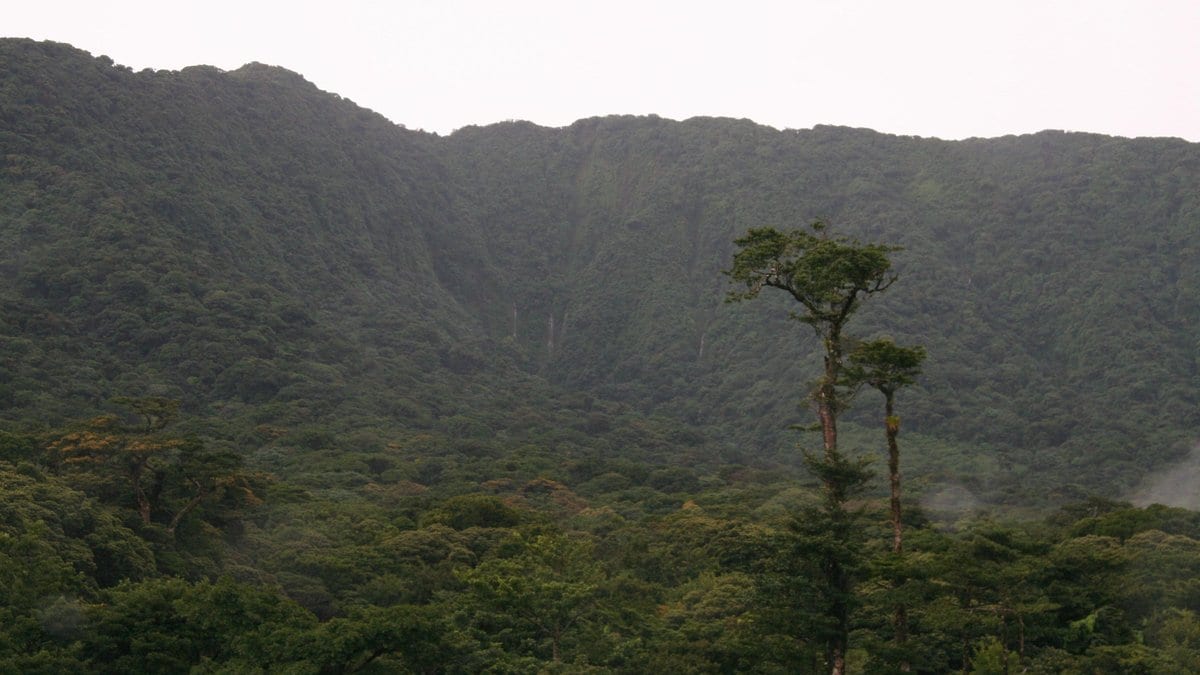
Climb Volcán Cacao in northwestern Costa Rica and the forest changes under your feet. At the bottom is seasonally dry lowland forest that bakes. About 1,500 vertical meters higher, at the top, is cloud forest: cool, wet and, by tropical standards, almost monotonously steady. It looks like the safest address on the mountain. For the beetles living in the leaf litter up there, it may turn out to be the most dangerous.
That is the finding of a study published July 27 in the Proceedings of the National Academy of Sciences, which measured the heat and cold tolerance of a leaf-litter rove beetle community along the volcano's full elevational range. Heat tolerance decreased with elevation. Cold tolerance increased. The beetles at the top, in the most climatically stable place on the slope, ended up with what the research team describes as the narrowest window of thermal tolerance anywhere on the mountain.
The paper is the work of Alexandre M. M. C. Loureiro and M. Alex Smith at the University of Guelph, with Winnie Hallwachs and Daniel H. Janzen at the University of Pennsylvania. Its central sentence is unusually direct for a journal abstract: "We found that heat tolerance decreased, and cold tolerance increased with elevation, supporting the predictions."
The predictions are old ones, and they belong partly to a co-author. In 1967 Janzen argued that mountain passes are effectively higher in the tropics: because tropical lowlands never experience a real winter, animals that live there evolve narrow thermal tolerances, and a mountain range becomes a far more formidable barrier than the same relief at temperate latitudes. Nearly six decades later, he is on the author list of a paper that put a thermometer to the idea on one volcano.
How they did it is worth spelling out. Beetles were collected from leaf litter at eight elevations up Volcán Cacao, inside Área de Conservación Guanacaste, the team says. Heat tolerance was measured by warming individual beetles until they reached their critical thermal maximum, the temperature at which an insect loses coordinated movement. Cold tolerance was measured differently, by chilling a separate set of beetles into a chill coma and timing how long each took to recover. Air temperature at the sites has been logged every 15 minutes since 2013, with soil temperature tracked since 2021, according to the methods section, allowing laboratory limits to be compared against what the forest actually experiences.
The result at the bottom of the mountain is no more comfortable than the result at the top, and the paper states it plainly: low-elevation communities "are already experiencing environmental temperatures that may meet or exceed their thermal limits." The paper adds that the low-elevation forests more frequently reach temperatures that meet or exceed those tolerances. What saves them, for now, is that leaf litter and soil are not air. Ground temperature swings less than the air above it, and the authors expect the soil "will offer a buffered refuge for some time." That is a considerably weaker guarantee than it sounds.
There is a complication running underneath all of this, and it is the part of the study that will unsettle anyone who assumes biodiversity science works from a complete list. Only about 1% of the rove beetle species known from Volcán Cacao have scientific names, according to the team. The other 99% are real, collected, measurable animals with no formal description and no binomial. To tell them apart, the researchers sequenced a standard fragment of DNA from each beetle and used the barcode to sort specimens into species. So the animals shown here to be running out of thermal room are, for the most part, animals nobody has yet described.
Smith, the study's corresponding author, put the gap in a homely way in the funders' announcement: "Trying to predict the future of biodiversity using only a fraction of the species that actually exist, is like trying to assemble your new furniture without all the pieces."
The most interesting line in the paper is not the headline trend but a disagreement the authors flag against their own field. The decline they measure, they write, "is predicted by theory yet is inconsistent with the values for insect species in the thermal tolerance literature." The shape of the pattern matches what ecologists expected. The numbers do not match what has been published for insects elsewhere. The authors do not treat that as a problem with their beetles. They read it instead as a reason to doubt how well the existing literature covers tropical taxa; the abstract closes by calling for "a better understanding of the thermal tolerances of diverse assemblages of tropical species."
None of this is the first time the direction has been shown. In 2016, a PNAS study of tropical insects across elevational gradients established the same relationship between elevation and heat tolerance. What is different here is the scale and the subject: a species-rich family sampled across a whole gradient, resolved by barcode rather than by name, in a place where the naming has barely begun.
While the dramatic "1% named" estimate for the volcano's overall diversity comes from the team’s announcement, the paper itself details the specific scale of the experiment (160 barcoded species sampled across eight elevations). Of course, a few limits are still worth stating: a critical thermal maximum measured in a laboratory is not the same thing as a death sentence in a forest; beetles move, and leaf litter is a more forgiving place than a warming cabinet.
Smith's other line in the announcement is the one that will stay with the reader: the beetles low down "may already be living very close to their limits, while the insects higher on the mountain are not built for the temperatures coming toward them." On a mountain, the standard response to heat is to climb. The beetles in the cloud forest have run out of mountain to climb, and most of them do not yet have a name to be listed under.
Sources
- Proceedings of the National Academy of SciencesPeer-reviewed
- Proceedings of the National Academy of SciencesPeer-reviewed