When Rain Falls, Rivers Get Less of It Than Yearly Averages Suggest

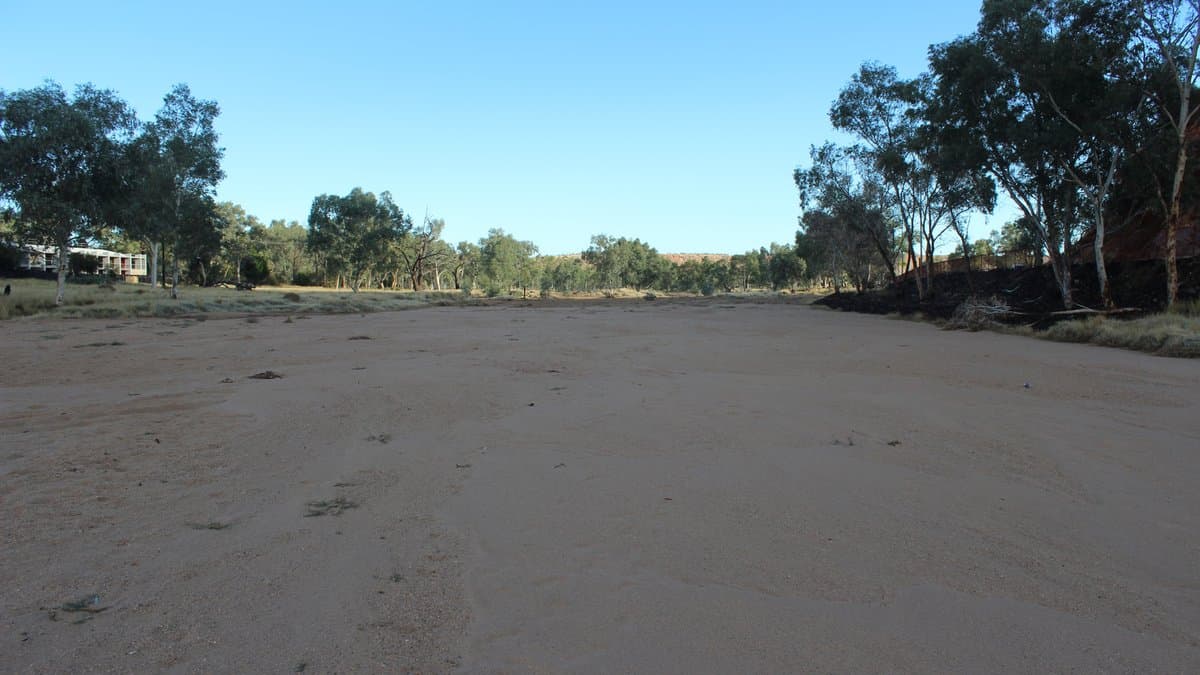
In dry country a river is often a line on a map and a bed of dry stones. Then a storm arrives, the stones are wet for an afternoon, and somewhere downstream a gauge registers a pulse of water. How much of the rain that fell actually reached the channel is the question hydrologists spend their careers on. The usual way to answer it is to add up the rain over years, add up the streamflow over the same years, and divide.
A paper published Sept. 25 in Environmental Research Letters answers it storm by storm instead, wherever the world's river gauges allow. Danlu Guo and Mohammad Masoud Mohammadpour Khoie of the Australian National University wrote it with Conrad Wasko of the University of Melbourne, and published it open access under a CC-BY license. They call it the first uncertainty-aware global synthesis of event-scale runoff generation. That means the first worldwide picture of what single rain events do, with the spread of the numbers carried through rather than averaged away. The qualifier matters. An independent global analysis of runoff at the event scale, covering 6,603 river basins, appeared in Hydrology and Earth System Sciences in July 2026.
What the storm-scale accounting shows is that rivers get less out of a given rain than the long-term figures imply. The authors report that the share of rain that becomes streamflow during a single event is substantially smaller than the share calculated over years. In the tail of that distribution, in fewer than 4% of basins, the typical event share comes to only a tenth of the long-term one.
The two numbers are counting different water. A multi-year ratio picks up everything that eventually arrives in the river, including rain that soaks into the ground and returns to the channel long after the sky has cleared. A storm-scale ratio counts only what shows up while the event is still being watched. Guo and colleagues describe the gap as a consequence of that lumping together of time, and say it may also take in the way water divides underground, including delayed flow through soil and groundwater.
Across climates the pattern is orderly. In arid basins most storms produce no measurable runoff at all, and the ones that do convert little of their rain. In humid basins the conversion is efficient. That gradient is not this paper's alone. The July analysis found the share of rain converted to runoff relatively high in wet areas, with climate the main control on how tightly a basin links rain to flow.
The trends over time are where the paper has to be read carefully. Most of the basins show no statistically firm change in how often runoff happens or in how much of a storm's rain it carries. The declines that are firm are not spread evenly. They fall disproportionately in arid regions, affecting up to 13% of the arid basins analyzed, and those are also the places where the decreases are largest. That is a minority signal inside a mostly flat global picture, which is the paper's own description of it.
All of this is measured where gauges exist. The authors say their coverage reaches across "the regions with available gauged data," which is not the same thing as every dry basin on Earth.
A second line of evidence, from a different group and a different dataset, points the same way. Matthew P. Berzonsky, Li Li and colleagues at Pennsylvania State University compared long-term rain and river-flow trends at 10,179 sites worldwide, in Geophysical Research Letters on Aug. 25. Rain and flow moved in opposite directions at 27% of those sites, and in 40% of those cases the flow fell while the rain rose. The gap between the two trends grew wider the more arid the basin became. The team writes that the results point to heightened water risks in drylands. Neither that paper nor the July one measures the storm-scale quantity at the center of the new study, so the arid-decline figure stands on this paper alone.
Guo and colleagues read the arid declines as a water-scarcity risk in the world's driest regions. The logic runs through what a dry basin has to work with. If most storms there yield nothing measurable, the water that does arrive comes in a few events, and the size of what those events deliver is the whole budget. The July analysis found that in dry climates the flow a storm produces is especially sensitive to how hard the rain falls. Where the biggest storms start handing over less, there is little else in the account to draw on.