The Best Number of Sheep for a Solar Farm's Grass Is Not the Best for Its Insects

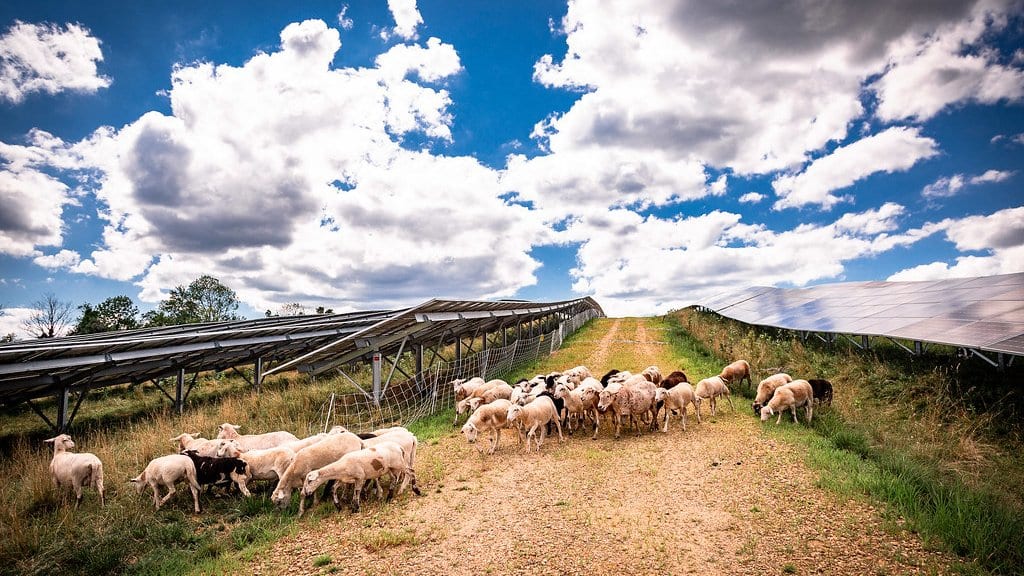
Mowing a solar farm is a stubborn expense. Grass and brush grow up between the panel rows, they shade the cells, and somebody has to keep cutting them. So solar operators have increasingly swapped the mowers for sheep, which eat the problem and do not mind working in the shade. That leaves whoever runs the site with a question the industry has not had to answer before: how many sheep?
A team at Cornell University spent three years answering that question at a working 18-megawatt solar farm, and published the result on Oct. 7, 2026, in Environmental Research Letters. Leana Zoller, Steven M. Grodsky and six colleagues ran a replicated experiment with six stocking rates, which is just the number of sheep per hectare, from no sheep at all up to 10. Over those three years they counted the insects a farm has a stake in: bees and lady beetles, the ladybugs that eat aphids.
Zoller and colleagues report that the light end of that range did best. Plots grazed at 2 sheep per hectare carried 38% more beneficial insects than plots with no sheep on them, and most of that gain came from a single species: honey bees were up 83%. Honey bees are managed livestock, kept in hives and not native to North America, so more honey bees is not the same thing as more wild pollinators.
The category is an agricultural one, and so is the finding. Bees and lady beetles are counted here as agriculturally beneficial insects, the pollinators and the pest eaters farmland runs on. Solar grazing is spreading fast for a plain reason: solar farms keep being built on farmland, and grazing keeps the land from being a straight either-or choice. The paper's case is that a site chosen for its sunlight could also go on supplying a farm's insects, and that how it is grazed decides whether it does.
For wild bees the evidence points the other way. A 2024 study in Ecological Indicators, which sampled grazed and ungrazed livestock pastures rather than a solar site, found wild bees and other insects more abundant where the sheep had not been. The two sets of results are less a contradiction than a difference of subject: honey bees against wild ones, light stocking against ordinary pasture use, a solar facility against open pasture. Put side by side, they turn the useful question about solar grazing into which insects, rather than how many.
Heavy grazing did damage. At 8 sheep per hectare and above, bee abundance fell by 42% to 68% against ungrazed plots, and the mix of species present shifted too. This is where the arithmetic gets awkward for whoever signs the grazing contract. The paper reports that a companion study put that same heavy rate at the top for the farming side of the job: the forage the flock gets and the vegetation the operator wants gone. That companion work came from the same project at the same facility, not from an outside group. The rate that was best for the insects, 2 sheep per hectare, is also where flock health peaked, so the stocking that keeps the grass shortest is not the stocking the sheep do best on.
The paper also offers a middle. At 4 sheep per hectare the beneficial insect community was statistically indistinguishable from ungrazed ground, which means the researchers could not tell the two apart, while the grass was kept down better than at the lightest rate. An operator who wants both can set the flock there and know what it buys on each side.
This is one solar farm, one region, three years of counting, and the authors keep their recommendation inside their own study region rather than offering it to solar grazing everywhere. What they have shown there is narrower than a slogan about panels and pollinators, and more useful: flock size works like a dial, and turning it changes which insects turn up under the panels. Solar is still spreading onto farmland, and somebody is setting that dial on every site.
Sources
- Environmental Research LettersPeer-reviewed