The Additives That Keep Plastic From Crumbling Change What It Leaks

A plastic crate that spends a summer in the yard comes back faded and chalky. Leave it there for a few more summers and it turns brittle, then starts to crumble. Manufacturers have a standard fix for this. They mix additives into the plastic: stabilizers, antioxidants and colorants, whose job is to soak up the damage sunlight does, so the crate lasts longer. Almost every plastic object built to sit outdoors carries some.
What that protection does to the pollution the crate leaves behind is far less clear. Amandine Passin, Fabienne Lagarde and colleagues at Le Mans Université set out to close that gap. They report in the journal Microplastics and Nanoplastics, on 5 September, that a plastic's recipe governs both how it comes apart and what it gives off while doing so. Judge a material by the fragments it sheds and you miss a good deal of what it puts into the environment.
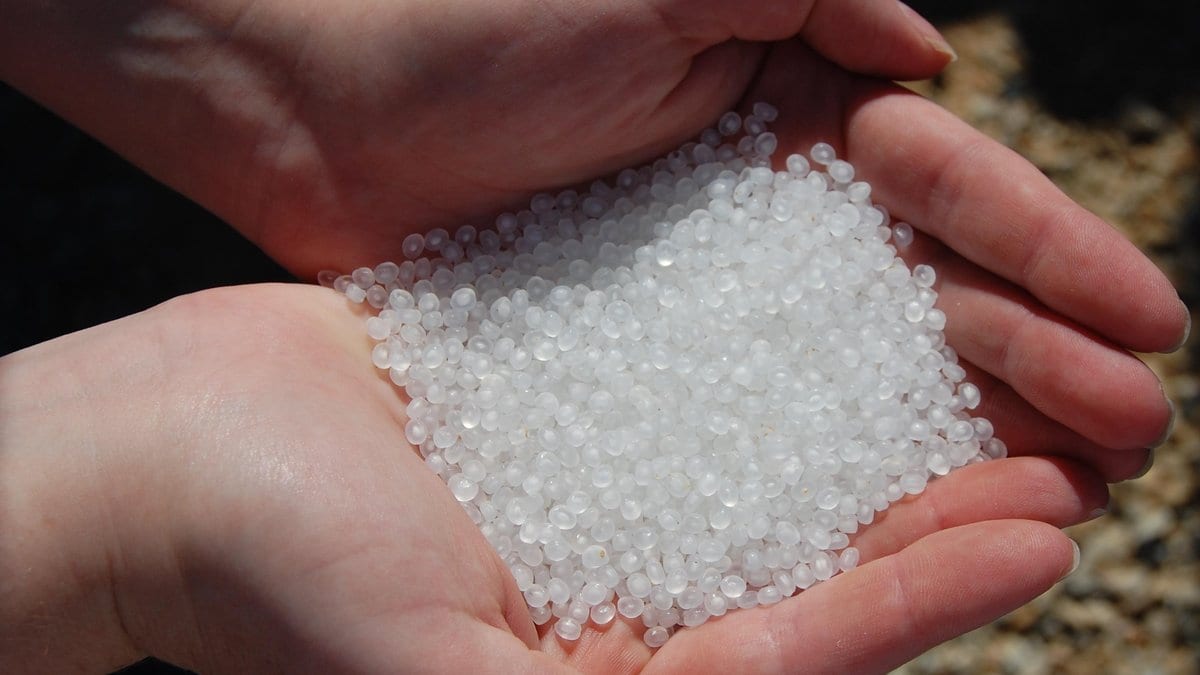
The experiment set two batches of polypropylene pellets against each other. Polypropylene is one of the most widely used plastics there is: packaging, car parts, garden furniture. One batch was plain. The other, labeled PP + 6, carried six additives chosen to represent what industry actually puts in. Both spent 50 days under accelerated ultraviolet light in a weathering chamber. Ultraviolet is the part of sunlight that breaks plastic down. Both were then shaken in water, standing in for the knocking and rubbing a plastic takes outdoors. These are chamber days rather than days on a beach. An accelerated test squeezes long outdoor exposure into a workable stretch of laboratory time. What it delivers is the comparison between the two batches, not a forecast of how a real crate ages.
The plain pellets came apart in three stages. First they gave off gases, along with dissolved matter and nanoplastics (fragments too small to see). Then their surfaces wore away, shedding the larger pieces usually called microplastics. Finally the granules themselves broke up, and that last stage did most of the work: about 62% of everything the plain pellets lost came from it. By the end, they had lost about 82% of their mass.
The protected pellets behaved differently at every stage. They lost about 24% of their mass over the same 50 days. They did it in two stages rather than three, with the whole sequence delayed. On the measure the additives are sold on, they worked.
They did not, however, stop the pellets from releasing anything. Throughout the exposure the protected batch gave off a steadily rising amount of gas, and its additives leached, seeped out, into the water around it. The batch that held together was handing over its own chemistry instead, without a pause, from the first day to the last.
That contrast is what the authors' conclusion rests on: the starting recipe strongly governs both the path a plastic takes as it breaks down and the kind of pollutant it leaves behind. It is a controlled comparison of two recipes in one laboratory, which is enough to show that the recipe matters and not enough to say which of the six additives is responsible. The experiment was not built to separate them, and nobody has yet repeated it elsewhere.
So the authors argue against judging a plastic on its fragments alone. On this evidence a material built to survive the sun can go on releasing something for as long as it sits in it, in a form a count of fragments would never register.
Sources
- Microplastics and NanoplasticsPeer-reviewed