In Full Seawater, Floating Plastic Grows Its Coat of Algae Fastest

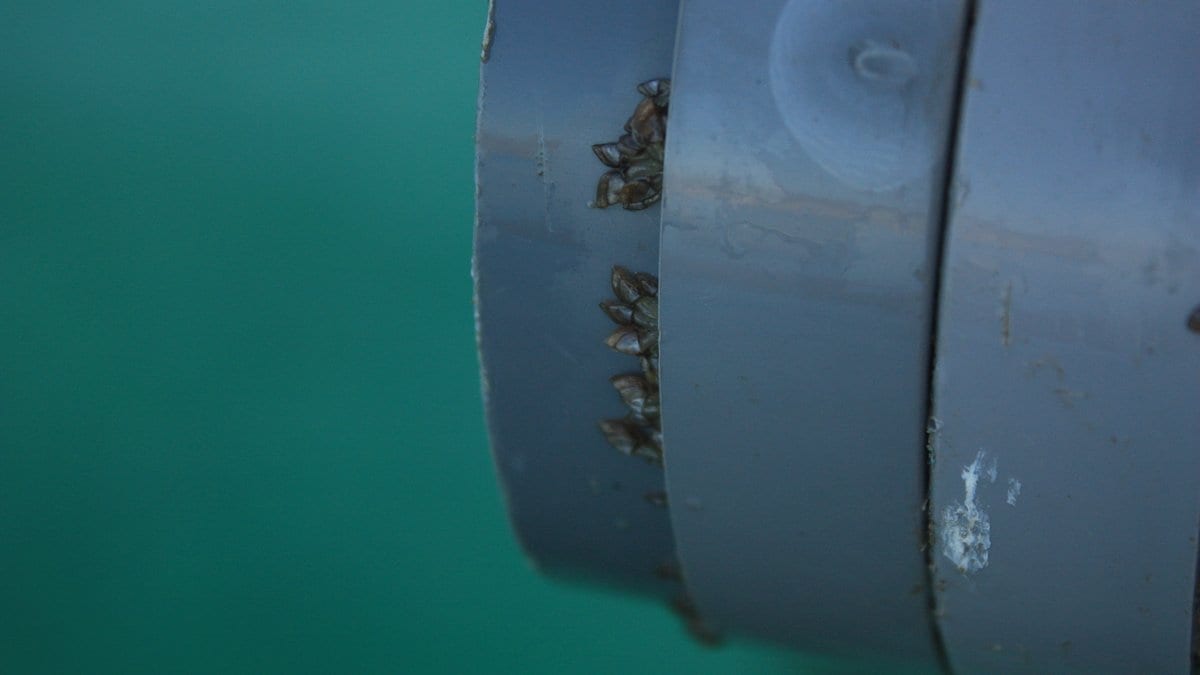
Drop a bottle cap into a river and follow it. Within days it can be out at sea, and on the way the water around it turns from fresh to fully salty. It does not travel empty. To anything small enough, a floating scrap of plastic is a surface, and in the ocean a surface is somewhere to live.
Which living things settle there, and how fast, has been hard to pin down. The algae drifting in the water and the ones that take hold on the plastic need not behave alike, and how either responds where river water meets the sea was largely unknown. Ji Nam Yoon, Seung Ho Baek and a colleague at the Korea Institute of Ocean Science and Technology built a small version of that journey in tanks. They mixed fresh water with seawater at three strengths: full seawater, a slightly weaker mix and water about as salty as an estuary. Into each went plates of polypropylene, the plastic of bottle caps. The tanks ran for 30 days; the results were published on Sept. 6 in Marine Pollution Bulletin.
They tracked chlorophyll, the green pigment algae carry, as a measure of how much had built up. On the plates in full seawater it accumulated at 6.16 micrograms per square centimeter a day. In the two weaker mixes the rates were 1.42 and 1.24. Set the fast rate against the slow ones, and the seawater plates gathered their coating about four times faster. That ratio is arithmetic on the paper's own three numbers; the authors quote no multiplier and say only that the seawater tanks showed "a much higher rate".
The gap is also a very tidy one: the spread around 6.16 is about a hundredth of the number itself, against roughly a sixth for each of the slower rates. The result leans on how closely the seawater tanks agreed with one another. Nor do the rates climb with saltiness. The slightly diluted mix was no faster than the estuary-strength one, and full seawater stands apart from both. The authors write of "salinity-associated environmental conditions" rather than of salt alone, and for the open water they point to a shortage of phosphate, a nutrient algae need.
Late in the run, the film on the seawater plates was more than 94% a single kind of diatom, algae that build glass shells, from the genus Navicula. The algae floating in the same tanks did not track it. That mismatch is what the team draws attention to: a piece of plastic can carry a community that is not simply a sample of the water it sits in. They put it as a capacity shown in tanks, not as something measured in a real estuary.
The direction of all this was expected. A review in Environmental Science and Technology sets out that the water around a piece of plastic shapes what colonizes it more than the plastic itself does, saltiness included. A 2025 study in Water Research followed plastics down the Pearl River estuary and found the same. What the Korean run adds is a measured rate, on one plastic, over one month, for something usually described only as a direction. It is the latest in this group's own series of tank runs, and it is a tank run: plates held in mixed water, not fragments riding a real tide.
Sources
- Marine Pollution BulletinPeer-reviewed