Wind, Not Just Current, Decides Where Ocean Plastic Washes Ashore

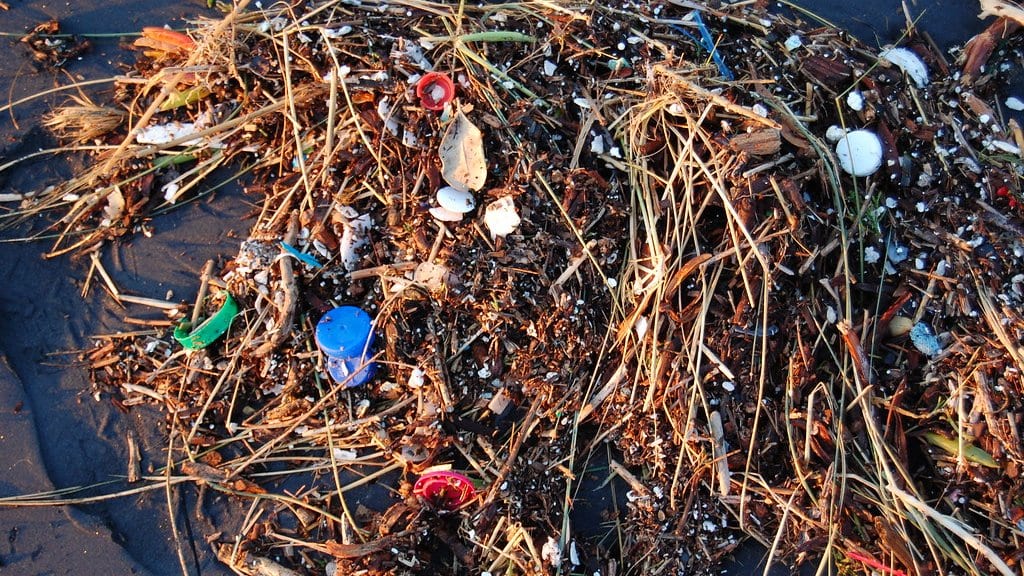
Most of the plastic that enters the ocean does not stay at sea. It comes back to land, washing onto beaches, piling up in mangroves, fouling the same coastlines it drifted away from. The hard question has always been where. Ocean currents are only part of the story, and models of marine debris have struggled to say which stretches of coast act as catchers and which let the plastic slide past.
A study accepted 22 July 2026 in Environmental Research Letters takes an unusually direct route to an answer. Instead of simulating how plastic ought to move, researchers Cody Cruz, Kayla Robertson, Helena Schreder, Georgy Manucharyan, and Michelle DiBenedetto turned to a real-world fleet already scattered across the world's oceans: the buoys of NOAA's Global Drifter Program. These instruments drift with the surface water, and once a buoy loses its underwater sea anchor, its drogue, it rides high and gets pushed around by wind much as a floating piece of plastic would. That makes an undrogued drifter a decent physical stand-in for buoyant debris.
Tracking those trajectories, the team found that about 13.7 percent of undrogued drifters beach within a year of losing their drogues. The debris does not come ashore evenly. It concentrates at particular coastal hotspots, each fed by a broad expanse of open ocean that funnels material toward it. The authors describe these catchment areas as "beaching watersheds," borrowing the language of rivers to capture how wide swaths of sea drain their floating contents onto specific shores.
The mechanism steering all this turns out to lean heavily on wind. Beaching probability, the study reports, depends strongly on the prevailing coastal winds: the stronger and more consistent the onshore breeze at a given stretch of coast, the more likely floating material is to pile up there. Currents carry debris across the basin, but it is the wind at the coastline that decides whether it lands or drifts on by. That helps explain why some shorelines become notorious debris traps while others nearby stay comparatively clear.
The practical payoff is in the models. Large-scale simulations of ocean plastic have to make assumptions about how debris behaves near coasts, and those assumptions have been hard to ground in observation. A measured beaching rate and a clear link to coastal wind give modelers something firmer to build on, improving how macro-plastic debris is represented in the big oceanographic models that forecast where the world's marine litter accumulates. Better forecasts, in turn, point cleanup crews and coastal managers toward the shores most likely to be doing the ocean's dirty work.
A caveat runs through the whole exercise, and the authors are upfront about it: drifters are proxies, not plastic. A buoy is not a bottle or a fishing net, and real debris comes in shapes, buoyancies, and degrees of weathering that a standardized instrument does not. The 13.7 percent figure describes the drifters, and how closely it maps onto actual plastic depends on how faithfully those buoys mimic the junk they are standing in for. This is an observational insight into surface transport, not a direct census of beached plastic.
Sources
- Environmental Research LettersPeer-reviewed