More Than Half of Earth's Migratory Birds Are in Decline, a Sweeping Review Finds

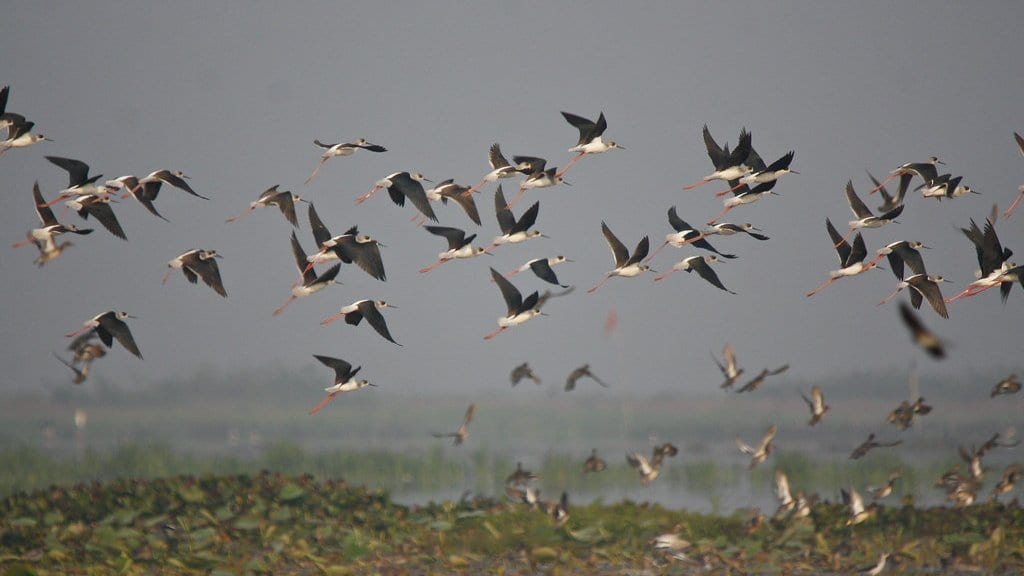
A bobolink that summers in a North American hayfield winters in the grasslands of Argentina, a round trip of roughly 12,000 miles. A spoon-billed sandpiper hatched on the Arctic coast of Russia will fatten on tidal mudflats in Southeast Asia. A Newell's shearwater spends most of its life over open Pacific water, returning to Hawaiian mountainsides only to breed. Each of these birds lives in several places at once over the course of a year, and each place has to hold up for the bird to survive. Pull one thread out of that network and the whole journey can unravel.
That fragility is the through-line of a comprehensive assessment published 23 July 2026 in Nature Reviews Biodiversity. Led by ecologist Peter Marra and Nathan Cooper, with a team of fifteen authors drawn from research groups on several continents, the review compiles the status of more than 3,380 migratory bird species. Its headline conclusion is blunt: more than half of them are declining.
The number matters less for its precision than for its breadth. This is not a report on one imperiled species or one troubled region. It is a portrait of an entire way of life, migration itself, coming under strain across the planet. And because migratory birds stitch distant ecosystems together, a decline in their ranks is read by the authors as a signal that the habitats they string together, from Arctic tundra to tropical coast, are fraying too.
The review does not pin the losses on a single villain. Instead it lays out a stack of pressures that compound along a bird's route: habitat loss, invasive species, collisions with buildings, hunting, the pet trade, toxic pesticides, and entanglement in commercial fishing gear. A migratory bird can run this gauntlet many times a year. Protecting it where it breeds does little good if the wetland where it refuels has been drained, or if it is shot on passage, or if the mangrove where it winters has been cleared.
That is the conceptual shift the authors press hardest. Conservation, they argue, has too often focused on a single place, a single season, or a single threat, when a migratory bird's survival depends on the weakest link across its whole annual cycle. Saving these species means protecting them across their entire journeys, which in turn means the countries along a flyway have to coordinate. A bird does not carry a passport, and the mudflat it needs in one nation is worthless to it if the marsh it needs in the next has been paved.
Here the review turns from diagnosis to something closer to hope. Over the past two decades, the tools for following individual birds have transformed. Miniaturized tracking tags, automated radio-telemetry networks that pick up birds as they pass, and citizen-science platforms such as eBird now let researchers trace where a specific population goes and when. That field, migratory connectivity science, is what makes targeted action possible. Instead of guessing, conservationists can identify the specific stopover site or wintering ground where an intervention will do the most good, and spend limited money where it will actually move the needle.
The authors are careful about the evidence behind their picture. Population trends for migratory birds are uneven in quality across regions, and some flyways are far better monitored than others. The review is a synthesis of existing science rather than a single new census, and it reflects the gaps in the underlying data as much as the birds' true state. Still, the direction of travel across thousands of species is consistent enough that the authors treat it as a clear signal rather than statistical noise.
What the review ultimately offers is a road map more than an obituary. The threats are real and largely of human making, which is also why they are, in principle, fixable: a drained wetland can be restored, a lethal building can be made bird-safe, a hunted population can be given legal cover. The birds themselves, meanwhile, are still making their journeys, still crossing the same borders they always have. Whether more than half of them keep declining depends on whether the places they pass through are defended as the single connected system the birds have always treated them as.
Sources
- Nature Reviews BiodiversityPeer-reviewed
- theconversation.com