Water Makes Everyday Plastics Chemically Active at Their Surface

A flask of orange dye, a spoonful of plastic powder, water, and a stirrer turning in the dark. After 10 days the orange was nearly gone. Nothing in that flask was supposed to be able to do that: the powder was polystyrene, one of the most ordinary plastics there is, picked precisely because it has no reactive chemistry to offer.
The experiments are reported by Naixin Qian and colleagues at Columbia University, with theorists at the University of California, Berkeley, in a paper published Oct. 14, 2026, in Nature. Nearly 90% of the dye broke down over those 10 days, and only in water: the same dye and the same plastic in methanol, ethanol and two other organic solvents left the color untouched. Whatever was taking the dye apart needed water to do it.
What the water was making is the hydroxyl radical, a short-lived and aggressive oxidant. The team found it three ways: a trapping agent that holds radicals long enough to read their magnetic signature, a sensor dye that lights up only when a hydroxyl radical reaches it, and a chromatography run confirming the product in the liquid. Under the microscope, the light was not spread through the water. It sat on the particle surfaces.
Watching single particles over time, the group saw the glow climb steadily, which let them put a floor under the rate: on the order of 0.1–1 nM per minute, which they describe as a lower bound. The reaction also kept going outside clean buffer, in cell culture medium and in serum.
A reaction that can be switched off at the surface
The effect can be switched off from the outside. Adding Triton X-100, a detergent that coats the boundary between particle and water, cut the glow, stopped it growing and halted the conversion in the bulk liquid. The same addition drove the particles' surface charge, strongly negative in plain water, to near zero. A control ruled out the obvious objection: the detergent does not interfere with the sensor chemistry itself, so what it switched off was the surface, not the measurement.
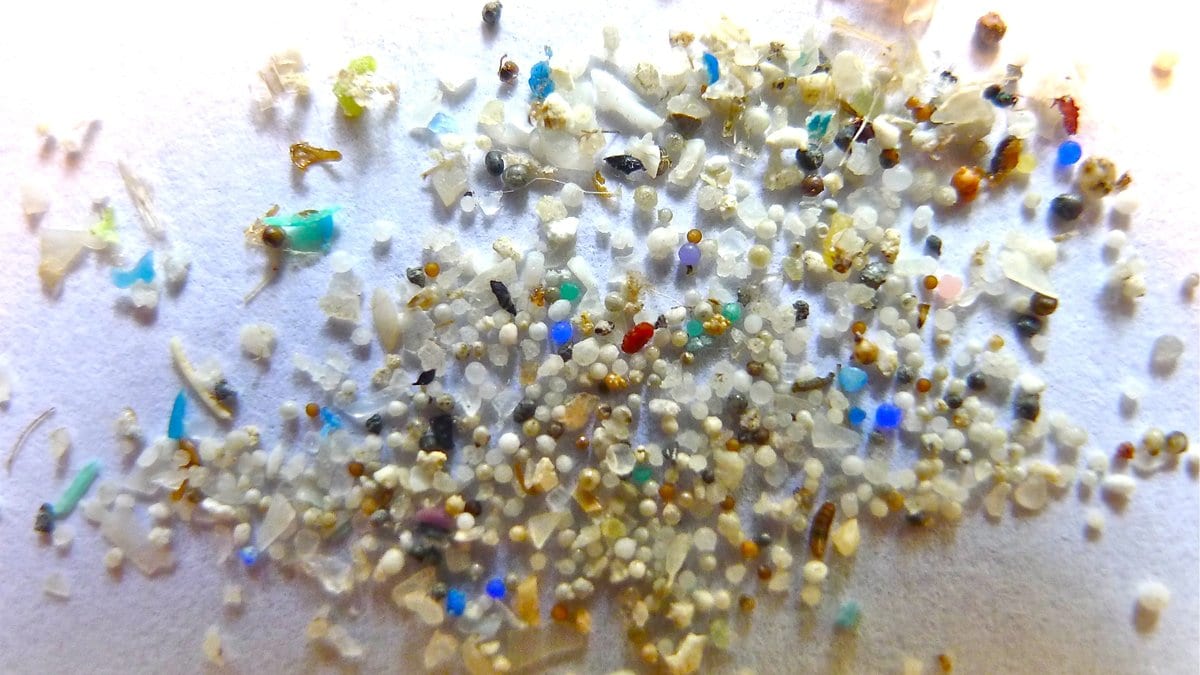
Polystyrene is not special. Microplastics, as the paper uses the word, are simply plastic fragments under 5 mm, and the panel covered six commodity plastics: polypropylene, polyethylene, PVC, polystyrene, PET and acrylic. The same imaging test found that all six made radicals in plain water. What differed was how much. Polypropylene and polyethylene, which repel water most strongly, were the most active; acrylic, the most water-friendly of the six, was the least. Set against a standard measure of how badly each plastic wets, the ranking lined up almost perfectly: a correlation of 0.93.
Water repellency turns out to be the dial
To find out why, the Berkeley half of the team modeled three of them: polyethylene, PVC and acrylic, then calculated how much energy it takes to pull an electron off a hydroxide ion, the step that makes a hydroxyl radical. Against a water-repelling surface, some of those ions sit where bulk water never puts them: held by fewer neighbors, alongside a water molecule with one hydrogen pointing out into empty space. Ions in that position are far cheaper to ionize, and adding the surface charge the experiments had measured pushes it lower still.
That outward-pointing hydrogen is what connects the chemistry to the feel of the material. Plastics carrying groups that can catch a passing water molecule leave fewer hydrogens dangling: in the simulations the share falls from 21% on polystyrene to 16% on PVC and about 10% on PET and acrylic, and across those four plastics that share tracks the measured activity. The calculation does not close the books, and the authors say as much: taking the electron away entirely is still expensive, and the sums only work if something nearby, dissolved oxygen or a hydrogen ion, accepts it.
The idea that water at a water-repelling boundary can do chemistry it cannot do in bulk comes out of microdroplet chemistry, a field built on sprayed droplets. Independent groups report the same class of effect there, and other groups argue that what is being seen is an artifact of ozone in the air or of contact with the vessel. This paper does not settle that argument. What it adds is a surface that is solid, durable and everywhere.
Proteins gather, and in a dish some cells break
Charged molecules collect on these surfaces. Two proteins of opposite charge and a short strand of DNA all gathered on the particles, more on water-repelling polypropylene than on acrylic, and the detergent took the effect away. Lysozyme, a small protein long used as a model for misfolding, formed clumps at the polystyrene surface, and adding caffeine, which mops up radicals, prevented them. That is the link in the chain: the damage follows the radicals.
The furthest the paper goes into biology is a dish of mouse red blood cells, drawn, washed and left in buffer. Mixed with plastic particles for an hour, some of them tore into the helmet shapes a hematologist calls schistocytes, and the hemoglobin they released rose with how reactive the plastic was. Those are cells in a tube, at particle loads of milligrams per milliliter over hours to days. No animal was dosed, no human cell was tested, and nothing here measures what happens at the amounts people and ecosystems actually meet.
The authors are careful about what follows from that. They offer this surface activity as a working hypothesis for how microplastics might alter and damage biomolecules and cells, say it may contribute at rates fast enough to matter biologically, and call the mechanism a possibly overlooked one rather than a demonstrated cause of any disease. They also write that the result challenges the prevailing view that plastics are inert, a view drawn from plastic in bulk; their own argument is that fragmentation multiplies surface.
Magnitude is a separate question. Polystyrene from two other suppliers, carrying more oxygen on its surface, was less water-repelling and measurably less active, and the authors note that particle shape, surface chemistry and surroundings all change how big the effect is. Plastic in a river or on a beach has been weathered for years, so the numbers measured here on pristine powders do not transfer to it.
The paper is peer reviewed, and Nature published the reviewers' file alongside it. Its forward-looking claim is a design rule: if what a surface does to the water against it drives this chemistry, then that interaction becomes something to engineer, next to strength and cost. Reflecting the commercial interest surrounding these mechanisms, Columbia University has filed a provisional patent application based on the study.
Sources
- NaturePeer-reviewed