Common Plastics Are Not Chemically Inert in Water
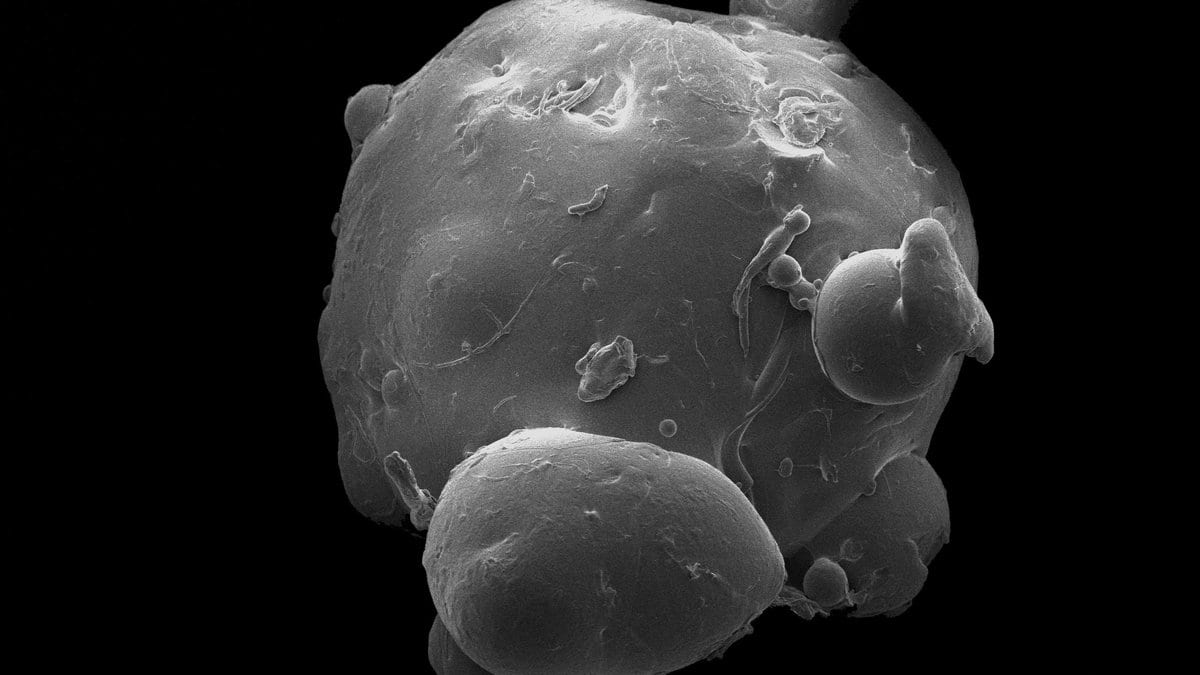
Six common plastics are not chemically inert once they sit in water as small particles, chemists at Columbia University and the University of California, Berkeley report. In a paper published Oct. 14, 2026, in Nature, the researchers show that the boundary where a particle meets water spontaneously produces hydroxyl radicals, a reactive form of oxygen, at room temperature.
Plastic is used almost everywhere partly because it is assumed to do nothing chemically. The authors argue that assumption comes from plastic in bulk and does not carry over to microplastics, particles smaller than 5 mm, which have much more surface for their volume. All of the work is bench chemistry, plastic powders stirred in water, and none of it measures an effect on a person, an animal or an ecosystem.
The first sign came from a dye. Naixin Qian, Wei Min and colleagues at Columbia stirred polystyrene powder at 10 milligrams per milliliter into water containing methyl orange, a dye that reactive oxygen breaks apart, and nearly 90% of it degraded over 10 days, they report in Nature. The same powder in ethanol and other solvents produced no comparable breakdown.
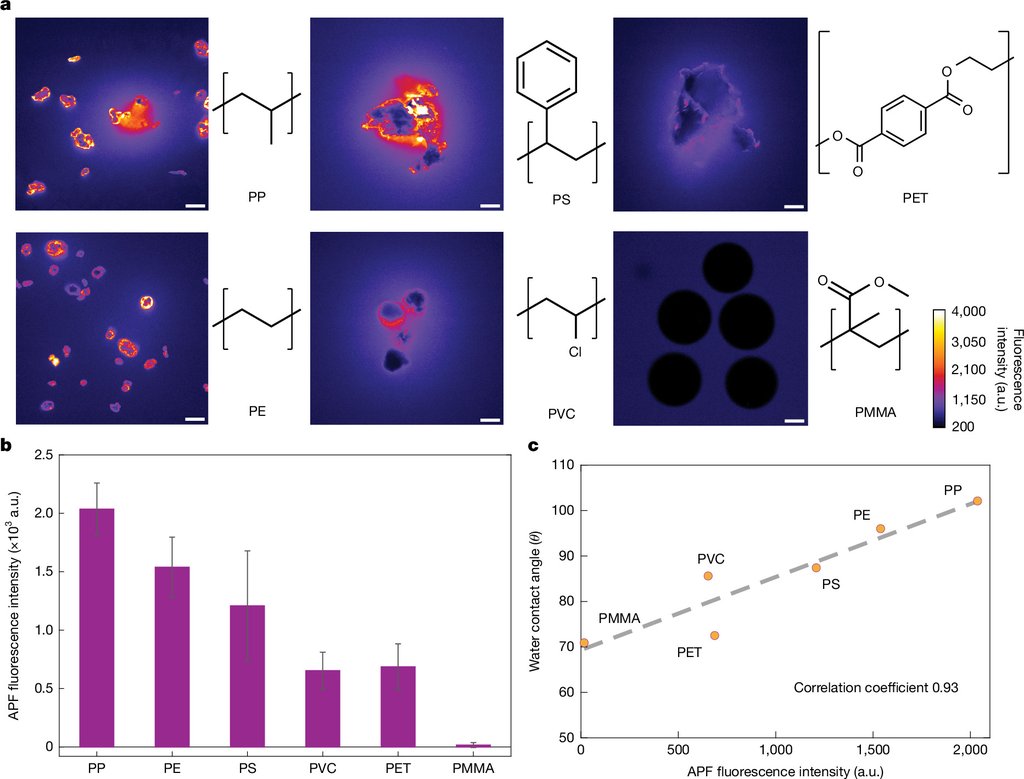
A sensor specific to hydroxyl radicals placed the reaction at the particle surface in all six plastics tested: polyethylene, polypropylene, polystyrene, PVC, PET and acrylic. The more water-repellent the plastic, the stronger the signal, and coating the surfaces with a detergent suppressed it. Calculations from Teresa Head-Gordon's group at Berkeley trace that to hydroxide ions only partly surrounded by water at such a surface, which makes an electron easier to remove.
The authors write that the findings challenge the prevailing paradigm of plastic inertness and point to a mechanism they describe as possibly overlooked. They offer the biological half as a hypothesis rather than a measurement: in the same experiments particles drew proteins and DNA to their surfaces, made a test protein clump unless the radical scavenger caffeine was added, and broke up mouse red blood cells.
The paper is open access and posts its source data and code. Columbia University has filed a provisional patent application based on the work.
Sources
- NaturePeer-reviewed