The Himalayan Glacier With the Longest Memory Is Running out of Time

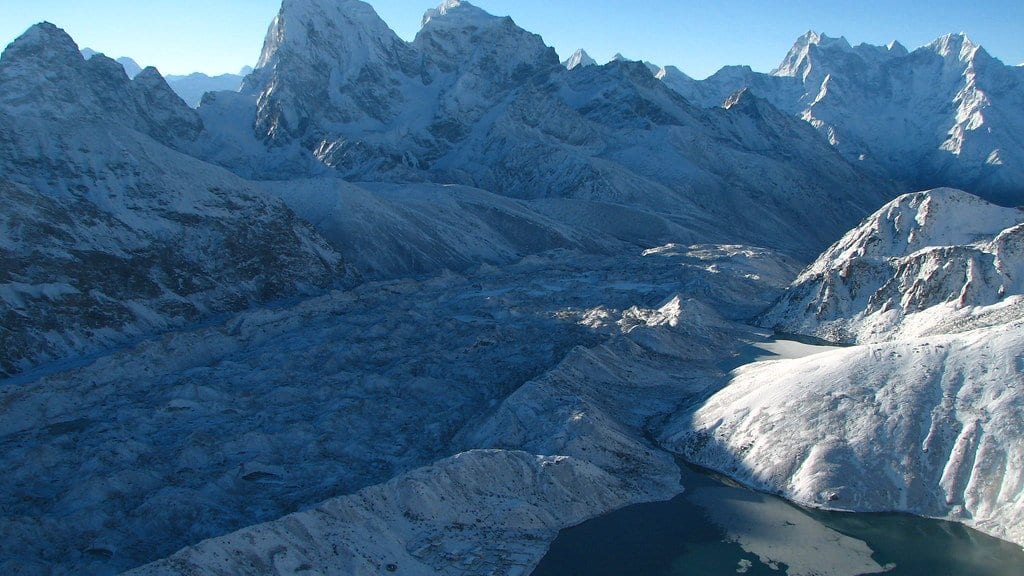
High in Nepal's Shorong region sits a glacier that scientists have been watching longer than almost any other in the Himalayas. It has no famous name, only a code from an old survey: AX010. For nearly half a century, researchers have returned to measure its ice, giving this modest patch of the mountains something rare in the range: a long memory. Now that memory is being read one last time, because the glacier itself is nearly out of ice.
In a new study in The Cryosphere, glaciologists Koji Fujita and Rijan B. Kayastha reconstruct 80 years of AX010's annual mass balance, the running tally of ice a glacier gains from snow and loses to melt. Their verdict is blunt in the paper's own title: this is a "disappearing Himalayan glacier," and it is disappearing because it is getting warmer, not drier.
The numbers trace a slow decline that turned into a rout. Over the most recent 15 years, from 2008 to 2023, AX010 shed ice at about 1.2 meters of water equivalent per year, a way of measuring loss that converts melted ice into an equivalent depth of water. Running the record back further, the authors find the glacier began losing mass in the early 1970s and that the loss sharpened around the start of the 2000s. Put those trends forward and the ice runs out. The glacier is "projected to disappear within one to two decades," the study concludes.
What makes AX010 useful is not just its length of record but what the record rules out. In the monsoon-fed Himalayas, a glacier's fate can hinge on snowfall as much as on heat, so a shrinking glacier does not automatically indict warming. Here the authors can separate the two. Reconstructing the mass balance with a physically based model, they find that rising temperatures drive the shrinkage while changes in precipitation "have neither accelerated nor mitigated mass loss." Snow is not the story. Heat is.
That distinction is why a single small glacier matters beyond its own valley. AX010 is one of countless glaciers feeding the rivers that millions across South Asia depend on for dry-season water, and a clean, long-term case where temperature is unambiguously the driver is exactly the kind of evidence that broad regional models are built to reproduce. When the glacier with the Himalayas' longest observational memory says warming did this, that is a data point worth its weight.
The paper is a brief communication in The Cryosphere, peer-reviewed and published on July 21, 2026. It does not claim to speak for every glacier in the range; AX010 is small and sits at relatively low altitude, which makes it more sensitive to warming than higher, colder ice. But its long record is precisely what most Himalayan glaciers lack, and it is running out at the same moment scientists have finally read it back to the 1940s. The oldest memory in the range is being closed just as it becomes most useful.
Sources
- The CryospherePeer-reviewed