A Laser on the Space Station Is Watching Congo's Forests Grow Back

Ask how long it takes a rainforest to grow back and the honest answer has always been slippery. You can count the trees. You can weigh the carbon. But a mature tropical forest is not just a stand of tall trees; it is a layered, tangled architecture of canopies at different heights, gaps, understory, and emergent giants, and that vertical complexity is much of what makes it good habitat. Measuring whether that architecture returns, across thousands of square kilometers of one of the least-surveyed forests on Earth, is a problem that used to defeat field crews and airplanes alike.
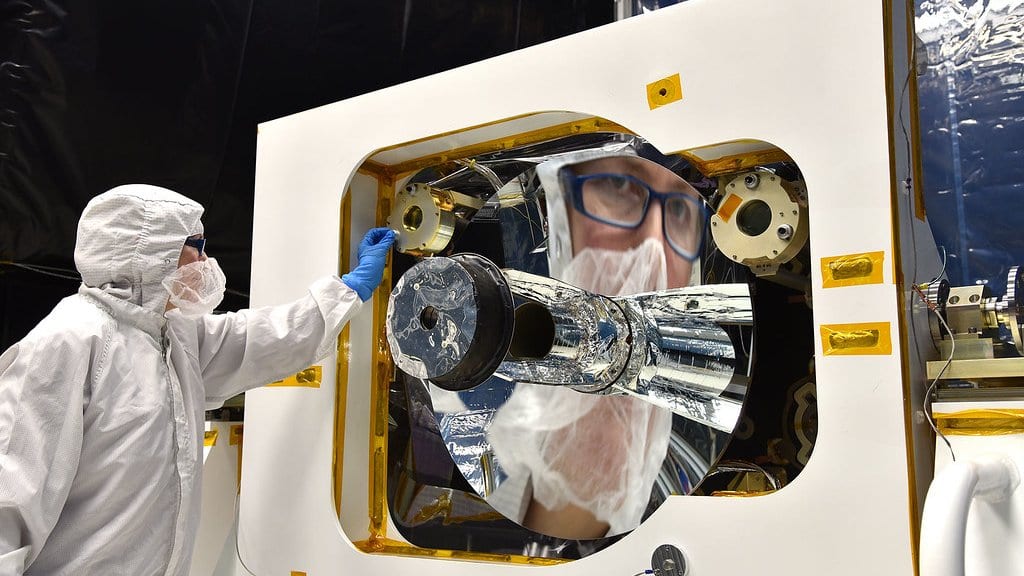
A team led by Herve Kashongwe of Michigan State University's Center for Global Change and Earth Observations decided to answer it from space. Their tool is GEDI, the Global Ecosystem Dynamics Investigation, a NASA laser instrument that rides on the outside of the International Space Station and sends pulses of light down through forest canopies, timing the return to reconstruct their shape. The work, published July 14 in Environmental Research Letters under an open license, turned that orbital vantage on the Democratic Republic of Congo, where the Congo Basin holds the planet's second-largest tract of tropical rainforest.
The metric at the center of the study is foliar height diversity: a measure of how much a canopy's leaves are spread across different heights rather than bunched in a single flat layer. A simple young stand scores low; a mature forest, with its stacked strata of vegetation, scores high. Before trusting GEDI to gauge it across the basin, the researchers checked the space-borne laser against airborne laser scanning flown over the same ground. Under stringent filtering the two agreed closely, with a relative error of about 5.9 percent, tight enough to let the orbital data stand in for the airplane at continental scale.
Then they applied it to 7,102 forest locations of known regrowth age. The pattern that emerged has a clear shape. Structural diversity climbs quickly in the first two decades or so after a forest starts to regrow, then keeps rising more slowly, decelerating with age. Even the oldest regrowing stands they measured, 34 years along, had not yet matched the structural diversity of undisturbed forest.
That gap is the finding worth sitting with. Thirty-four years is longer than many conservation programs, land-use plans, or careers. And it still is not enough to rebuild what clearing takes down. Recovery is real: the curve rises, the architecture returns, the forest is on its way back. But it is unhurried, and the last stretch toward true old-growth complexity is the slowest.
The result cuts against a comforting assumption that shadows a lot of climate accounting: the idea that a regrown forest is more or less as good as the one it replaced. By the carbon books, a regrowing stand does draw down atmospheric CO2, and that matters. But carbon is not the whole ledger. The habitat value of a forest lives in its structure (the niches, perches, and microclimates that a layered canopy provides), and that structure, the GEDI data show, lags well behind the carbon. A forest can be pulling its weight on climate while still falling short as a home for the species that once lived there.
There is a hopeful reading, too, and the authors lean into it: letting cut forest regrow delivers on two fronts at once, sequestering carbon and slowly rebuilding biodiversity habitat. The two goals are not in tension here; they are the same reforestation, measured on different clocks. The catch is patience. If the aim is a forest that functions like the original, the timeline runs to decades and beyond, not years.
The study's central claims rest on a validated instrument rather than a single model run: the GEDI signal was cross-checked against airborne LiDAR before the regrowth analysis. What it offers is a structural snapshot across space substituting for time, reading regrowth trajectories from many stands of different ages rather than watching one plot for 34 years. That is a standard and powerful approach in forest ecology, and it is now anchored to a laser that circles the planet roughly every 90 minutes, quietly taking the measure of how the Congo's forests are healing.
Sources
- Environmental Research LettersPeer-reviewed