How Antarctica's Ice Streams Quietly Reorganized Over the Last 3,000 Years

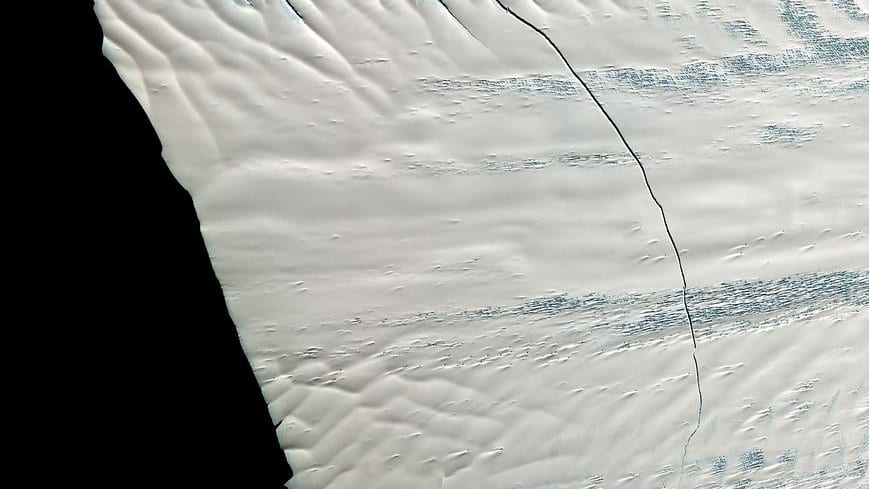
On the satellite maps that glaciologists have relied on for four decades, the ice streams of West Antarctica look fixed. Rivers of ice hundreds of kilometers long slide toward the Ross Sea between banks of slow, nearly motionless ice, and their outlines barely twitch from one year to the next. It is tempting to read that stillness as permanence.
Read a little deeper into the ice, though, and the picture changes. A study published July 20 in The Cryosphere uses radar that sees through the ice sheet to reconstruct where those rivers of ice ran in the recent geological past, and it finds they have moved. Andrew Hoffman of Rice University and colleagues report that one of them, the van der Veen Ice Stream, was roughly 40 kilometers wider more than 3,000 years ago, then contracted to its present width sometime between about 3,000 and 1,000 years ago.
The evidence is written into the ice itself. The team surveyed Conway Ice Ridge, a slow-moving spine on the Siple Coast that sits at the junction of the van der Veen, Whillans and Mercer ice streams. Beaming radar down through the ridge, they mapped the internal layering, the buried annual snowfall that accumulates year after year like tree rings turned on their side. Where ice has flowed calmly, those layers stay smooth and follow the surface. Where the flow was once violent, they buckle and break.
Hoffman's group found both. Near the top of the ridge, calm, surface-conforming layers overlie a zone of disrupted stratigraphy, and buried within it are old crevasses, fractures that only open under the high stresses of fast, deforming ice. Those healed-over cracks are fossils of a faster past. They mark ground that once belonged to the shear margin of a wider, more energetic ice stream, and was later abandoned as the fast ice pulled back.
A margin that moves
The heart of an ice stream is its speed. In the fast core, ice can travel hundreds of meters a year; a short distance to either side, in the ridge, it barely moves. The boundary between the two, the shear margin, is where the ice tears itself apart, and it is that boundary that Conway Ice Ridge records shifting.
Why would a margin migrate at all? To test the mechanism, the researchers built a diagnostic ice-flow simulation, a physics-based reconstruction of how the ice deforms, and ran it across plausible past states of the region. The model points to a sensitive relationship between how thick the ice is and how firmly it grips its bed. As ice thickens, more of its weight is held up by contact with the ground rather than floated by buoyancy, and that added grip can lock a margin into a new position.
The sensitivity is what makes the result striking. In the model, on the order of nine meters of thinning, a slight change against the hundreds of meters of ice involved, was enough to drive a large shift in where the shear margin sat. Small nudges in thickness, in other words, can translate into big jumps in an ice stream's outline. The margins do not drift gradually so much as flip.
That fits the field evidence. The picture the study assembles is of ice on the Siple Coast that was once thinner and moving faster over a broader footprint, then thickened, advanced, and slowed, with the van der Veen Ice Stream narrowing and part of the flow from Mercer toward Whillans easing off across the ridge. The ice streams reorganized themselves over a few thousand years, quietly, with no external catastrophe required.
What the record can and cannot tell us
The study lands squarely in a long-running debate about the late Holocene, the last few thousand years of Antarctic history. Some evidence has suggested the ice sheet in this sector thinned and then readvanced in relatively recent geological time rather than simply retreating since the last ice age. The Conway Ice Ridge layers support that readvance story: here, the ice appears to have been thinner and quicker before thickening and stabilizing into the configuration we map today.
It is worth being precise about what this does and does not imply. The study is a reconstruction of the past, a paleo record built from radar layers and a flow model, not a forecast. While these findings represent past climate responses rather than a direct projection of current warming, they provide a vital baseline for modern ice-sheet behavior. The van der Veen's slow millennial reshuffling unfolded under natural variability, over timescales far longer than a human lifetime.
What it does establish is a mechanism, and mechanisms travel. If a few meters of thickness change can relocate a shear margin, then the position of West Antarctica's ice streams is more negotiable than a four-decade snapshot suggests. As the authors frame it, marine ice sheets act as low-pass filters of climate, absorbing change slowly and responding over centuries to millennia. Conway Ice Ridge is a record of one such response already run to completion, and a reminder that the ice streams draining West Antarctica have rearranged themselves before, well within the span of recorded human history.
The results appear in The Cryosphere, a peer-reviewed, open-access journal, and follow the study's earlier preprint through review to final publication.
Sources
- The CryospherePeer-reviewed