The Seafloor Vault: Once Permafrost Carbon Settles Into Arctic Nearshore Mud, Less Than a Tenth of It Is Breathed Back Out
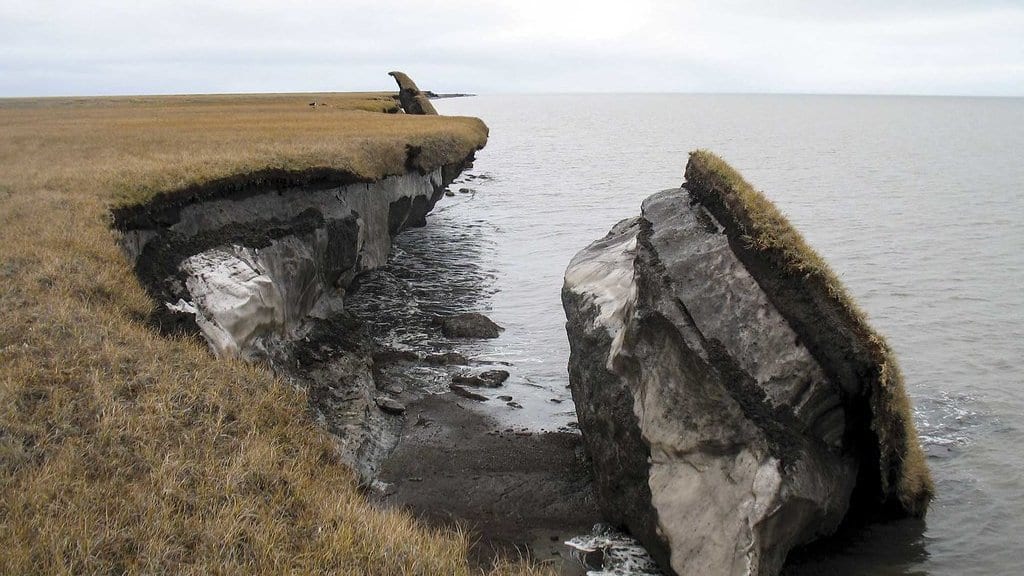
Qikiqtaruk is a small, treeless island off the Yukon coast, and every summer it gets smaller. Waves undercut its ice-rich bluffs, thawed ground slumps, and slabs of Pleistocene permafrost drop into the Beaufort Sea. Where that material goes next is not much of a mystery: a good deal of it settles a short distance offshore and becomes mud. What happens to it once it is down there has been the open question, and the answer decides whether this stretch of Arctic seafloor behaves like a chimney or like a vault.
A team led by Manuel Ruben at the Alfred Wegener Institute, working with colleagues at MARUM at the University of Bremen, took cores from the seabed off the island to find out. Their answer, published July 31 in Nature Geoscience, is that the mud largely keeps what it is handed. They estimate that less than 10% of the land-derived Pleistocene permafrost carbon is respired after it has been redeposited in those nearshore sediments.
The cores came from several points at increasing distance offshore, and together they hold roughly 50 years of deposition. Two things were measured in them. The first was the organic carbon in the sediment itself. The second was the dissolved inorganic carbon in the pore water between the grains, which is essentially the exhaust of whatever the resident microbes have been breathing. Both were then run through two carbon isotopes at once: carbon-13, which carries a signature of where the material came from, and carbon-14, which tells you how old it is. "Carbon isotopes represent our atomic indicators that can identify the food source of the microorganisms," said Gesine Mollenhauer, the AWI geochemist who is the study's senior author.
The two measurements disagreed, and the disagreement is the result. Organic carbon in the sediment was overwhelmingly ancient and terrestrial, exactly what you would expect where eroding permafrost bluffs are the main supplier. The dissolved inorganic carbon seeping back out of that same mud was younger, and predominantly marine. The microbes were producing carbon dioxide, but not from the material surrounding them. They were feeding on something fresher that had drifted down from the water above. Mollenhauer's description is that the sediment is home to "gourmet" bacteria that prefer fresh carbon from recent algal remains over the old carbon in permafrost deposits.
Now the qualifier, which is not decoration. The figure describes what happens after redeposition. It applies to permafrost carbon that has already survived the trip out from the coast and been buried in nearshore mud. It is not a statement about all the permafrost carbon that enters the Arctic Ocean, and the authors are careful not to make one. The paper highlights this point: because permafrost organic carbon is highly reactive when it first reaches the sea, a reactive fraction of it may still be in the water column, or may have been degraded before it ever reached the sediments they sampled.
Work elsewhere in the Arctic suggests that this earlier leg of the journey is where most of the losses happen. Studying surface sediments across the Laptev and East Siberian seas, Lisa Bröder and colleagues found that roughly 55% of the terrigenous organic carbon there resists degradation on millennial timescales, and that the flux of carbon degraded out of those sediments is orders of magnitude smaller than earlier estimates for degradation of dissolved and particulate terrestrial carbon in the overlying water. Buried carbon is comparatively safe; carbon in transit is not. Read alongside the new cores, that points to a pathway whose losses are concentrated in the water, not in the seabed.
Why old carbon should be so unappetising is not fully settled, but Bröder's team listed three plausible contributors: sediments hold less oxygen than the fully oxygenated water above them, terrestrial carbon binds to mineral surfaces in ways that shield it, and a larger share of what survives to be buried is chemically stubborn to begin with. The new isotope work adds a behavioural version of the same story. Given a choice, the microbes take the easy meal.
How much carbon is in play? The AWI announcement of the study puts about 1,300 gigatonnes of organic carbon in terrestrial Arctic permafrost and about 400 gigatonnes already sitting in ocean and river-delta sediments. Up to 0.02 gigatonnes currently enters the sea each year, and Ruben expects that flow to rise by 70% to 150% by 2100 as coasts retreat faster. While these broad estimates represent the institute's wider context for the research, they set the scale: the annual delivery is small against the reservoir, and it is growing.
Qikiqtaruk has been worked over before. In 2021, George Tanski and colleagues incubated eroded permafrost debris from the same island and traced its carbon dioxide production along two different erosion pathways, reporting that the largest organic carbon losses occurred once the sediments reached the nearshore zone. That earlier result and this one are not in conflict; they are looking at different moments. The incubations followed material through its first year in the water and at the seabed surface. The new cores ask what is left after decades of burial.
The limits are the ordinary ones for fieldwork this specific. This is one Canadian permafrost coast and one nearshore setting, sampled over roughly 50 years of accumulated sediment. Arctic coastlines differ enormously in what they are made of, how fast they retreat, and how much oxygen and organic matter the water above them carries, so a number from the Beaufort shelf near Qikiqtaruk should not be transplanted to the Laptev Sea or the Alaskan North Slope without checking. The study is peer-reviewed and appeared online July 31; it does not claim to be a global accounting.
What it is good for is arithmetic that climate models currently have to guess at. Earth system models handle the permafrost carbon feedback crudely, and the marine end of it barely at all; a measured partition between what is buried and what is breathed out gives modellers something to fit to. Ruben says the work provides an important foundation for models that try to predict the consequences of permafrost thaw, and the paper closes by arguing for more comprehensive assessments of how permafrost organic carbon degrades and for putting that process into Earth system models.
For now the practical takeaway is narrow and worth stating exactly. On one eroding Yukon island, the seabed is holding onto more than nine-tenths of the ancient carbon that settles into it, and the microbes down there show no appetite for the rest. Whether the same holds where the water is warmer, the shelf is wider, or the carbon spends longer in transit before it lands is a question for more cores, from more coasts.
Sources
- Nature GeosciencePeer-reviewed
- www.awi.de