Mid-May Is the Hinge: An Early Thaw and a Green Summer in the Altai

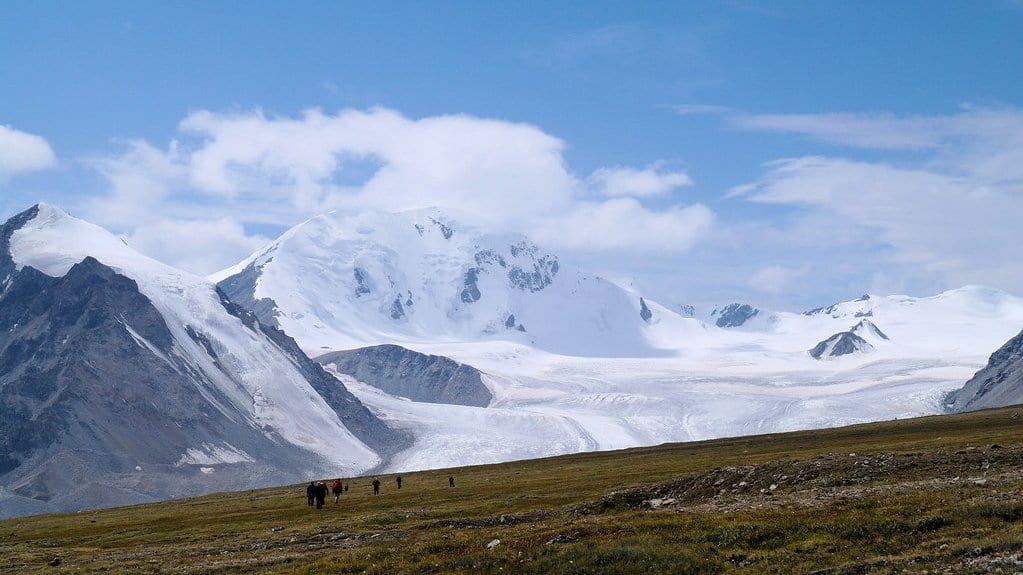
Spring in the Altai arrives as a boundary moving down through the soil. The frozen layer that has held since autumn softens from the top, water becomes available to roots, and whatever grows there gets started. In a warming climate that boundary is moving earlier in the year. What has divided the field is whether an earlier start is a gift or a loan.
Kang Wang of East China Normal University, with colleagues at the University of Colorado Boulder and the Mongolian Academy of Sciences, took the question to the Altai, a semi-arid mountain range spanning Mongolia, China, Russia and Kazakhstan. Their paper, accepted on Aug. 3 by Environmental Research Letters, combines multi-source satellite records with a technique borrowed from empirical economics. Double machine learning uses one set of models to strip the influence of many measured variables out of both the treatment and the outcome, then estimates what is left of the relationship between them.
Mid-May, they report, acts as a critical phenological tipping point. Thaw onset before that date is a net subsidy, in their phrasing, and significantly raises peak growing season leaf area index, the standard satellite measure of how much foliage a landscape is carrying. They put the size of that effect on a par with what precipitation and solar radiation contribute.
The second result is the contested one. The legacy of the spring thaw, the authors write, almost completely dissipates by the late growing season in October. The early advantage neither compounds nor is repaid. In this range, the autumn deficit that the whole debate is about did not turn up.
Elsewhere it has. In 2018, Buermann and colleagues reported in Nature that across northern ecosystems the productivity gained from a warm spring is broadly compensated later in the year, and the mechanism they identified is water: an early start draws down soil moisture, and plants pay for it at the dry end of summer. A semi-arid mountain range is precisely where that mechanism should bite hardest, which makes a null result here interesting rather than reassuring. It is also one region, and one region is the entire evidence base for this finding.
The peak-season half of the result sits on firmer ground. Independent work in other permafrost landscapes points the same way, including a 2025 study in Nature Communications reporting that earlier thaw accelerates land-surface greening.
Then there is the word in the title. The paper claims causal inference, and that claim rests on the method rather than on any experiment. Double machine learning is a legitimate and well-established estimator, but it recovers a causal effect only if every confounder of thaw timing and plant growth has been measured and controlled for, and that condition cannot be tested. There is an obvious candidate for a confounder here: the same warm spring that pulls the thaw forward also warms and lights the plants directly. The authors add a strict matching check, which leans on the same untestable assumption rather than replacing it.
The authors' own closing caution is methodological rather than ecological. Rigid linear assumptions applied to a system like this one, they warn, may miss the controls that actually matter. On their evidence the relationship between an early thaw and a green summer bends at a date in May, and a model that draws it as a straight line will get both ends of it wrong.
Sources
- Environmental Research LettersPeer-reviewed
- Environmental Research LettersPeer-reviewed
- www.nature.com