One Brain, Many Maps: How Siibra Unifies Scattered Neuroscience Data Into a Single Atlas

Ask two neuroscientists to point to the same spot in the human brain and you may get two different answers. One is looking at a stained tissue slice under a microscope, counting cell layers a fraction of a millimetre thick. The other is looking at a whole-brain MRI scan. Both are describing real anatomy, but their data live in different coordinate systems, different file formats and different online repositories, and lining them up by hand is slow, error-prone work. That mismatch is one of the quiet frictions holding back brain research: the measurements exist, but they do not naturally talk to one another.
A software suite called siibra sets out to fix that, and as of 20 July 2026 it carries the weight of a peer-reviewed publication behind it. Timo Dickscheid, Xiaoyun Gui and Katrin Amunts describe the tool in Nature Methods, the journal's dedicated venue for research methods and tools. The work first appeared as a bioRxiv preprint in May 2025 and has now completed peer review, so this is a genuine academic tool release rather than a vendor announcement, published open access in a Nature journal by a public research institute.
The name is an acronym: Software Interfaces for Interacting with Brain Atlases. What it actually does is act as connective tissue. In the authors' own framing, siibra links "data acquired with different modalities and at different resolution," creating what they call a Multilevel Human Brain Atlas. In plainer terms, it takes measurements that span scales, from the chemistry and cellular architecture of a single region up to the large-scale structure and wiring of the whole organ, and anchors them all to a common spatial reference frame. Once everything shares the same map, a molecular measurement and a structural scan of the same brain region can finally be laid over one another.
Crucially, siibra is not one more dataset. It is the plumbing that lets existing datasets be found, compared and combined. Researchers reach the contents three ways: an interactive 3D web viewer for pointing and clicking through the brain, a Python library for scripted analysis, and an HTTP API for programmatic access. The underlying data can run to gigabytes or terabytes, so siibra streams what a query needs rather than forcing anyone to download the whole archive first. A researcher can ask for everything known about a specific region and get molecular, cellular and imaging data returned in a shared coordinate space, without wrangling incompatible files by hand.
That design choice speaks to a problem the field has been circling for years: reproducibility. When each study stitches its data together in its own ad hoc way, results are hard to check and harder to build on. A shared reference frame changes the terms. Analyses become repeatable because they rest on the same spatial definitions, and the datasets underneath become machine-usable, which matters for the AI models increasingly trained on brain data. siibra already powers the Human Brain Atlas on EBRAINS, the European digital research infrastructure for neuroscience, so it is not a proof of concept sitting on a lab server but working infrastructure other scientists use.
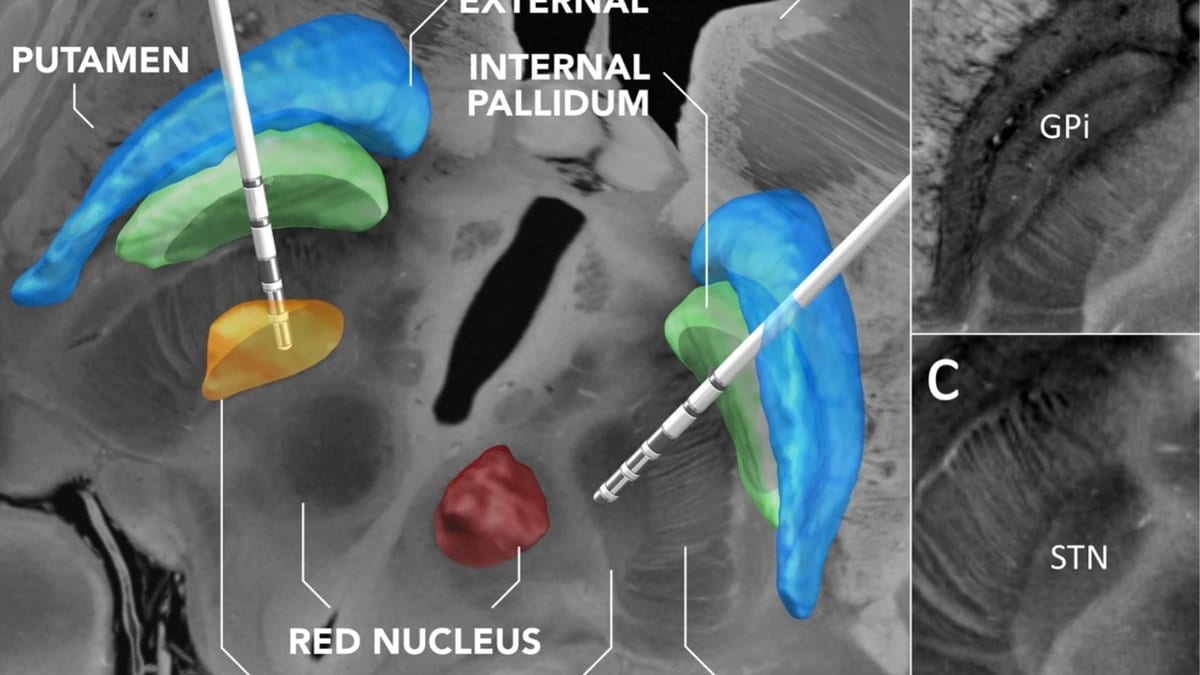
The institutional release points to a concrete payoff. Using siibra to re-examine published data, the team revisited targets for deep brain stimulation in the thalamus, a treatment used for conditions such as Parkinson's disease that depends on placing an electrode with great precision. The re-analysis suggested that one target zone, the VIM nucleus, "might sometimes be confused with neighbouring regions" during localisation. When a stimulating electrode has to land within millimetres, telling one small region from its neighbour is exactly the kind of distinction a unified atlas is built to sharpen.
It is worth being precise about what this is and is not. siibra is infrastructure, not a discovery: it does not, by itself, reveal anything new about how the brain works. Its contribution is to make the data other people gather more comparable, more reproducible and easier for both humans and machines to use. That is a narrower claim than a breakthrough, and a durable one. Much of modern science advances less through single dramatic findings than through better shared foundations, the reference frames and standards that let thousands of separate measurements finally add up to more than the sum of their parts.
Sources: siibra in Nature Methods · University of Koblenz / Jülich Research Centre press release (idw) · bioRxiv preprint (2025)
Sources
- Nature MethodsPeer-reviewed
- idw-online.de