Keeping up With a Quantum Computer's Errors, Without Giving up Accuracy

Every microsecond or so, a superconducting quantum processor finishes another round of checks on itself and hands the results to a piece of classical hardware. That hardware, the decoder, has to work out what went wrong and say so before the next round arrives. Falling behind is not merely slow: a decoder that cannot keep up builds a backlog that never clears, and the computation it is protecting slows exponentially.
The decoder must get through rounds as fast as they arrive, and answer quickly enough that the algorithm above it is not left waiting. It must also be right, because a less accurate decoder has to be compensated for with a larger code, which means more physical qubits. So far, the decoders quick enough for superconducting machines have bought their speed with accuracy. A preprint posted Nov. 19, 2026, describes a decoder called Rapids that its authors say does both. They are Chenyang (Eric) Jin of the University of California, Berkeley, and Andi Gu and Susanne F. Yelin of Harvard University. The work has not been peer-reviewed.
Rapids was built first for the rotated surface code, the leading scheme for protecting one logical qubit behind a patch of ordinary ones. At distance 19, where a single logical qubit occupies 721 physical ones, one chip processes a round of measurements in under a microsecond. That is more than a million rounds a second, the rate a superconducting processor sets. Reading rounds that fast is only half of the problem. Rapids returns its decision 20 microseconds after the measurement that prompted it, on one chip, and the paper's own yardstick is shorter — the 10-microsecond reaction time that typical resource estimates assume. A two-chip build narrows that gap without closing it, and only the paper's models, of many chips or of custom silicon, go under the budget.
The accuracy is where the qubits come from
The authors report that Rapids makes 240 times fewer logical errors at distance 19 than union-find, a fast matching method that is, by their account, the only decoder previously shown running in real time at a code that large. Against minimum-weight perfect matching, the slower and more accurate standard, the margin is nearer 10 times. Both comparisons are at a physical error rate of 0.15%, and the union-find curve they measure against is a software implementation, so the figure is not a result against a hardware product. That accuracy converts into qubits, on paper. The authors calculate that union-find would need a code of about distance 31 to match Rapids at distance 19: 1,921 physical qubits for every logical one, against 721. It is a calculation of what the older decoder would cost, not a count of qubits anyone has built.
The same design, retrained, works on codes of a different shape. On the Gross code, which packs several logical qubits into one dense block, their decoder is 16 times more accurate than Relay-BP-1, a real-time decoder described in a separate preprint. That comparison runs at a different noise level and against a different baseline from the surface-code one.
Making the network small enough to fit
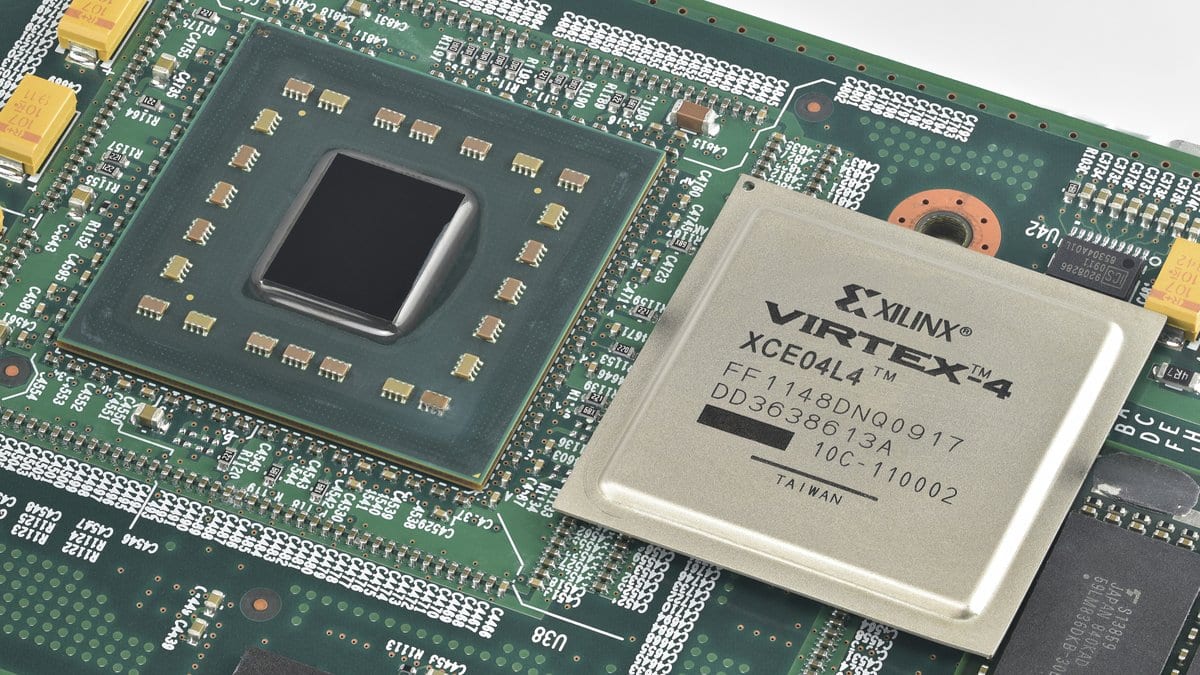
Getting there was as much a hardware problem as a machine-learning one. Rapids builds on Cascade, a convolutional decoder posted as a preprint in April 2026 by Gu and Yelin with two colleagues. In its original form that network needed far more multiplier units than the AMD Versal Premium VP1802 has, a field-programmable gate array whose logic is wired to the task. So the authors rebuilt it from operations that are cheap in plain logic. Each filter now works on one channel of the data at a time instead of mixing them all, and the mixing happens afterward in a pair of sparse, block-structured steps that still connect everything to everything. The weights are trained as integers four bits wide, so each multiplication becomes a couple of shifts and additions the chip can do with no multiplier at all.
The decoder also had to handle an endless stream rather than a finished experiment. Each block of the network holds a few rounds in memory and works on a different one than its neighbors, so data flows through the chip like a production line, one site per clock tick. Because each block reads only the output of the one before it, the line can be cut at any joint and the halves placed on separate chips, with a single stream of numbers crossing between them. Decoders built on matching or on belief propagation, a message-passing method, cannot be divided that way: their computation runs over the whole graph at once, and splitting it would put a chip-to-chip delay inside every iteration.
The qubits it saves are paid for in watts
The qubits Rapids saves are bought with classical hardware, and the paper is plain about the scale. One chip per logical qubit, across an algorithm using thousands of logical qubits, would mean thousands of these boards and several hundred kilowatts, the equivalent of tens of server racks. An estimate in the paper, not a build, puts the same circuit in custom silicon at about 10 watts. The peer-reviewed decoder it beats on accuracy, Collision Clustering, already runs as a chip drawing 8 milliwatts. The trade on offer is qubits for classical silicon, not qubits for nothing.
None of this ran on a quantum computer. The speeds, chip areas and power figures come from designs placed and routed on real AMD parts; every logical error rate comes from simulated memory experiments. The one real-time neural decoder that has run on an actual superconducting processor, reported in a preprint posted in May 2026, works at distance 3. The decoder integrated with a real machine is small; the large one is not yet integrated.
The paper states where its support came from. The work was backed by Anthropic under its AI for Science program, and the AMD University Program donated the design-software licenses used to build on AMD's own part. A section on the use of AI tools says the authors used Claude to help write training code and to implement, optimize and debug the FPGA builds. A competing-interests note adds that Yelin's spouse is a co-founder and shareholder of QuEra Computing, which builds a different kind of quantum machine. The routed builds, floorplans, timing and power reports behind every hardware number are posted openly on Zenodo; the trained weights are not.
Their closing point is a budgeting one. If the power and cost of decoding have to be designed in alongside the qubits, classical hardware stops being an accessory to a quantum computer and becomes one more thing an architect can spend.
Sources
- arXivPreprint
- zenodo.org
- www.nature.com
- arXivPreprint
- arXivPreprint
- arXivPreprint
- docs.amd.com