Noisy Instruments Set a Predictable Limit on What Models of Cells Learn

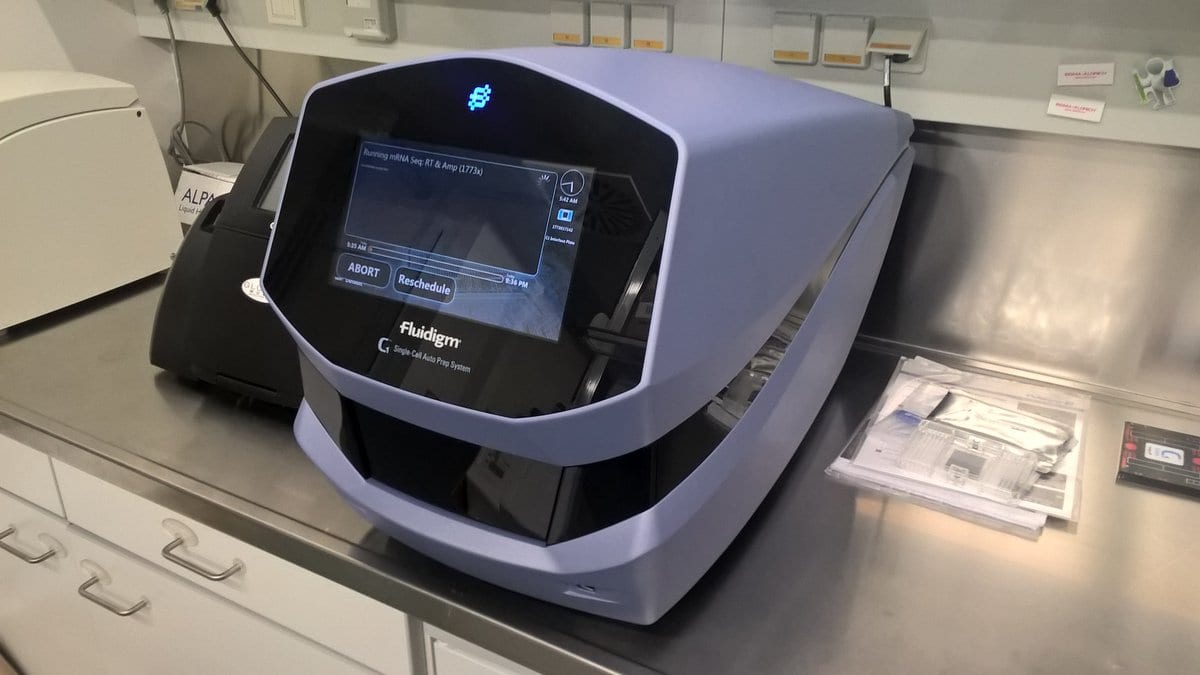
In a single-cell sequencing run, most of the evidence never arrives. For many of the methods in use today, the chance of catching any particular mRNA molecule inside a cell is well below 50%, so the gene-expression profile that lands in the data file is a thin sample of the cell it came from. Biologists build ever larger models on top of those profiles anyway, on the assumption that a big enough network can see through the gaps. A team led from Harvard Medical School has now measured what the gaps cost, and the answer turns out to have a regular shape.
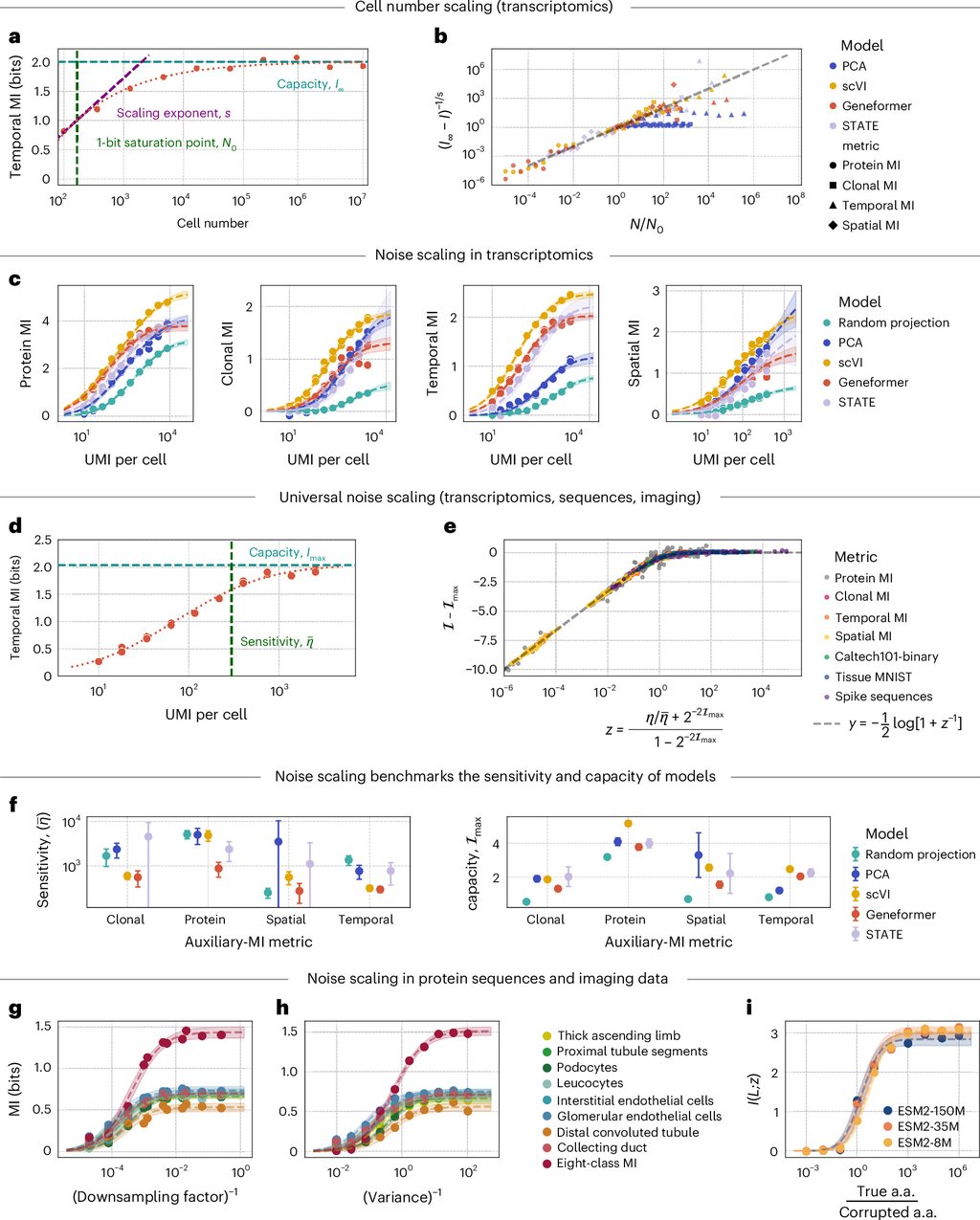
Gokul Gowri, Allon Klein and four colleagues decided to put a number on the gaps. Their paper appeared Nov. 26, 2026, in Nature Machine Intelligence. The method is simple: take a good dataset, spoil it by hand in controlled steps, and train a model on every spoiled version. Across 2,328 fitted models and three kinds of biological data, performance falls away along a single logarithmic curve as the measurement gets noisier.
To measure the damage, the team needed a different yardstick. Training loss cannot be compared between models built on different loss functions, and a lower loss need not mean a more useful summary of a cell. So each model was graded instead on mutual information: how much its compressed description of a cell tells you about something the model never saw. For the single-cell datasets, that hidden signal was a cell's developmental stage, the proteins on its surface, the neighboring cell in a tissue section, or a clonal relative. The score comes out in bits, and it measures fitness for one chosen task, not a model's quality in general.
The noise was added by the researchers, not produced by real instruments, which is what made it possible to test so many levels. Transcript counts were thinned by drawing a fixed fraction of each cell's molecules, down to a mean of barely ten detected molecules per cell. Microscopy images were degraded in two ways, with added pixel noise and with pixelation. Protein sequences had amino acids swapped at random. The authors note that outside the transcript data there is no way to read the instrument's own noise level, so for images and sequences the fitted sensitivities are conservative lower bounds, not measurements.
What ties the three sweeps together is the shape of the curve. Rescale each of the 233 measured curves by its own two fitted parameters and they fall onto one relationship, with an average goodness of fit of 0.967. The form comes by analogy with a classical result for a signal buried in Gaussian noise, and it is exact only for the one-dimensional version of that channel. Why so simple a model describes high-dimensional biology this well is an open question the authors flag themselves. The behavior holds across every architecture and data type tested, which the authors call a third scaling axis for this kind of model, alongside dataset size and model size.
Two numbers instead of a leaderboard
The two parameters the fit returns are meant to be used. One is noise sensitivity: the point below which a model gains little from a more sensitive measurement, which for transcript data comes out in detected molecules per cell. The other is capacity: the most a model could extract from a flawless measurement at a fixed sample size. This means capacity is a limit set partly by how many cells were available, not a fixed limit of the model.
The two numbers don't always go together. Geneformer, a transformer model of the kind behind large language models, was the most noise-tolerant model tested, and it is already operating above the depth it needs at ordinary sequencing depths. Its capacity is the lower one: between 0.4 and 1.4 bits below scVI's across every task, which the paper puts at roughly half the complexity of the signal being captured. scVI, a variational autoencoder that compresses and rebuilds its input, comes out ahead on capacity, though by a margin that depends on the task. The trade-off is measured on that one pair, out of five kinds of model in the sweep, from a principal-component baseline up to a second transformer.
What a lab can work out before buying more cells
Inverted, the law answers a different question: how sensitive does a measurement need to be for a model to reach a given level of performance? For transcript data the team reports that as the sequencing depth required to reach 90% of the information a model can access. Geneformer sits above that line on today's data. The spatial task does not: reading information about a cell's neighbor takes more than 1,000 detected molecules per cell, far beyond what spatial methods currently deliver. That is a concrete argument for assays that recover more molecules from each cell.
The other two kinds of data sit on opposite sides of the same line. Pixelated microscopy images keep their label information down to about 15 by 15 pixels and start losing it below that. Protein-sequence models were unbothered by substitutions up to roughly 1 in 1,000 amino acids, a worse error rate than modern sequencing produces once multiple reads are combined. So sequence models can largely ignore the noise in their measurements — single-cell transcriptomic models remain noise-limited at the signal-to-noise levels available today.
The edges the authors mark themselves
None of this describes a model that shrugs noise off. "Of note, no model or dataset exhibits large regimes of noise robustness," the paper reports. Each model tolerates noise up to a point, which depends on the data, the task and the model, and then its performance drops.. The authors list what the law has not yet been asked to cover: further tasks and architectures, models that bring outside knowledge, and real-world batch effects instead of the simulated ones they tested. They say the range of noise levels and data types over which it can safely be extrapolated will be clear only once the reason it works is understood.
Three of the six authors work at Cellular Intelligence, a company in Boston. Klein and Jonathan Rosenfeld co-founded it and consult for it, and the company helped pay for the work alongside the National Institutes of Health. The paper evaluates none of the company's own products: every model in it is public and somebody else's, and every dataset it uses was published before. The code is public and archived, and the journal published its referees' reports, naming four of them.
What the work hands over is a measurement. A group deciding where its next budget should go can fit those two numbers to its own models and read off, in bits, what the instrument is costing it.
Sources
- Nature Machine IntelligencePeer-reviewed