A Microsoft Model Samples How Proteins Move Without Running the Simulation

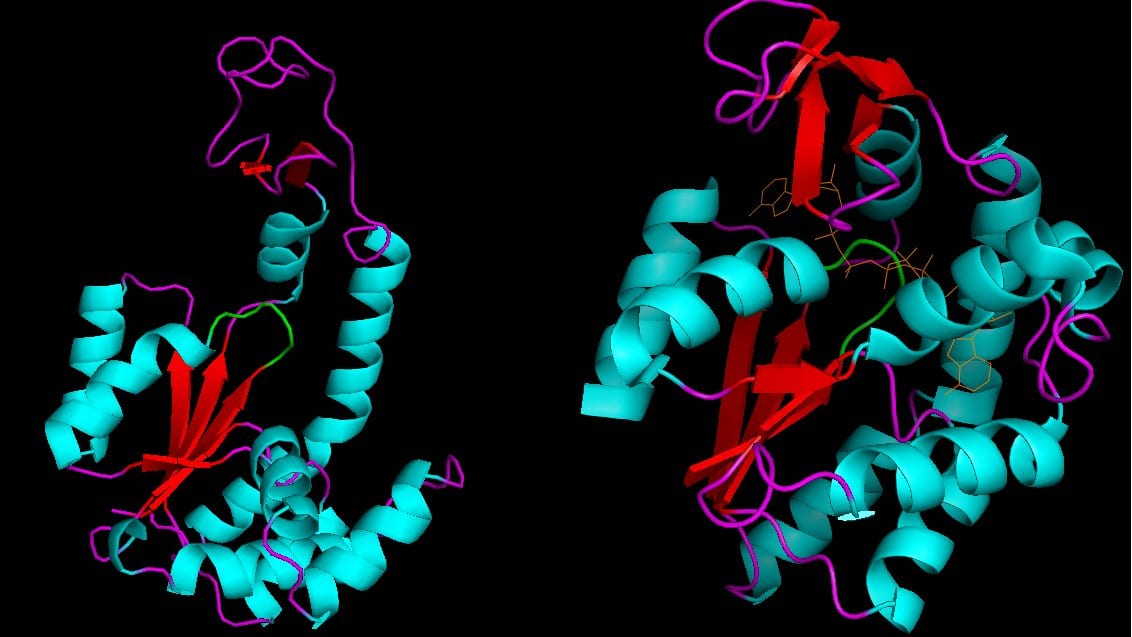
Hemoglobin is the textbook example of a molecule whose job is a change of shape. Oxygen binds, the protein shifts from a low-affinity form to a high-affinity one, and that shift is why blood takes up oxygen in the lungs and releases it in tissue. A decade of progress in structure prediction has made it routine to get a picture of such a molecule. The picture is a single still frame of something that is never still.
To watch the motion instead, the standard tool is molecular dynamics: a simulation that advances every atom in steps of about a femtosecond and adds the steps up. The events worth watching are rare, so the simulation has to grind through vast stretches in which nothing happens. The authors' own summary of the problem is that the method's predictive power is "limited by the accuracy of the interaction potential," but limited above all by what it costs to sample enough.
On Nov. 20, 2026, thirty authors posted a preprint describing BioEmu2, one model that does three jobs: it predicts a biomolecule's structure, it samples the spread of shapes that molecule occupies in water at room temperature, and it steps a given shape forward by an interval the user chooses. Michael Gastegger is the first author and Frank Noé the last; the work is Microsoft Research's, by the company's own repository and model card. It has not been peer-reviewed, and there is no journal reference, no acceptance notice and no second version.
The reference it is measured against is another simulation
The paper's main result concerns the second task: sampling a molecule's shapes. BioEmu2 learned the spread of shapes produced by simulations that track every atom, water included, at room temperature and atmospheric pressure; those simulations use the Amber force fields, the standard equations for the forces between atoms. What is reported is how closely the model matches the relative populations of each long-lived shape, in energy units.
Across single proteins, protein pairs and protein-small-molecule complexes, the team reports that BioEmu2 recovered about 50% of the states the reference simulations found for proteins and protein complexes, and on average more than an equally sized sample of simulation frames found for protein-ligand systems. Among the states it did find, the free-energy error was 0.7 to 1.2 kcal/mol. The error is computed only over sampled states, so the half it missed does not count against it.
The other side of that comparison is a simulation, not an experiment, and the paper claims no experimental validation anywhere. Microsoft's own description of the model is even more direct, saying predicted structures "are not experimentally validated measurements and should not be treated as such," and how often the model visits a shape "must not be interpreted as a calibrated Boltzmann probability or quantitative free energy." The paper says as much about its own reference: it is an approximation, bounded by the force field behind it.
Stepping a molecule forward without the steps in between
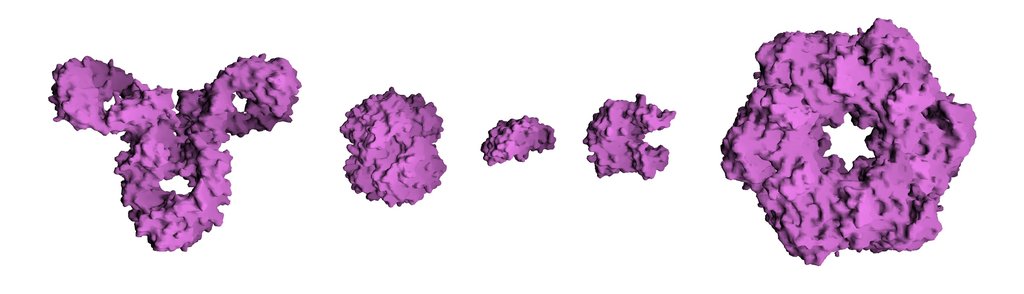
The third job is the one the paper treats most carefully. BioEmu2 was trained on pairs of structures taken a chosen interval apart in simulated trajectories, so it predicts where a molecule ends up without computing the path in between. Linking these jumps together produces a movie of the molecule with huge time steps. With long enough jumps, the model forgets the starting shape entirely and simply produces typical shapes.
In one run, the two ligands of adenylate kinase are placed beside the open enzyme; both find their sites, one domain closes over the first and the second follows. At 43 microseconds the enzyme is within a tenth of a nanometre of the closed crystal structure. Of 500 runs of the disordered PUMA fragment approaching the protein MCL-1, 78% end up bound. In dozens of tests, the model's molecules moved away from their starting shapes at about the same pace as in simulations, though where they differed, the model usually moved too fast.
The paper itself warns that predictions of slower binding, dissociation, folding, unfolding and other rearrangements are "not established as quantitatively accurate kinetics in the current BioEmu2 release." The introduction names slow kinetics as still experimental. The two trajectory runs are demonstrations of what the model produces, not measured rates.
Every number in the comparison is the developers' own
For the structure-prediction half, the team did not take published scores from other papers. It re-ran every competing model itself, on its own modified versions of two public benchmark suites, FoldBench and Runs N' Poses, so that each model faced an identical set of systems through one scoring pipeline. Every exclusion is itemised, the largest group being 584 protein-ligand systems whose structures were deposited before the training cut-off but released after it, which would otherwise have leaked test answers into training. AlphaFold3 was left out over its license, and Boltz-2 because its training data runs later, though Boltz-2 does appear in the comparison on simulation emulation. On the benchmarks as the team built them, BioEmu2 scored about level with the open-weight folding models it was set against.
The preprint is only days old, and no independent group has yet tested its results. It also carries no funding statement or declaration of competing interests, a gap worth noting in a paper where a company evaluates its own model. The paper reports one result against its own interest: for single proteins, its predecessor BioEmu1 (peer-reviewed in Science in 2025) is still the better model, because that version was fine-tuned on measured protein stabilities and this one has not been.
The code and the weights are out, under the MIT license, on GitHub and Hugging Face: about 500M parameters, and the smallest device the model card reports testing on is an 80-gigabyte A100. That card dates the release to October 2026, which puts the software in the world before this account of it. It also states plainly what the outputs are not: "Outputs are plausible hypotheses, not measurements."
Users can also guide the model. Telling the model that two parts of a large complex touch at one point reduced its error from about 71 angstroms to 5. Researchers can also nudge it toward rare shapes, and the results can later be corrected statistically for the nudge. For a laboratory with a molecule it cannot afford to simulate, that is the useful part, and the first outside check on these numbers can be run by whoever downloads them.
Sources
- arXivPreprint
- github.com
- huggingface.co