A Crystal-Designing AI That Learns From Rewards, Not Labeled Data

Ask for a material that does one particular thing, such as a magnet without rare-earth metals or a chip insulator that doesn't leak charge, and the work turns into a loop. Propose a structure, compute what it would do, propose a better one. The expensive part is computing the properties, not proposing the structures.
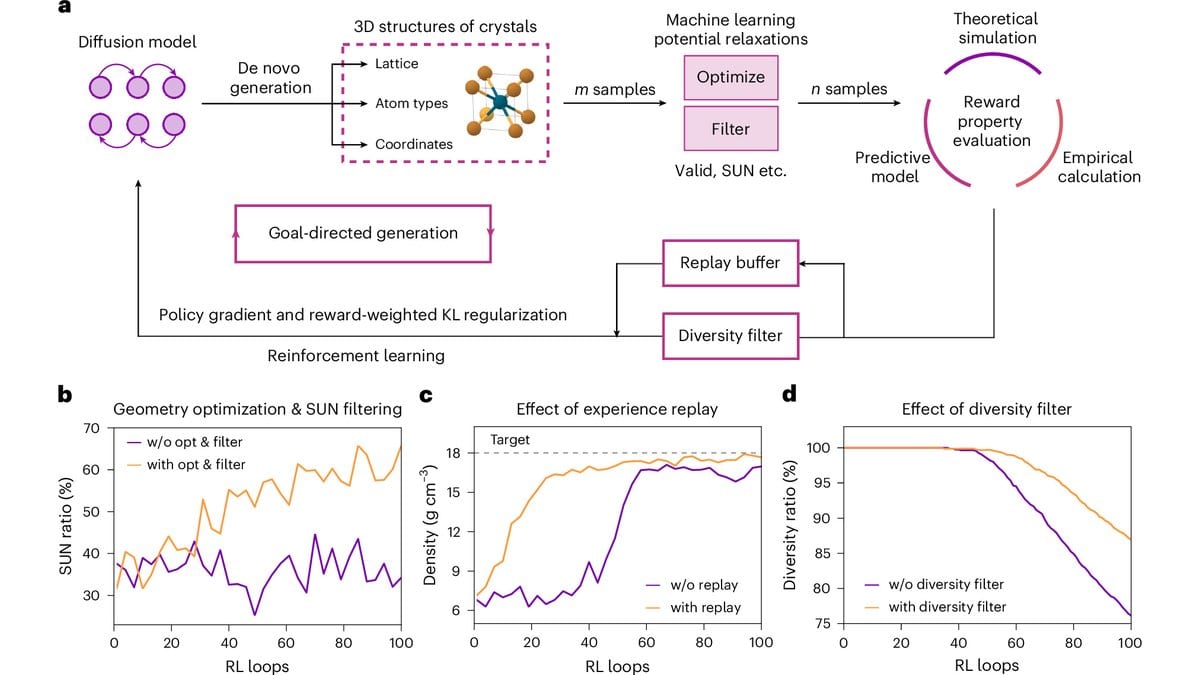
Over the past few years, generative models have learned to invent plausible new crystals. Diffusion models, which assemble a structure by removing noise from a random starting point, now do it across most of the periodic table. Steering one toward a property somebody actually wants is the harder problem. The usual route trains the model on structures whose properties have already been computed, and the paper puts the appetite of that approach at more than 10,000 labeled examples.
Junwu Chen, Philippe Schwaller and two colleagues at EPFL's Laboratory of Artificial Chemical Intelligence propose paying in feedback instead of labels. Their workflow, MatInvent, was published open access Nov. 26, 2026, in Nature Machine Intelligence; it takes a crystal generator that has already been trained and tunes it by reinforcement learning, where a model learns from rewards rather than examples. The idea is not new to the field. A preprint and a workshop paper have been circulating since 2025, the authors point to concurrent reinforcement-learning work on crystal generation, and what they claim is a general framework rather than priority.
The move that makes it work is to treat the generator's own output as a sequence of decisions. A diffusion model builds a crystal in many small denoising steps, and MatInvent reads each step as a move in a game whose payoff arrives at the end, when the finished structure is scored. Each round begins with a fresh batch of structures. They are relaxed using machine-learning interatomic potentials, fast stand-ins for quantum calculations, and kept only if they are stable, unique and new. A sample of the survivors is then evaluated for the target property and rewarded; the best-scoring ones are used to update the model, and the round repeats. Two additions keep the search from stalling: a buffer that holds past high-reward crystals and feeds them back in, and a penalty that docks the reward of a composition the model has already produced.
What a thousand calculations actually buys
The eight single-property tasks the team set are a mix. Some are the obvious ones: a particular band gap, a high magnetic density, a high heat capacity, a very stiff solid. Others are less so, including how closely a crystal would match the silicon wafer it was grown on, a machine-learned score for how easily a composition could be made, and a published index of how concentrated the supply of its elements is. The authors report that within 60 rounds, about 1,000 property evaluations, the average property value of the structures the model generated reached the target for most of those tasks. That is an average over three to six independent runs per task, and it is not a claim that every structure landed on the mark.
Property evaluation is carrying a lot of weight in that sentence, and the paper is specific about what it means. For band gap and magnetic density, the evaluator is density functional theory, a full quantum-mechanical calculation. For heat capacity and the wafer matching, it is a simulation run with a machine-learning potential. For stiffness, dielectric constant and ease of synthesis, it is a trained prediction model. For supply-chain risk, it is an index computed with open-source software. A thousand calls, in other words, is not a thousand quantum calculations.
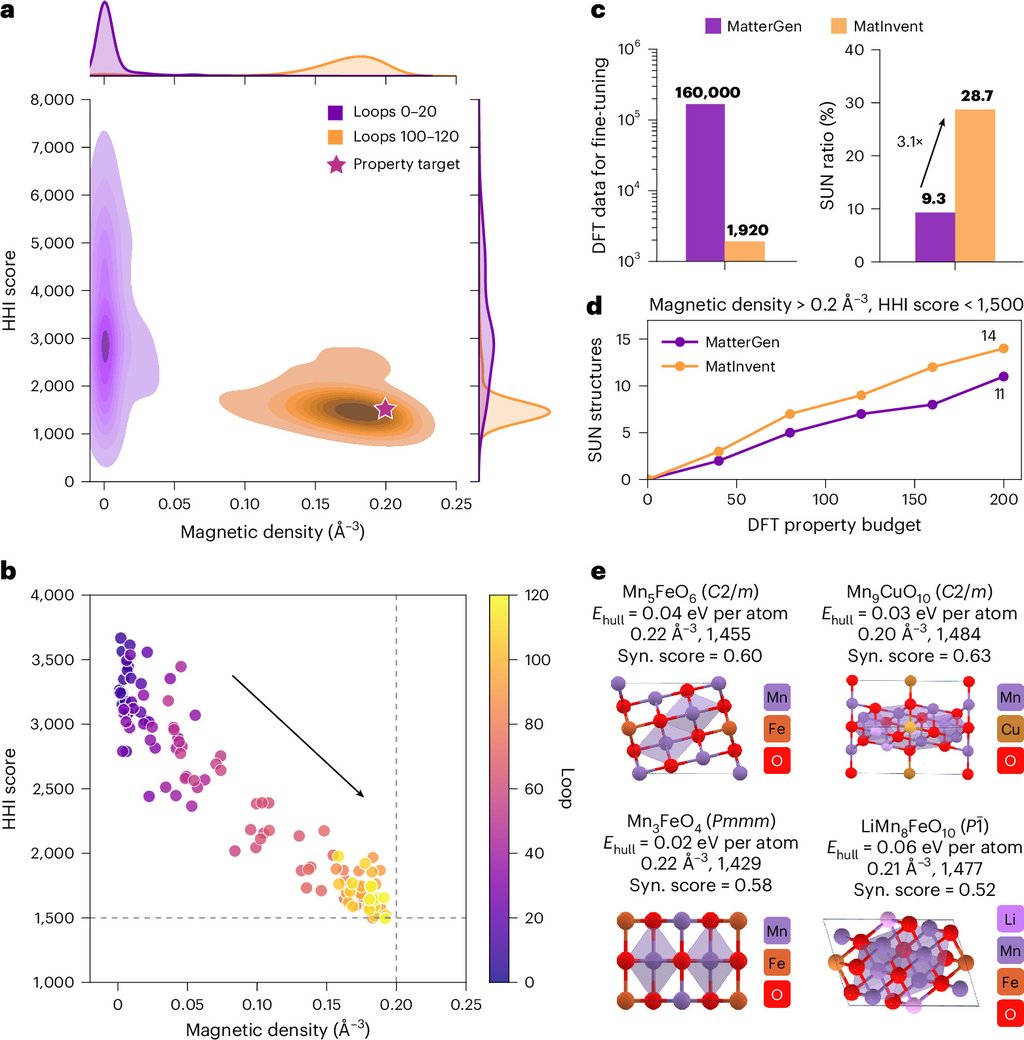
That threshold is the paper's description of how the conditional approach usually works, not a measurement made in this study. The comparison the team did run is narrower: MatInvent against MatterGen's conditional generation, both starting from the same pretrained model, on two of the tasks. There MatInvent needed 1,600 quantum calculations to earn its rewards, and about twice as large a share of what it generated was stable, unique and new. The task suite, the reward functions and that single baseline are all the authors' own; no outside benchmark has been run on MatInvent, and the paper cites one built for this kind of problem without using it.
Two goals that pull against each other
The harder test is two goals that pull against each other. Permanent magnets are the standard example: the strongest ones use rare-earth elements, whose supply is concentrated in a few countries. Asked for a high magnetic density and a low supply-risk score at once, the model moved toward the region where both hold as the rounds accumulated. Inside a budget of 200 quantum calculations it turned up 14 candidate structures that met both conditions, and a machine-learning model rated most of them as probably synthesizable, which is a prediction of feasibility rather than evidence of it.
The second two-goal task shows the method's limits, which the authors report openly. Chip makers want an insulator with both a high dielectric constant and a wide band gap, two properties that rarely coexist. Because the quantum route was too expensive to use as the reward here, trained predictors supplied it instead. The team ranked its candidates by prediction and sent the top 200 for a full quantum check: more than 95% cleared the band-gap target, and only about 20% cleared the dielectric one, which the authors suggest comes from their predictor's poor accuracy on that property. Within the same budget, 17 structures satisfied all three criteria the task set.
The candidates exist as calculations, and the code is public
None of the materials has been made in a lab. There is no sample and no measurement on a bench; every property here is computed, and even synthesizability is a machine-learning score. The authors list synthesis information, such as which precursors are available, as something a later version of the workflow could take in, and they thank two colleagues for "valuable discussions about wet-lab synthesis of AI-generated materials."
Other groups can build on it directly. The code is public and archived with a DOI, the model checkpoints are online, the paper itself is open access, and the authors' own summary stays hedged: MatInvent "could offer broad applicability in materials discovery."
Sources
- Nature Machine IntelligencePeer-reviewed
- github.com
- Zenodo