A Four-Legged Robot's Springs Chose Which Feet Step Together

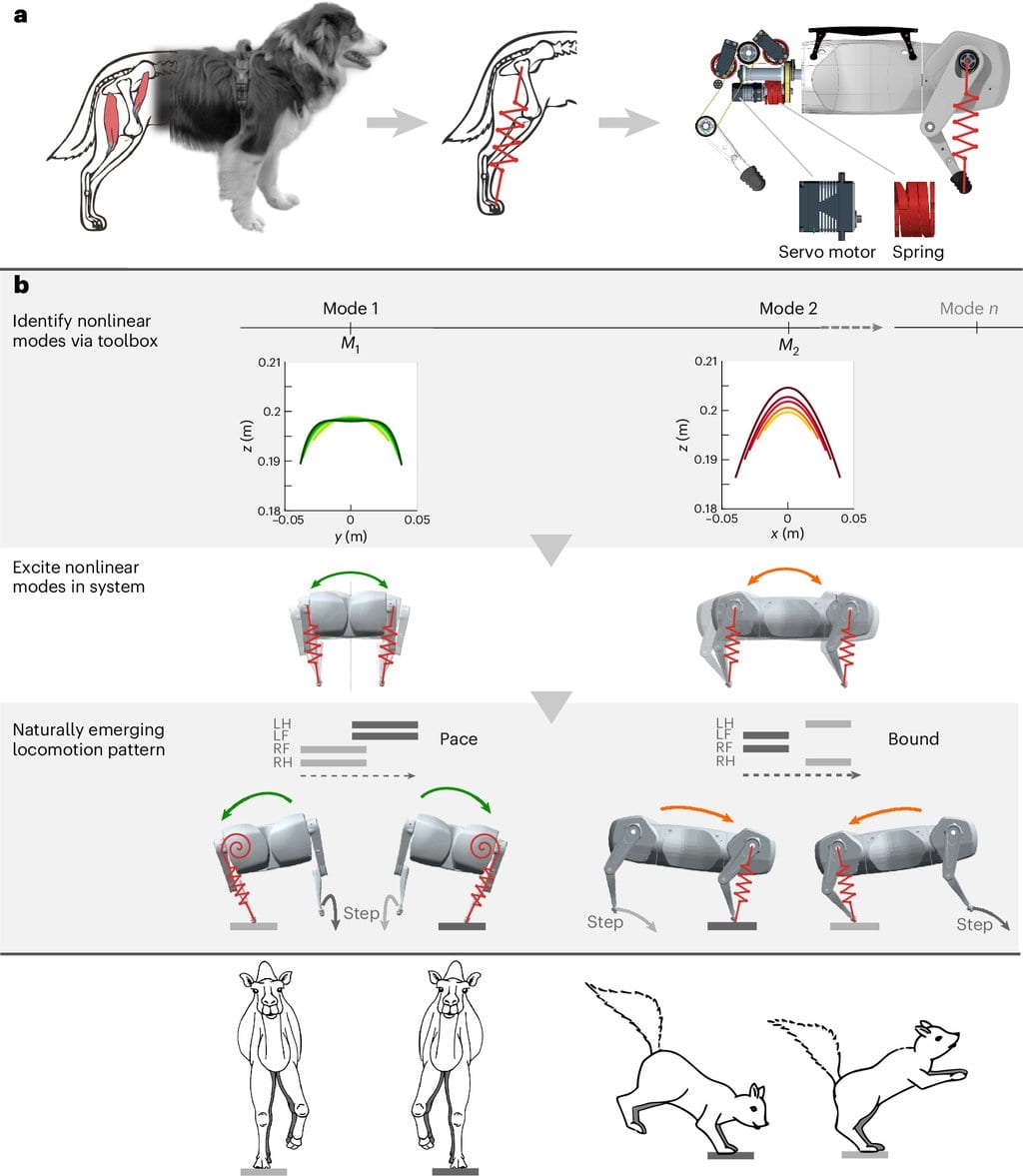
Stand a four-legged robot on springs soft enough that its own weight settles into them, and it will not hold still. Push it once and the body swings, and it swings in a few particular ways: side to side, nose to tail, up and down, twisting about its own middle. A team at the German Aerospace Center's Institute of Robotics and Mechatronics in Wessling and the Technical University of Munich asked whether those swings are enough to walk on. Their answer, published Nov. 27, 2026, in Nature Machine Intelligence, is a robot called eBert, and it suggests the answer is largely yes.
Most quadruped robots work the other way round. Stiff joints under tight feedback let a controller put each foot where the plan says it goes, and the gait that comes out belongs to the controller, not to the body, as Annika Schmidt and her colleagues write. eBert was built to let the body go first. Each of its 12 joints carries a spring between motor and limb, so the machine stores and returns energy roughly as a tendon does, and its legs are deliberately flimsy, under a tenth of the total mass, so the trunk leads the motion.
The springs themselves came out of biology, by way of an old scaling rule in which an animal's leg stiffness follows its body mass. The designers fed in the body dimensions of a small dog weighing 4.5 kg, which put 6.55 N m rad⁻¹ into the hips and knees and stiffer springs still into the shoulders, enough to stand upright without active correction and to favor swinging forward over swinging sideways. That 4.5 kg is the dog, not the robot: the finished eBert weighs 4.56 kg, or 5.2 kg with its battery.
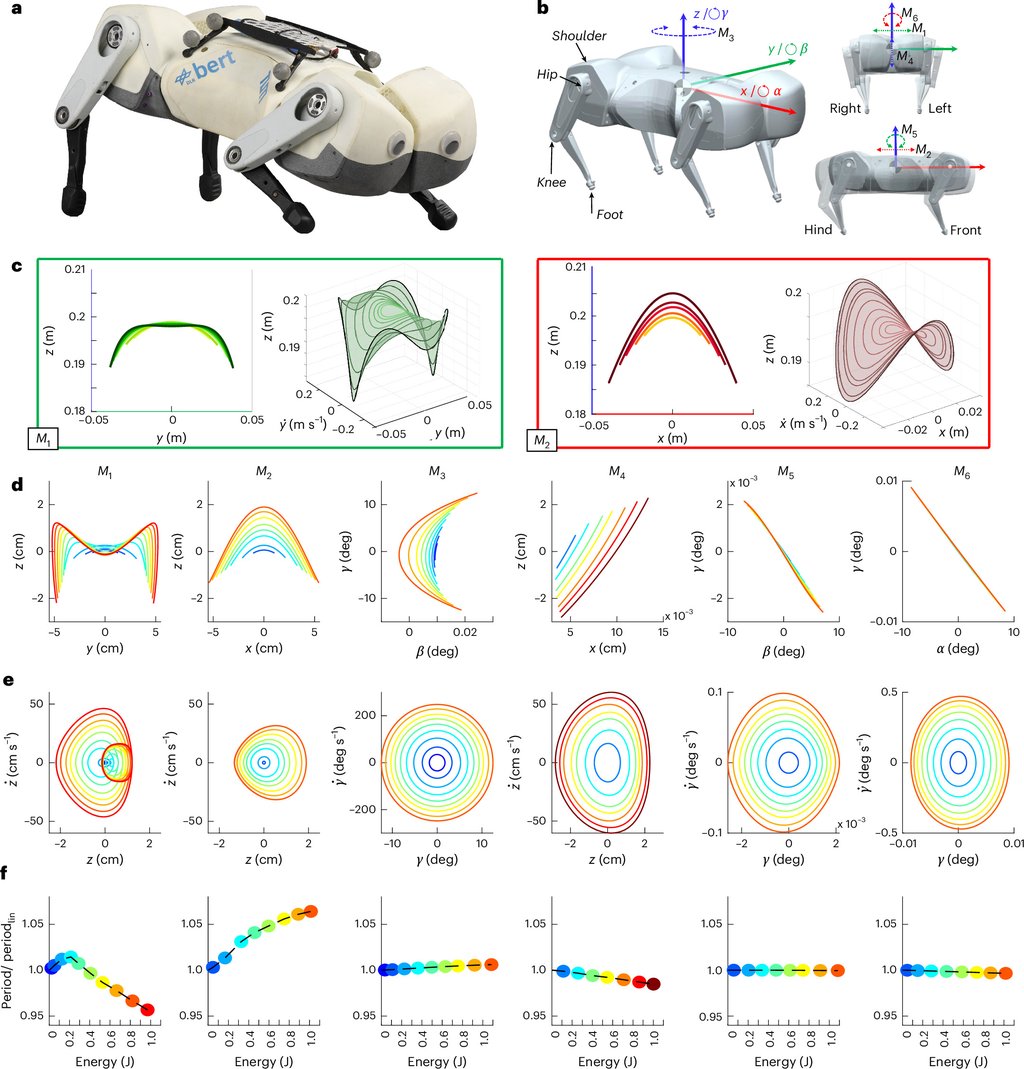
With the feet pinned to the ground, the team computed six nonlinear normal modes, the oscillations a body prefers, straight from the mechanics: gravity, inertia and the springs, with no control input anywhere in the calculation. Each mode is a shape, a direction, a frequency and a fixed timing between the joints. Sorted from slow to fast, they run from a sideways sway with a roll in it, through a pitch coupled to a forward-and-back slide, a twist about the vertical and an up-and-down bounce, to pure pitch and pure roll.
What the springs decided, and what the engineers commanded
Which feet move together fell out of the same arithmetic. Symmetries in each mode's shape pair the feet off: the two left feet against the two right in the sideways modes, front pair against hind pair in the pitching ones, diagonal pairs in the twist, all four at once in the bounce. Those are the footfall patterns of familiar quadruped gaits, and the paper names the animals they are known from: a camel's pace, a squirrel's bound, a horse's trot, a springbok's hop — in carefully hedged verbs: the diagonal pattern "suggested the trotting of horses". The match rests on which feet carry weight together, and on nothing else. The team is explicit that it is not claiming to reproduce animal locomotion in stride, speed or efficiency; what it claims is that a body's own resonance can organize the coordination of four legs with no script for it.
The engineers still added some control of their own. A controller injects a pulse of energy at each turning point of the swing, where the motion has naturally stopped, like a hand pushing a playground swing as it comes to rest on either side. The standing posture was chosen by a grid search. And at every crossing of the equilibrium the same controller commands that mode's own foot pair forward, with the length of the step found by black-box optimization over 100 to 200 simulation trials per mode, then optimized again on the robot itself. The bounce was the exception: the body already leans forward, so the paper records that "no dedicated step had to be commanded for this mode".
Four of six modes walked, and two slipped
On the hardware, four of the six modes produced the gaits the simulations had predicted: both sideways sways, the twist and the bounce. The two pitching modes did not. High torque in the hind legs' hips and knees made the belt drives slip, and the gait could not be sustained. The team reads that as a limit of its own method: the modes were computed for an idealized model that conserves energy and leaves the drivetrain out, so nothing in the analysis could have predicted a slipping belt. Measured frequencies also ran below the predicted ones, by around 20% for three modes and within 10% for the rest.
The key result is how much of the work the springs did on their own: in some modes up to 80% of the positive mechanical work per cycle was supplied passively by the mechanics rather than by the motors. The modes are strictly defined only for smooth systems that conserve energy and keep their feet planted; a walking robot breaks contact and loses energy, so the mathematics stops applying the moment eBert steps. The paper treats the modes as templates of coordination a body prefers, not as generators of motion in their own right.
What this hands the next robot designer
Compliant legged robots are not new, and this paper does not claim otherwise. It sets eBert beside earlier spring-legged machines, among them PAWS, built by an independent group, whose gaits stayed in the fore-and-aft plane. What is different here is a body carrying several usable swing directions at once. The team calls the whole thing a proof of concept, with no comparison of efficiency, stride length or speed against animals or other robots, and no testing yet across different controllers, disturbances and rough ground. The European Research Council funded the work, and two of its authors also hold posts at Eindhoven University of Technology and KAIST.
What the work does hand a designer is foresight. The modes can be computed from a model before a robot is built, so which oscillations a machine will have, and which feet each one pairs up, are knowable while it is still a drawing. The code that computes eBert's modes is public, and the raw trial data from simulation and hardware is deposited on figshare, so the next group to try this can start from the same six modes.
Sources
- Nature Machine IntelligencePeer-reviewed
- figshare
- github.com