TESS Caught a Planet by the Way It Warped Starlight, a First for the Transit Hunter

TESS has one job, and for eight years it has done it well: stare at stars and wait for a planet to cross in front of one, dimming its light by a fraction of a percent. That method, the transit, has a hard limit built into it. You can only see the planets that happen to pass between their star and your telescope, and in practice that keeps TESS's catalog close to home, within a couple hundred light-years.
Gaia23bra b is nearly 40,000 light-years away. TESS was never supposed to be able to find it. It found it anyway.
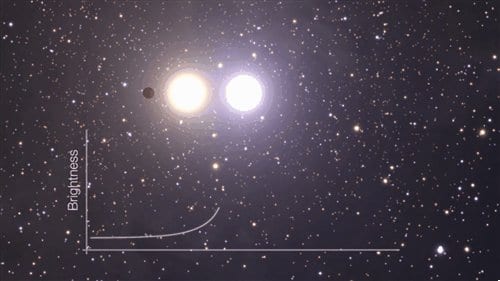
The planet turned up not through a transit but through gravitational microlensing, and the distinction is the whole story. When two stars line up almost perfectly along our line of sight, the nearer one's mass bends and focuses the light of the farther one, acting as a lens. The background star flares up for days or weeks and then fades as the alignment drifts apart. If the foreground star carries a planet, that planet's own gravity leaves an extra kink in the brightening, a spike within the spike. Read the light curve carefully enough and you can weigh a world you never actually see.
Reading it carefully was the trick. The alert came first from Europe: in 2023, ESA's Gaia space telescope, through its alert system, flagged a star that had suddenly brightened. Gaia has since been retired, but its warning pointed astronomers at the right patch of sky. When a team led by Mallory Harris, a Ph.D. candidate at the University of New Mexico, went digging, they found that TESS had been watching the same star all along, and watching it far more often than Gaia had.
"Gaia's observations were too sparse to pick up on the planet," Harris explained. "Its denser time coverage showed extra features in the light curve caused by a planet." The word "its" there is TESS: the satellite's rapid, repeated snapshots resolved the fine structure that Gaia's sparser record had smeared over. What retired the mission to a footnote in one dataset made it the discovery instrument in another.
The planet the two telescopes jointly pinned down is a heavyweight. Gaia23bra b weighs about 1.6 times as much as Jupiter (a super-Jupiter) and circles an orange dwarf star holding roughly 80 percent of the Sun's mass. The result is peer-reviewed, published July 1, 2026, in The Astrophysical Journal Letters.
A capability nobody planned for
The part that has astronomers reworking their assumptions is what this says about everything TESS has already recorded. The mission launched with no expectation of doing microlensing at all.
"When TESS launched, no one expected it to ever be capable of finding this kind of planet," said Diana Dragomir of the University of New Mexico, a co-author on the study.
That reframes eight years of archived observations. TESS has swept nearly the entire sky, again and again, at exactly the dense cadence that makes a microlensing planet's signal legible. Gaia23bra b was found by matching one European alert to those records. But the records themselves may hold other microlensing events that were caught and never recognized, because no one was looking for them in transit data. The team treats that as a prospect, not a tally: a reason to comb the archive, not a count of planets already in hand. Whether the haul is one more or many is exactly the question the discovery opens.
For a telescope built to watch planets march across their stars, catching one by the bend of distant starlight is a genuine first, and a hint that the instrument has been quietly capable of more than its designers asked of it.