In New Simulations, a Magnetic Field Lifts a White Dwarf's Mass Limit

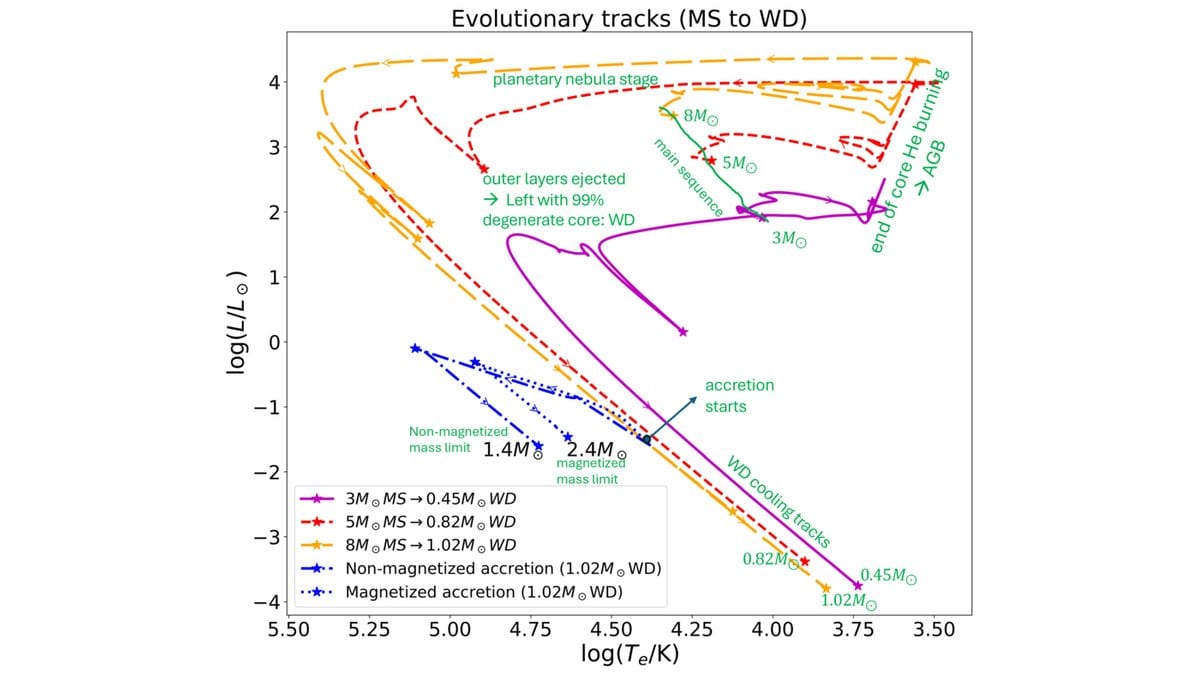
Nothing holds a white dwarf up except its own electrons, which refuse to be pushed any closer together. Work out how much weight that refusal can carry and the answer is about 1.44 times the mass of the Sun. That is the Chandrasekhar limit, one of the cleanest numbers in astrophysics and one of the few a student can derive on paper. It is also a calculation, and a calculation has inputs. The version everyone quotes describes a star that spins slowly and carries almost no magnetic field. On Oct. 8, 2026, a group led from the Indian Institute of Science published a set of simulations in which that second assumption is dropped, and the ceiling moves.
Zenia Zuraiq and Banibrata Mukhopadhyay led the work, with colleagues at the University of Cambridge, the University of Florida, the Czech Academy of Sciences and IIT Palakkad. Their paper in The Astrophysical Journal Letters begins with STARS, the Cambridge stellar evolution code, and adds two things to it: the forces a magnetic field exerts on the gas inside a star, and cooling. With those in place the team ran model stars from the main sequence, the long hydrogen-burning stretch of a star's life, through to the white dwarf left at the end.
Follow one of those stars. A model that starts out eight times the mass of the Sun ends as a carbon-oxygen white dwarf of 1.02 solar masses, the heaviest in the family. Now give it a companion to draw gas from, at roughly a billionth of a solar mass a year. Start it with what the authors call a dormant field: one too weak at first to alter the star's track, which strengthens as the star is squeezed. In that run the white dwarf sails past the usual ceiling and settles at 2.4 times the mass of the Sun. Repeat the feeding with no field worth speaking of and it stops at 1.38, just shy of the textbook value.
That figure is the outcome of one model with one set of choices, and not a new constant to replace the old one. Change the geometry of the field, the rate of feeding or the rate of cooling and the number moves with it. The abstract gives the new mass limits as depending on all three, and ends by granting that the limit "may be sacrosanct" while "its value greatly depends on the underlying physics." The claim is not that the ceiling is higher than anyone thought, but that it is not a single number.
The mechanism is also contested, and has been since 2014, when Nityananda and Konar published strong constraints on magnetized white dwarfs heavier than the limit in Physical Review D. They argued that models of this kind leave out the force the field pushes back with. They also derived a bound on the central field from the simple balance of pressure against gravity, and found it far below the values such models assume. Later papers objected that stars like these could not hold themselves together. The replies are in the published record too, and the senior author of the new paper is one of the people writing them: Mukhopadhyay has argued in print that the central-field bound is mistaken.
The size of the fields is part of why the argument has lasted. At the center of the model star the field climbs to about 80 trillion gauss. The strongest fields ever measured on a white dwarf are around a billion gauss at the surface, and nobody can look inside one of these stars to check. A stability analysis runs through the new paper, below the limit and above it, which is exactly the ground the objections are fought on.
The reason to care about any of this is a handful of explosions. A Type Ia supernova is a white dwarf pushed past what it can carry, and these explosions are nearly uniform in brightness, which is what makes them useful for measuring distances across the universe. A few are far too bright. One of those outliers, SN 2003fg, is the new paper's own motivation, and its introduction cites other groups' estimates putting progenitor masses for such events as high as 2.8 times the Sun's. A white dwarf able to carry more than the usual ceiling before it detonates would be one way to account for them.
No such white dwarf has been seen. The paper is peer-reviewed and freely readable, and what it claims is the possibility of such stars rather than their existence; the observational prompt is the brightness of the supernovae, not a star on anyone's detector.
The authors propose a second job for the same effect. A few white dwarfs lighter than the limit are larger than they should be for their mass, among them a star cataloged as SDSS J123204.19+522548.2. The field, together with the heat still in the star, could be "decisive" in explaining that radius. That explanation is this group's own, and nothing outside their own work supports it yet.
The constant becomes something that has to be worked out star by star, from the field a star carries, what it feeds on and how fast it cools. Whether nature builds such stars, and whether a field that strong could sit inside one at all, are both still open.
Sources
- The Astrophysical Journal LettersPeer-reviewed