The Glow That Swept Across Kepler's Empty Sky Followed the Sun

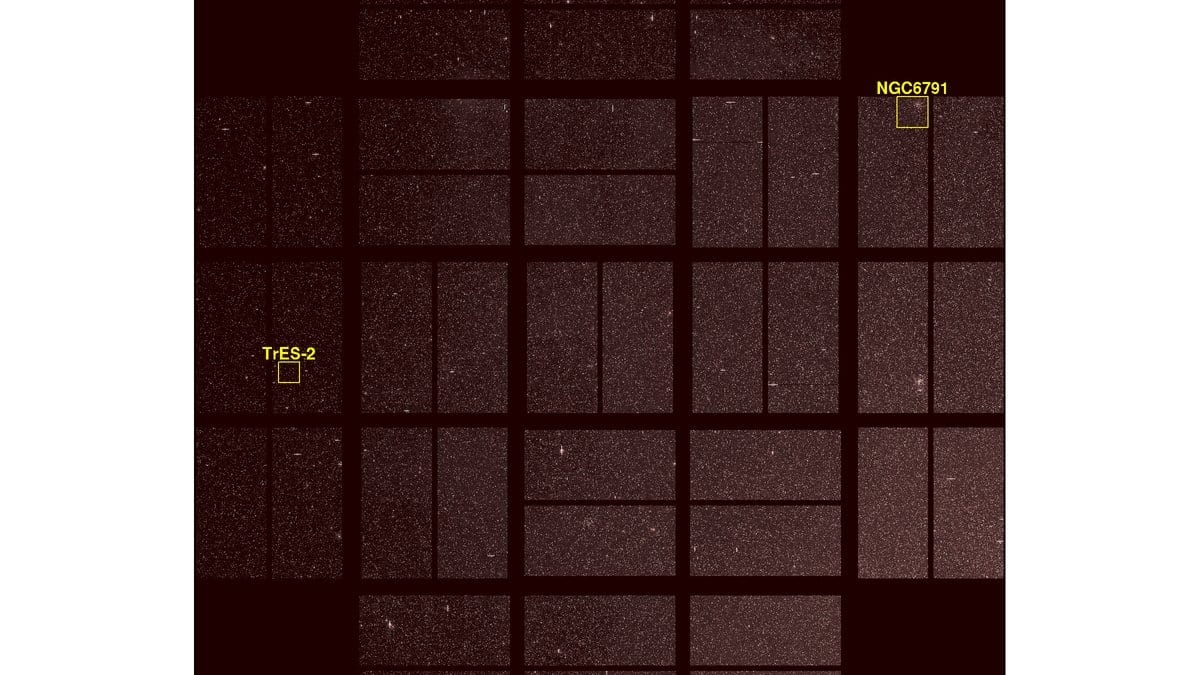
Every 29.4 minutes, for four years, NASA's Kepler telescope sent home a few thousand pixels of empty sky. They were deliberate. To measure how bright a star is, you must first know how bright the sky behind it is, so the mission set aside small clumps of blank sky between its targets, read them out on the same clock as its stars and subtracted what they saw. Then the subtraction threw that background away. The pixels went to the archive, around 560 gigabytes of them, and were rarely used for science again.
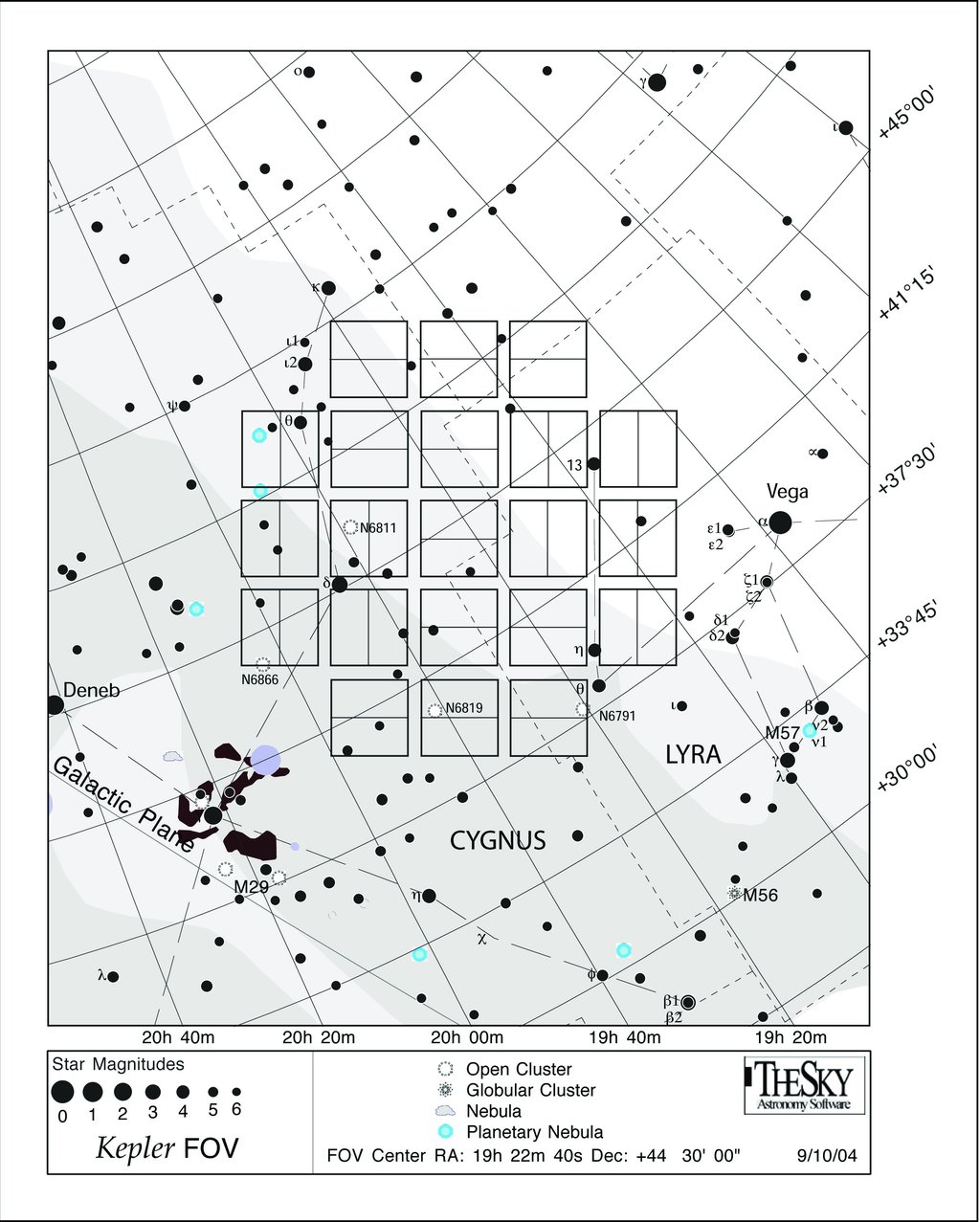
Peter M. Shearer, a professor at the Scripps Institution of Oceanography in La Jolla, California, went and got all of them. In a preprint posted to arXiv on Nov. 14, reports a field-wide glow in those pixels that brightens and fades as fronts sweep across Kepler's patch of sky in a day or less during the mission's 2009–2013 observations. He argues, on four lines of evidence, that it is sunlight scattered by electrons in the solar wind flowing past the spacecraft. The paper has been submitted to The Astrophysical Journal but has not been peer-reviewed. Shearer is the sole author, and the paper currently carries only its arXiv identifier.
A faint signal nobody noticed in a famous dataset invites one objection above all: the telescope made it. Kepler's data handbooks describe brief diffuse brightenings of its focal plane, and an instrument that stares for four years collects heater cycles, focus drift and electronic noise. The glow also sits inside something hundreds of times brighter: the zodiacal light of sunlit dust in the inner solar system, which has a seasonal cycle of its own.
A rolling spacecraft settles the first question
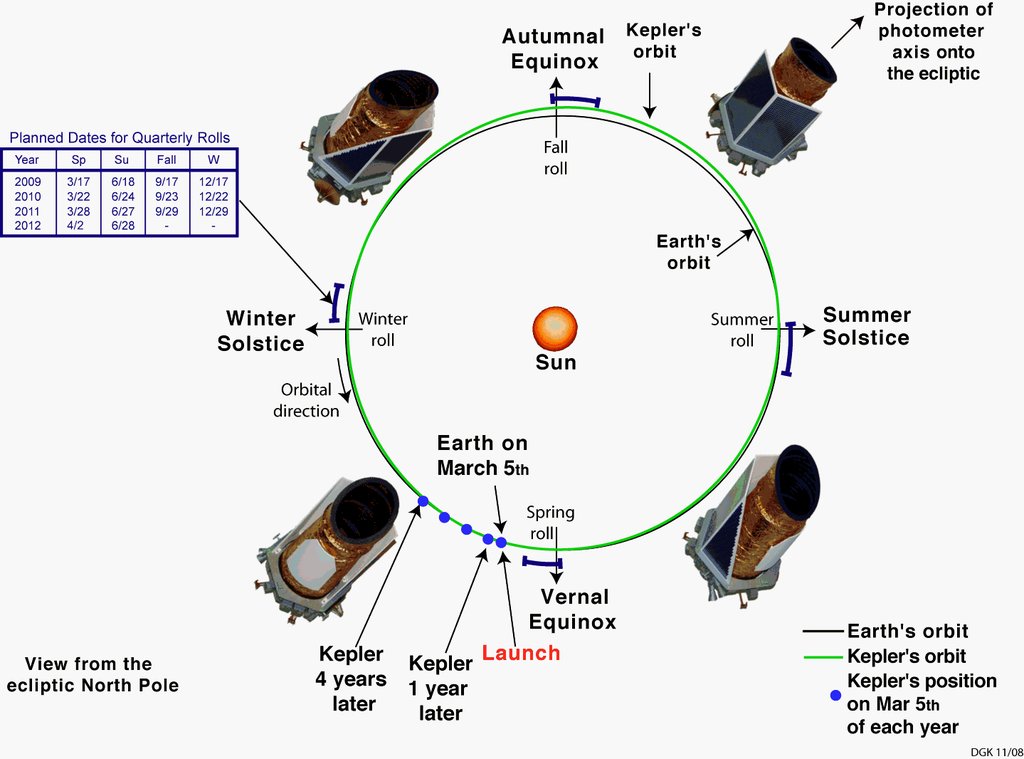
Shearer's strongest answer turns on where the telescope was pointing. Kepler held its attitude fixed for a quarter of a year at a time, then rolled 90 degrees. The Sun, meanwhile, kept moving: seen from the spacecraft, the direction pointing straight away from it rotated by about 80 degrees during each quarter. Anything tied to the telescope should hold one direction throughout a quarter and jump at every roll. Anything out in space, illuminated by the Sun, should follow the Sun and ignore the rolls. The sweeps followed the Sun. Where their direction could be measured cleanly, 84% pointed broadly away from the Sun, compared with the 25% expected from random directions. Their measured direction tracked the Sun's own motion with a slope of 1.01, with no break at any roll across the four years. "The propagation is therefore tied to the Sun, not to the instrument," the paper concludes.
The density, the speed and the seasons agree
The second line of evidence comes from outside Kepler. Shearer compared the field's average brightness with the proton density measured hour by hour by spacecraft near Earth, and the two rise and fall together within a day of zero lag, with a correlation of 0.19. That is a weak correlation, and the paper says why: "The correlation is modest because the two quantities sample different plasma." One monitor samples a single point, while Kepler's sightlines extend across an astronomical unit of space. A weak correlation is not necessarily accidental. Shifting the near-Earth record by random amounts never reproduced the correlation, and removing every interval of heavy high-energy particle flux, the obvious way for stray hits to fake a brightening, left it essentially unchanged.
The third line is the shape the signal makes in time. Binning the field by angular distance from the Sun and stacking those profiles in sequence turns each sweep into a slanted front, similar to those seen in data from purpose-built solar-wind cameras. The slant gives a speed. The fronts move outward at a median rate of 15 degrees across the sky per day. Shuffling the geometry at random, which destroys any real propagation, finds far fewer fronts and no outward preference at all. Shearer's own forward model, with shells of denser plasma drifting outward at 400 kilometers per second, reproduces the same measured speed. A faster wind does not.
The fourth line is the brightness itself, and it comes with the paper's own warning label. As Kepler orbits, the angle between its field and the Sun opens and closes over the year, which should make a given clump of plasma look about three times brighter at the near end of that swing. The measured fluctuations change by close to that factor. The dust is excluded twice over: a running median taken over about a week removes it along with its slow seasonal swell, and the seasonal test then discriminates directly, because the dust brightens by only half as much again between the two ends of the year, while the pixel noise changes by even less. "The seasonal contrast is not an instrumental effect proportional to the sky brightness," the paper states. On the absolute brightness, Shearer declines the win: "We have not measured the structure size independently, however, so the amplitude is a consistency check rather than a confirmation of the model."
What the archive can be used for now
If the interpretation is right, the value of the record is its geometry. Kepler watched one patch of Cygnus and Lyra about 65 degrees above the plane in which the planets orbit. It did so from its own orbit around the Sun, trailing Earth, so its sightlines cut through solar wind well out of that plane. Purpose-built instruments have mostly looked elsewhere: the cameras aboard the twin STEREO spacecraft look back toward the Sun and close to the plane of the planets. Among dedicated instruments, the paper notes, only the all-sky Solar Mass Ejection Imager routinely covered Kepler's directions. The two records overlap, and comparing them is the obvious next move.
What the archive cannot do is follow individual storms. Averaged over all interplanetary coronal mass ejections that reached Earth while Kepler was watching, the glow does rise about a day afterward, but the paper does not call that a detection: the peak is not statistically significant once every possible lag is counted. A single viewpoint cannot establish how far away the structures are, so every speed in the paper is expressed in degrees of sky per day, not kilometers per second. The practical concern it does resolve is Kepler's day job: the pipeline's background fit absorbs the glow, changing the light curves of faint stars by less than one part in a million.
Little of this is hard to check, which is rarer than it should be. The reduced archive and the code behind every figure and table are deposited on Zenodo, and the raw Kepler files have been publicly available for years. The main results also survive a deliberately crude version of the analysis, using one number per detector per reading with the cleaning switched off. The acknowledgments add that Claude, Anthropic's AI model, assisted with the analysis and narration.
The author's own field is not the solar wind. Shearer's listed research topics at Scripps are seismology and earthquake physics, and the tools he turned on Kepler's blank sky, measuring delays by cross-correlation and stacking records along trial slopes, are ones seismologists use to study earthquakes. The paper makes nothing of that. It does mention one other thing the same discarded pixels caught: a comet's ion tail breaking off, described in a companion preprint by Shearer that has also not been peer-reviewed.