Twelve Years Under the South Pole Push the Milky Way's Neutrino Signal Past Five Sigma

Cosmic rays arrive at Earth with no return address. They are charged particles, and the Galaxy is threaded with magnetic fields, so by the time one reaches an instrument its direction says nothing about where it started. More than a century after their discovery, the objects inside our own galaxy that accelerate them to energies no laboratory can match are still, in the strict sense, unlocated.
Neutrinos are the workaround. They carry no charge, they barely interact with anything at all, and they travel from wherever they were made in a straight line. The catch is that same property: a particle that barely interacts is very hard to catch.
The payoff for catching one is bigger than a direction. Gamma rays from these regions can be produced two ways, by fast electrons scattering off light and magnetic fields, or by protons and heavier nuclei colliding with interstellar gas. Neutrinos come only from the second. A neutrino from the Galactic plane is therefore direct evidence that hadronic cosmic rays are being accelerated somewhere along it, which is why the new preprint opens by noting that the Milky Way hosts objects accelerating particles beyond the reach of terrestrial accelerators.
That preprint went up on July 28. In it, the IceCube Collaboration, 420 authors working on a detector that occupies a cubic kilometer of Antarctic ice, reports high-energy neutrino emission from the plane of the Milky Way at 5.7 standard deviations, drawn from 12 years of data. It has not been through peer review and carries no journal reference.
This is not the discovery of that emission. IceCube published it in Science on June 30, 2023, at 4.5 sigma, from 10 years of data and a machine-learning analysis of a single class of events, and the result was covered worldwide when it landed. The signal has been on the books for three years. What has changed is how firmly it is pinned down.
Particle physics runs on a convention about that. Three sigma is a result worth reporting; five sigma is the bar a claim has to clear before the field treats it as established, roughly a one-in-3.5-million chance that a fluctuation in the background could counterfeit it. The 2023 measurement sat below that line. This analysis clears it.
The extra significance did not come from waiting. Statistical significance grows roughly as the square root of exposure, so two more years on top of ten buys very little on its own, and the arithmetic here is not hypothetical: IceCube ran a Galactic-plane analysis on 12.1 years of data in July 2025, combining throughgoing tracks, starting tracks and cascades, and it came out at 4.5 sigma again. The difference in the new paper sits in the same sentence of the abstract as the flavor combination: recent improvements in ice modeling, calibration and reconstruction.
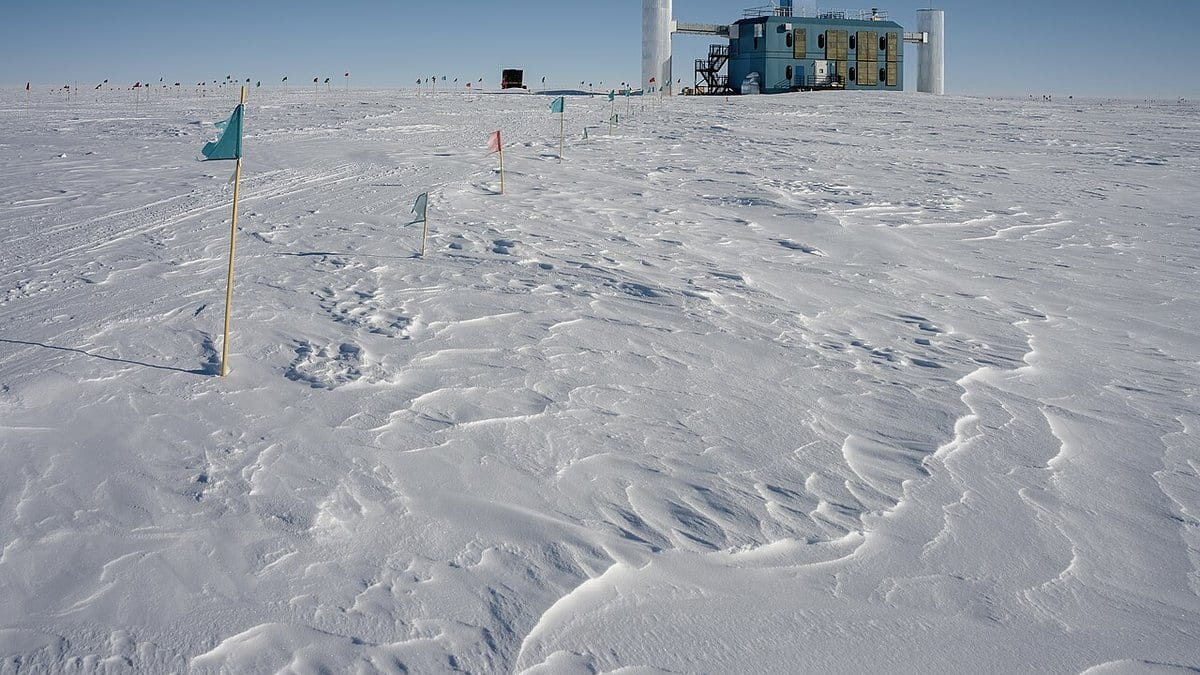
For IceCube, the ice is not the container. It is the detector. Some 5,160 optical modules hang on 86 cables between 1,450 and 2,450 meters below the South Pole, and what they record is faint blue Cherenkov light thrown off by the particles a neutrino interaction produces. Reconstructing where the neutrino came from means knowing precisely how that light scatters and is absorbed on its way to a sensor, through glacial ice layered with dust deposited over tens of thousands of years. Improve that model and you improve every direction the detector has ever measured, including the ones it measured a decade ago.
Working against all of it is the background. Cosmic rays hitting Earth's atmosphere manufacture muons and neutrinos of their own, in numbers that swamp anything astrophysical, and the Galactic plane is a broad band across the sky rather than a point that stands out sharply against the noise. Pulling a diffuse signal out of that is a statistics problem before it is an astronomy one.
The analysis also combines the event shapes characteristic of all three neutrino flavors. A muon neutrino interacting in or near the array leaves a long track through it, which points well. An electron or tau neutrino dumps its energy into a roughly spherical shower, which measures energy well and direction poorly. Using both, rather than one class alone as the 2023 analysis did, means more of the sky's neutrinos count toward the answer.
One phrase in the abstract does more work than it looks. The analysis was predefined and global, meaning it was fixed before it was run on the data. That matters, because a search across a large sky with adjustable choices will eventually turn up something at three sigma somewhere, and a significance quoted after the fact is worth less than one quoted in advance. Fixing the procedure first is how a collaboration earns the right to quote 5.7 sigma without an asterisk.
Then comes the second result, and its qualifiers need keeping. In a follow-up study, the collaboration counts 217 shower events with visible energy above 5 TeV from the inner region of the Galaxy, against an expected background of 154.4 plus or minus 4.1. That is a surplus of roughly 60 events over a background whose uncertainty is quoted at about four, which is a large and well-posed excess. The paper's own phrasing for what it means is that the inner region of the Galaxy is a prominent neutrino source.
What it is not: a picture, a resolved object, or a ranking of the neutrino sky. Nothing has been imaged. The evidence is a count of events arriving from a direction, and the direction is a region rather than a point.
An older ambiguity is still open, too. When IceCube published in 2023, it noted that the signal was consistent with modeled diffuse emission from the Galactic plane but could equally arise from a population of unresolved point sources. Those are two different galaxies to describe: cosmic rays colliding with gas all along the disk, or a scattering of individual accelerators too faint to pick out one by one.
The collaboration's own summary is that the result heralds a new era of Galactic multi-messenger astronomy. More concretely, the next question is which objects, and the inner-Galaxy excess is where to start asking it. Turning 217 counts into a list of names will take either more events or a sharper reconstruction, and IceCube has just demonstrated it can still extract the second from ice it drilled years ago.