The Rock That Remembers Mars's Most Violent Era

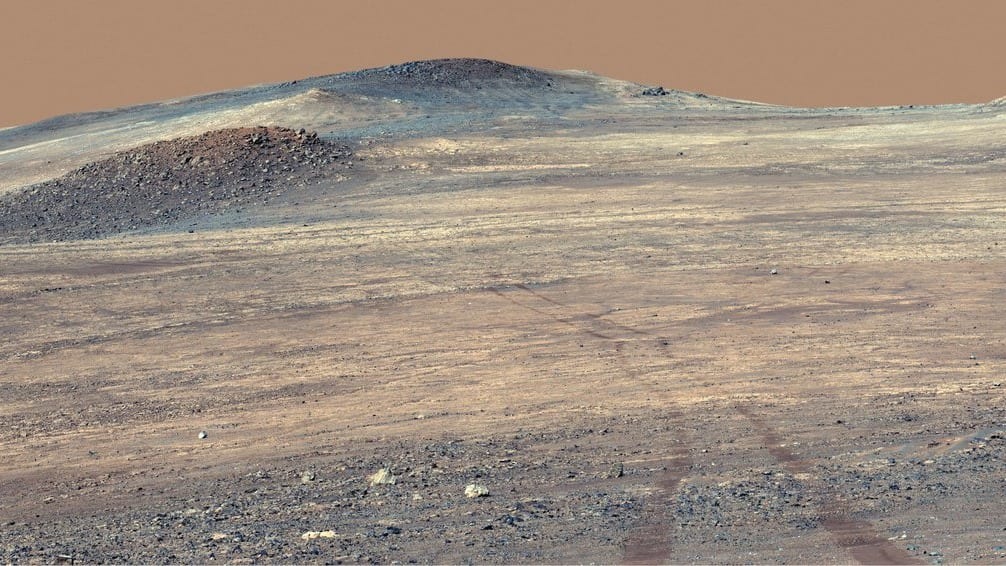
Earth has almost no memory of its own violent childhood. Plate tectonics keeps recycling the crust, erasing the scars of the asteroid barrage that battered every young world in the inner Solar System. Mars kept its memory. On the rim of Jezero Crater, NASA's Perseverance rover has now read a chapter of that lost history, layer by layer, in a stack of rock more than 3.9 billion years old.
The formation is called the Broom Point member, and it stands about 75 meters thick, roughly the height of a 20-story building. Working through it, the science team identified six distinct rock types, described in a study published on 15 July 2026 in the peer-reviewed Journal of Geophysical Research: Planets. What makes the stack remarkable is not any single layer but the rhythm of them, coarse and violent bands alternating with fine ones, over and over up the outcrop.
Reading the layers
Some of the layers are breccias, jumbles of angular fragments welded together. Many of those fragments are pocked with gas-bubble cavities, preserving the frozen record of rock that was once molten and frothing before it cooled. Scattered through the sequence are tiny dark glassy beads, the same kind found in the debris of the Chicxulub impact that ended the age of dinosaurs on Earth. Between the coarse bands lie layers of fine, pulverized dust.
That alternation is the whole story. "The different rock layers are a record of variable-sized impacts occurring at different distances from where this rock sequence was accumulating," said Alex Jones, the study's lead author and a doctoral student in planetary geology at Imperial College London. Big impacts nearby laid down molten, shattered debris; smaller or more distant ones dusted the surface with pulverized material. Read from bottom to top, the Broom Point member records high-energy impacts happening again and again across this corner of early Mars.
Some layers may capture an even more dramatic moment, when molten rock met water or ice and flashed into surges of steam and debris. It is a snapshot of a planet under bombardment, its surface repeatedly melted, blasted, and buried.
Why the record survives on Mars
The reason this archive still exists comes down to a difference between the two planets. "Because Mars lacks plate tectonics to recycle its crust, this ancient record remains intact, giving us a rare glimpse into a geological time period that doesn't exist on our own planet," said Ken Farley, Perseverance's deputy project scientist at Caltech. Earth was pummeled just as hard in its first few hundred million years, but geology long ago scrubbed the evidence away. Mars simply stopped rewriting the page.
Perseverance did more than photograph the outcrop. It drilled and sealed two rock cores, named Bell Island and Main River, and left them cached for a future mission to collect. Back in a laboratory, scientists could measure the precise ages of these layers, something no rover can do on the surface. That would convert the Broom Point member from a relative sequence into a dated calendar of the early bombardment.
The stakes reach well beyond Mars. If those layers can be dated, they would fix the timing of the era when asteroids rained across the whole inner Solar System, the same era that shaped the infant Earth and whose record here at home has been wiped clean. "If we can pin down the ages of these layers," Jones said, "it would be like reading a cosmic weather report from 4 billion years ago." For now that report sits in a sealed tube on the surface of Mars, waiting for a ride home.