Ancient DNA Reveals the Scythian Steppe's Ruling Lineages and Its Powerful Women

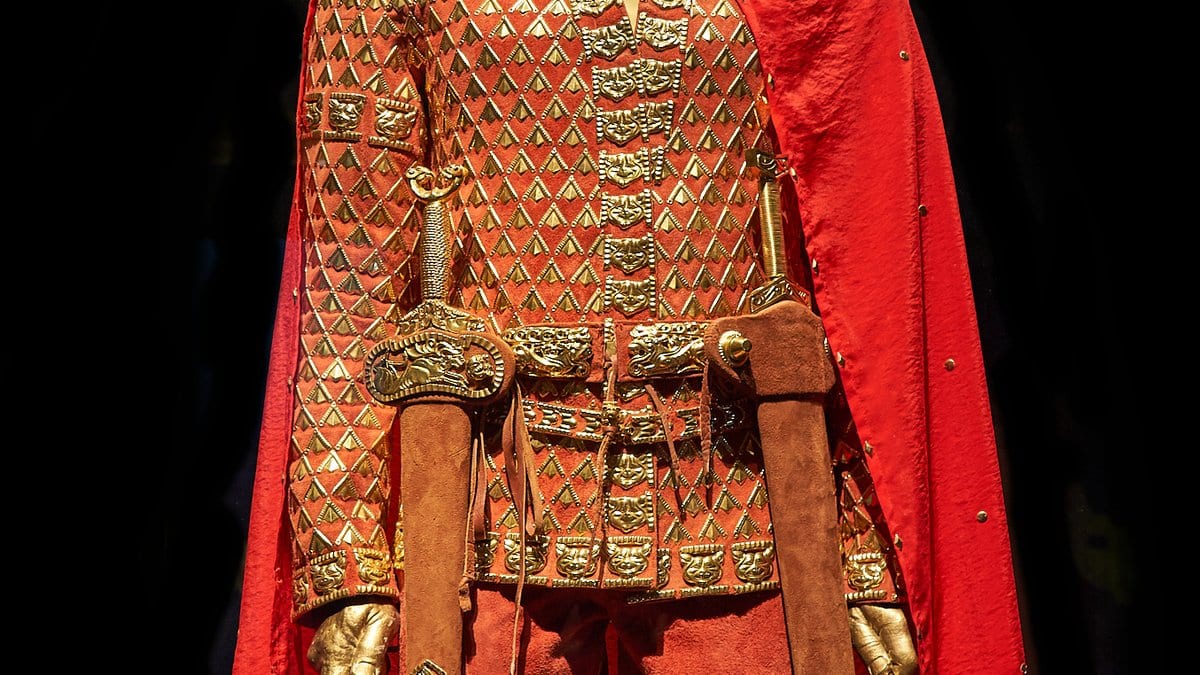
For centuries the Scythians have been more legend than people: the mounted nomads Herodotus wrote about, remembered for their gold, their horses, and the towering burial mounds they left across the grasslands from the Black Sea to the Altai. The mounds, called kurgans, are the loudest thing they left behind: some of the richest ones held individuals draped in thousands of gold ornaments. But who those people were to one another, and how someone came to be buried under all that gold, has mostly been guesswork. A new genetic study turns some of that guesswork into data.
Kinship across a hundred kilometres
A team led by Ayshin Ghalichi at the Max Planck Institute for Evolutionary Anthropology, with colleagues at the University of Texas at Austin and the Institute of Genetics and Physiology in Kazakhstan, sequenced and analyzed genome-wide DNA from 85 Iron Age individuals from across Central Eurasia, 46 of them newly sequenced. Crucially, the sample included both people buried with elite grandeur and people buried plainly, sometimes at the same sites.
That pairing is what made the central finding possible. When the researchers compared the genomes, a clear pattern emerged: the elite individuals were more closely related to each other (across different cemeteries, some more than 100 kilometres apart) than they were to the non-elite people buried alongside them at the same locations. Rank, in other words, tracked bloodline. The families in the grand mounds at one site were kin to the families in the grand mounds at another, forming what looks like a network of related ruling lineages spread over long distances of open steppe.
The stability of that pattern surprised even the researchers. "We did not expect to find that social status was passed down from generation to generation," said co-author Ainash Childebayeva, yet the elite burials showed stronger kinship bonds than the team had anticipated. It is a genetic signature of inherited power (dynasties, loosely speaking) written into who was allowed under the biggest mounds.
Nearly half the elite were women
The second finding cuts against a long-standing image of the Scythians as a purely warrior-and-warlord society. Of the elite individuals in the dataset, nearly half were female.
"Nearly half of the elite individuals in our dataset were female, indicating that women held high social status within Iron Age Scythian society," Ghalichi said. That does not mean status was distributed evenly, and the sample is modest. But it is direct genetic evidence that the highest tiers of Scythian society were not closed to women. That is consistent with the archaeological finds over the years of richly furnished female graves, including some containing weapons, that helped inspire the ancient Greek stories of the Amazons.
The most famous individual sequenced is not part of the female-status result at all.
The Golden Man gets a genome
The "Golden Man" of Issyk is one of Central Asia's archaeological icons: a burial from roughly 400–300 BCE discovered near Almaty, Kazakhstan, its occupant dressed in a costume of more than 4,000 gold pieces. The figure has become a national symbol. Yet until now, its DNA had never been read.
The new study reports the first genome-wide data from that burial. It also resolves a question the gold could not answer. The analysis indicates the Golden Man was, as the nickname has it, "more likely male than female." So while the study makes a real case for high-status Scythian women, the Golden Man is not the evidence for it; that individual sits on the other side of the ledger. Keeping the two apart matters, because the two claims are easy to blur into a single, tidier story than the data supports.
What it adds up to
Read carefully, the study replaces a romantic haze with something more concrete: a picture of Scythian elites as members of extended, geographically dispersed families who inherited their standing, and of a ruling class that included substantial numbers of women. Neither claim is a wild leap (both fit decades of archaeology), but genetics gives them a firmer footing than grave goods alone ever could.
There are limits, and they are the ordinary ones for ancient-DNA work. Eighty-five individuals is a keyhole onto a world that spanned centuries and thousands of kilometres, and "elite" is inferred from how lavishly someone was buried. The kinship result is robust; the finer social interpretation is a reasonable reading, not a proof of how Scythian politics actually ran day to day.
Sources
- phys.org
- Science AdvancesPeer-reviewed