The Reassuring Touch Is Older Than Humanity: Apes Hug and Hand-Hold to Keep the Peace

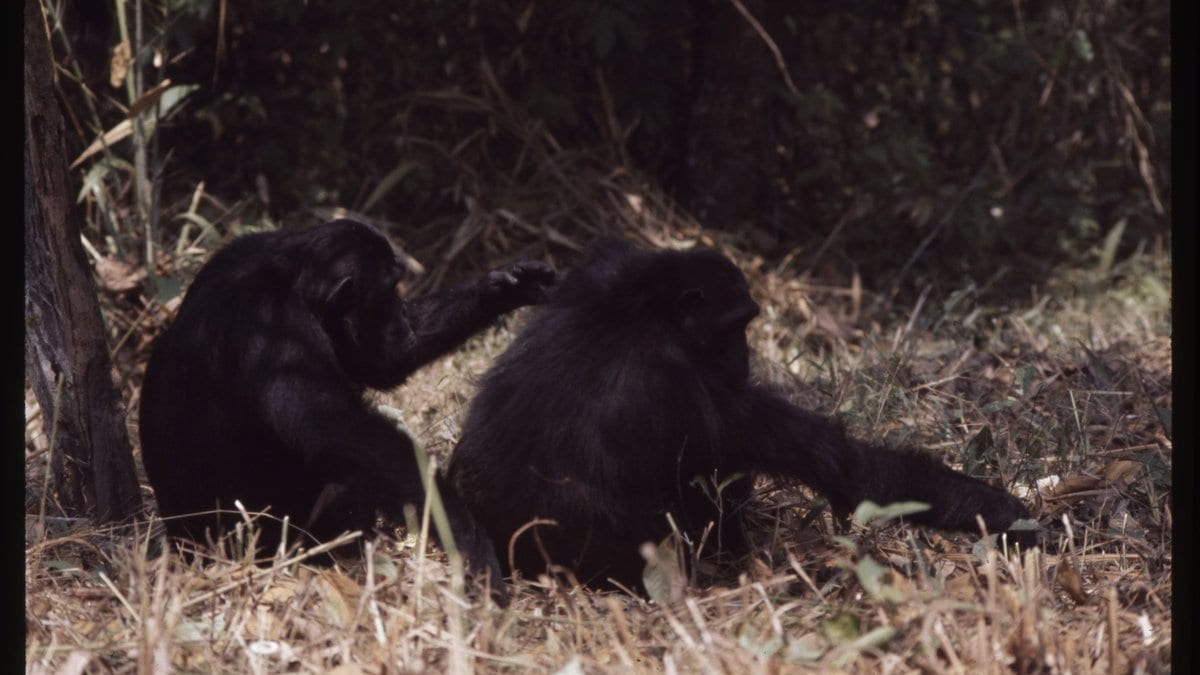
Watch a group of apes just before the food arrives, and you can feel the room tighten. Bananas or sugarcane are about to land in the middle of a hierarchy, and everyone knows it. In those loaded seconds, some of the animals do something oddly familiar. They reach for one another: an embrace, a hand slipped into a companion's, a quick touch, a kiss, sometimes a finger placed in a friend's mouth. Then the food drops, and more often than not, the ones who touched first settle in and eat side by side without a squabble.
That pattern is the finding at the heart of a study published in Proceedings of the Royal Society B by Jake Brooker of Utrecht University and Zanna Clay of Durham University. Working at two African sanctuaries (Lola ya Bonobo in the Democratic Republic of Congo and Chimfunshi in Zambia), the team filmed 116 apes across five groups over 60 feeding sessions, coding every gesture of what they call "reassuring contact" in the moments before a competitive meal.
The behaviors looked less like grooming and more like consolation: embraces, pats, hand-holding, gentle genital touches, the hand-in-mouth gesture that reads almost like a plea for calm. And the animals that did more of it beforehand spent significantly more time feeding peacefully alongside others once the food appeared.
The touch even followed each species' social grammar. Among bonobos, whose societies lean on female alliances, the reassurance flowed most strongly between females. Among chimpanzees, where male bonds tend to hold the group together, males were the ones reaching for each other. In both cases the effect was clearest in the more tolerant, easygoing groups and faded in the stricter, more hierarchical ones, as if reassurance is a tool that works best where there is already some goodwill to build on.
Here the caution matters, and the authors are the first to raise it. This is a correlation, not a proven cause. Watching who touches and who then shares cannot tell you whether the touch produces the calm, or whether calmer, more tolerant animals simply touch more to begin with. As Clay put it, the team can't say for sure whether the touchy-feely behavior helps apes tolerate one another or whether tolerant groups just tend to touch more: "it's probably a two-way street." Read it as a real and repeatable association, not a lever anyone has pulled to prove the direction of the effect.
What gives the result its reach is the family tree. Humans, bonobos, and chimpanzees all reach for a reassuring touch under stress, yet the lines leading to us and to them parted more than six million years ago. When a trait shows up in all three branches in such similar form, the simplest explanation is not that each invented it separately but that all three inherited it from a shared ancestor. By that logic the reassuring touch is, in Brooker and Clay's framing, "certainly far older than our own species." (The six-million-year figure marks that lineage split; it dates the fork in the tree, not the exact birthday of the behavior.)
There is something disarming in that. The hand on a shoulder before a hard conversation, the hug that heads off a fight, the instinct to make contact when tension spikes: all of it can feel like a refinement of human culture, the etiquette of a social animal. The apes suggest otherwise. Long before language, before cooking, before anything we would call a custom, a body seems to have known that a steadying touch can keep a group from coming apart over a meal.
It comes at a time when the science of touch is being fundamentally reassessed. Human studies keep finding that contact buffers stress and knits people together, and it is easy to treat that as a story about oxytocin and modern psychology. This work pushes the roots down much deeper, into a shared inheritance we can watch play out in a sanctuary clearing. The peacemaking hug, on this evidence, is not something we thought up. It is something we never stopped doing.