Human Sperm Cells Coaxed From Stem Cells: Grown, for Now, on a Mouse's Kidney

The headline you may have seen this week almost writes itself: lab-grown sperm. It is worth resisting, because the cells that a University of Pennsylvania team actually grew are not sperm. They are the biological step several removes earlier. The gap between the two is exactly where the science still is.
Here is what the group led by Kotaro Sasaki, with first author Eoin C. Whelan, reported in Cell Stem Cell in July, 2026. Starting from human pluripotent stem cells (the versatile cells that can, in principle, become any tissue in the body), the researchers nudged them along a developmental path and then did something less obvious. Rather than trying to finish the job in a dish, they mixed the cells together and transplanted them onto a region of a living mouse's kidney that is well suited to supporting grafted tissue. The kidney, in effect, served as a warm, blood-fed bioreactor.
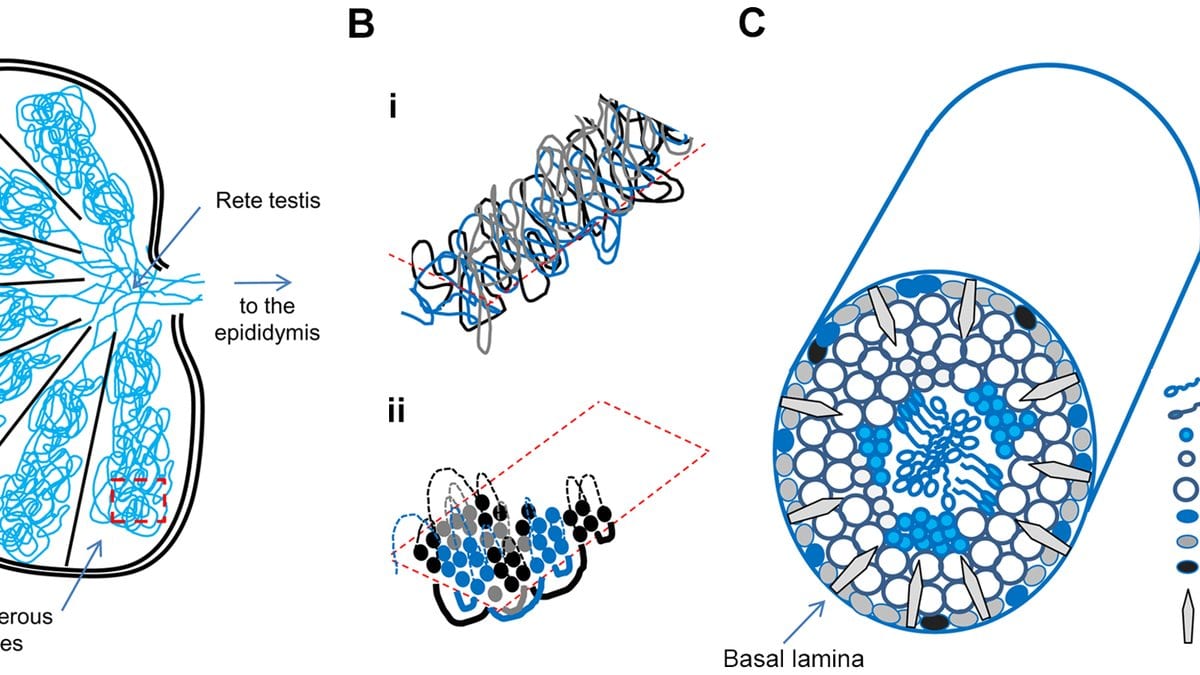
Left there, the human cells organised themselves. They formed tubular structures resembling the seminiferous tubules of a testis, the tightly coiled tubes where, in a real body, sperm are made. And roughly six months later, some of those cells had matured into spermatogonia.
That word is doing a lot of quiet work, so it is worth being precise about it. Spermatogonia are the stem cells of the male germ line: the reservoir that sits along the wall of each tubule and, in a functioning testis, divides and differentiates through a long relay of stages before anything resembling a swimming sperm appears. Reaching the spermatogonia stage means the cells have committed convincingly to becoming sperm-making machinery. It does not mean they have become sperm. In this experiment, development stopped there. No mature, motile sperm were produced, and nothing was fertilised.
That ceiling is the honest centre of the story. For decades, biologists have been able to run the equivalent process in mice more or less to completion, coaxing stem cells all the way to functional sperm that yield live pups. Humans have proved far more stubborn. The human germ line takes longer, involves more stages, and has repeatedly stalled in the lab. Getting human cells to self-assemble testis-like architecture and reach the spermatogonia stage, inside a living scaffold rather than a plastic well, is a meaningful advance on that stubbornness. It is also still short of the finish line by a wide margin.
Whelan has been candid about the distance. As the Nature news report on the work put it, the team has "inched closer" (the verb matters), and the researchers describe the results as a long way from any clinical application. That framing is not false modesty. It is a fair reading of a proof-of-concept: a demonstration that a difficult thing is possible in principle, not a treatment that is nearly ready for a clinic.
Why chase it at all, given how far off the payoff is? The motivation is a specific and underserved kind of infertility. Some men (including boys who survive childhood cancer, whose treatment can wipe out the sperm-forming cells before puberty ever sets them working) cannot produce sperm at all. For them, today's assisted-reproduction toolkit has little to offer, because that toolkit assumes there is at least some sperm to work with. A route from a patient's own stem cells to functional germ cells would, in theory, change that. "In theory" is the operative caveat, and it will remain so until the later stages of sperm development can be reproduced and (a separate and formidable hurdle) the resulting cells are shown to be genetically and epigenetically sound.
There are reasons for restraint beyond the biology. Any technology that manufactures human germ cells arrives trailing hard ethical and safety questions: whether lab-derived cells carry hidden errors that could be passed to a child, how such work should be regulated, and where the line sits between restoring lost fertility and engineering it. None of those questions is answered by growing spermatogonia on a mouse kidney. They are, rather, the questions this line of research will have to answer before it goes anywhere near a person.
A note on the evidence itself. The underlying study is peer-reviewed, published in Cell Stem Cell, a credible venue in the field. This account draws on Nature's reporting of that paper; the specifics above (the mouse-kidney scaffold, the self-organised tubules, the six-month spermatogonia result) are as described there. As with any single early result, the real test is replication and, eventually, whether the cells can be pushed past the immature stage where they currently stall.
So: a genuine step, honestly reported by the people who took it. Not a cure, not lab-grown sperm, and not, whatever the headlines suggest, close to a clinic. Just a difficult process nudged one stage further than before. In a field that has spent years stuck, that is enough to be worth reporting plainly.
Sources
- www.nature.comPeer-reviewed
Medical Disclaimer: This content is provided for general informational and educational purposes only. It is not medical advice and should not be used as a substitute for professional medical advice, diagnosis, or treatment. Always consult a qualified healthcare professional regarding any medical condition, concern, symptom, or treatment decision.