Bats Arrived Late to a Jurassic Forest Already Singing in Ultrasound

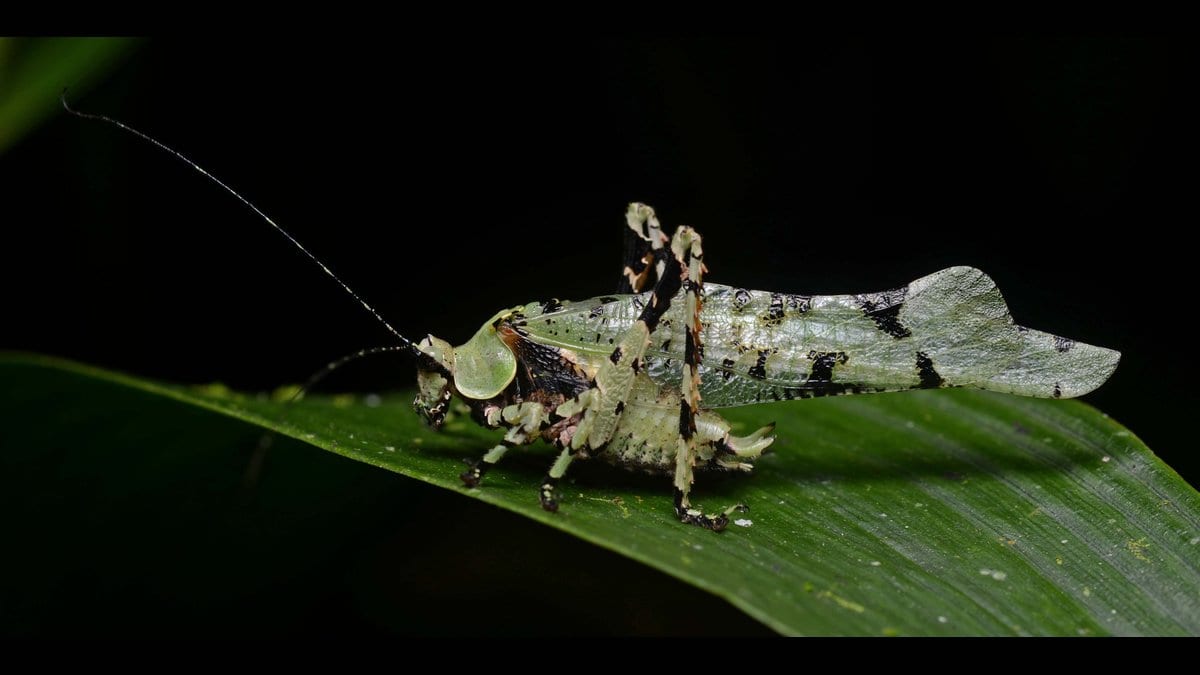
In a humid forest of conifers and ferns, in what is now Inner Mongolia, the loudest thing in the undergrowth may have been an animal no human ear could have picked up. Its song was made by scraping one wing against the other, and it ran above the frequency where human hearing gives out.
That is the reconstruction offered by a study published on Aug. 25 in the Proceedings of the National Academy of Sciences by Jun-Jie Gu of Sichuan Agricultural University and Capital Normal University, Fernando Montealegre-Z of the University of Lincoln and colleagues. They worked from 20 fossil forewings representing nine extinct species of ensiferans, the group that holds today's crickets and katydids, all of them from a single site: the Jiulongshan Formation of Inner Mongolia. The rock there is about 165 million years old.
Fossils are usually silent. "The sounds made by dinosaurs and other charismatic vertebrates are not definitively known because their vocal organs rarely preserve well in fossils," the authors write. Insects are the exception. A male cricket sings by dragging a hardened scraper along a file of teeth on the opposite wing, and both structures are cut from the same tough cuticle that survives in rock. Tooth spacing, file length and wing size are not a recording, but they narrow down what the wing could have done. Such fossils, the paper says, "incorporate a fingerprint of the acoustic signals they generated."
Turning that fingerprint into a sound took several different lines of work at once. The team placed the fossil species on a family tree of living relatives, then measured how those relatives' wings actually vibrate, using laser Doppler vibrometry, which reads motion off a surface without touching it. Numerical simulations extended the same physics to each fossil wing, and machine-learning models trained on wing shape predicted the calling patterns that resulted. No laser was pointed at a fossil: the living insects supplied the physics, the fossils supplied the shapes.
What comes out is not one Jurassic note but a chorus. The nine species differ in pitch and in repertoire, a diversity the authors put down to the shape of the file and the size of the wing. Most sang in pure tones, a narrow, whistle-like signal the paper reads as an adaptation to avoid being located by predators listening in. That is an interpretation of a fossil structure, not an observed behavior. And one species called above 20 kHz. Sci.News, which reported the study, names that species as Sigmaboilus peregrinus and puts most of the others near 5 kHz; neither detail is in the paper's abstract.
Insect ultrasound is usually explained by bats: night hunters that find prey by echolocation, and insects that shifted their own signals to where an eavesdropper has more trouble using them. The timing is the problem. Bats appear in the Eocene, well after these insects were already calling. The conclusion the authors draw is narrower than a reversal. "We here reject the hypothesis that bats were the sole driver of ultrasound evolution in katydids," they write, arguing instead that early mammals and other pre-bat predators were listening in, and that competition for acoustic space between species pushed some songs upward as well. Bats, on this account, "emerged — nearly 100 million years after singing ensiferans — into a soundscape already busy with ultrasounds."
The step the authors describe as having been out of reach is not pitch but timing: the rhythm of a song, which depends on how the whole wing moves rather than on the file alone. Their models produce it, and the paper stops short of calling it settled. "For now, we can only confirm that Jurassic ensiferans were communicating with a broad range of frequencies from low audio to moderate ultrasound," the authors write. Frequency is what the fossils pin down; the rhythm is a reconstruction.
On the ultrasound itself they go further, and they scope the claim as they make it: "We show that ultrasonic communication was likely adopted by katydid ancestors during the Middle Jurassic, some 165 million years ago, the oldest record known for ultrasound communication in animals."
Some of the same researchers have worked this seam before. In 2012 an overlapping team reconstructed a single Jurassic katydid, Archaboilus musicus, as a producer of low-pitched musical calls. That study is cited by this one and is a different piece of work: one species at one frequency, whereas this paper takes on a whole assemblage.
The paper is peer-reviewed and open access under a CC BY license, so anyone can read the full argument and the wing measurements behind it. What it offers is a chain of inference (morphology to resonance to song, calibrated on living animals) rather than a recording, and the authors are explicit about which link in it is firm. Their larger suggestion is the one that will take longest to test: that insect song and early mammalian hearing were shaping each other in the Middle Jurassic, tens of millions of years before any bat. On the mammal side, that case rests on hearing thresholds inferred from fossil bones, not on anything that sang back.