Burying Beetles Rebuild a Corpse Before Their Eggs Hatch, and It Puts Rivals Off

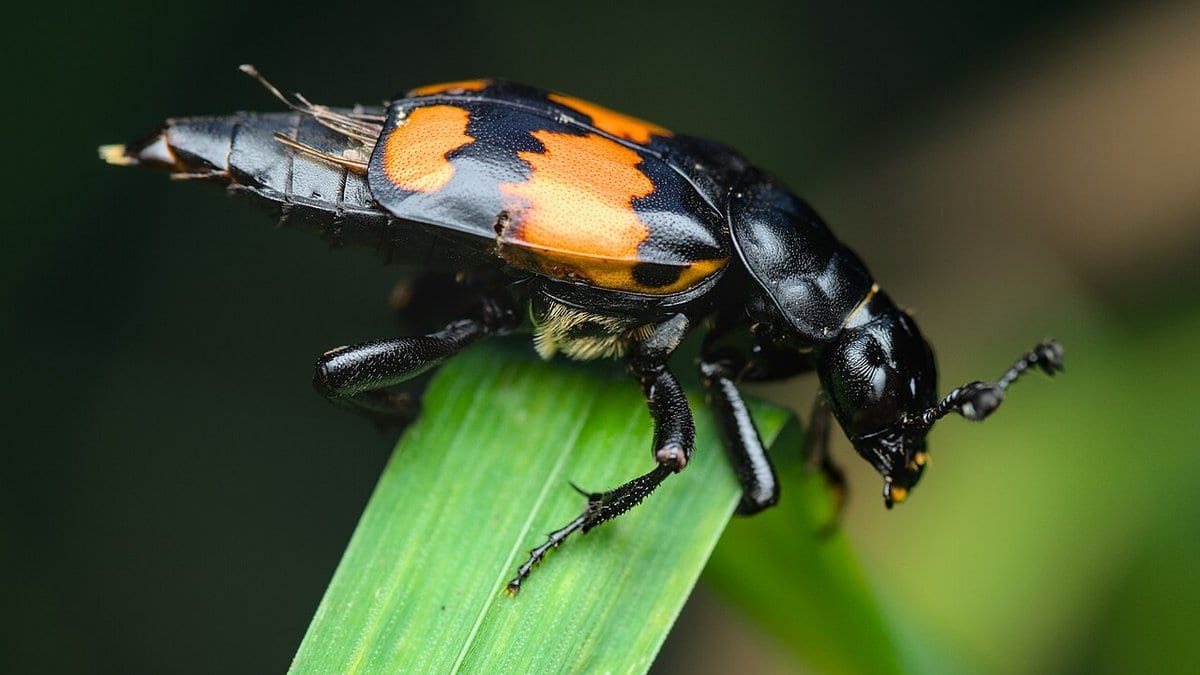
A mouse dies in the leaf litter of a northern European wood, and within a few hours a pair of burying beetles has found it. They work through the night. The two of them drag the body down into the soil, strip away its fur, work it into a rough ball and coat it in fluids of their own. Only then does the female lay. Her eggs go into the soil a short distance off, and the larvae that hatch some days later crawl toward a corpse that no longer smells much like the animal it came from.
Entomologists have described that routine for decades, down to the antimicrobial chemistry of the fluids the pair applies. What has been harder to pin down is what the whole performance buys, and whether the larvae would be any worse off without it. A study published on Aug. 26 in the Proceedings of the National Academy of Sciences pulls the preparation apart under conditions closer to a real burial than to a clean dish: soil carrying its own microbes, and rival beetles free to come looking for an easy meal. Eric Grubmüller, Sandra Steiger and colleagues at the University of Bayreuth, working with a collaborator at Kyoto University, report that the work parents do before hatching does at least three separable things.
The first is the plainest: under those natural microbial and competitive conditions, prehatch care improved both larval survival and larval growth.
The second involves smell. A dead animal advertises itself to everything that eats dead animals, burying beetles included, and a pair that has buried one has to hold it against rivals. Preparation changed the mix of volatile compounds coming off the carcass, and it made the carcass less attractive to competitors.
The third is about microbes, and it is the result with the widest reach. Soil type shaped the community of microbes that grew on a carcass: different ground, different colonists, different odds for whatever is trying to develop on it. Parental care flattened that difference. Prepared carcasses carried a more consistent microbiome whatever soil they were buried in, and fewer larvae died of causes the environment had introduced.
That the beetles manage microbes at all is established. A 2018 study in the same journal found that their symbionts form a biofilm-like layer over a carcass, holding back the putrefaction chemistry that would otherwise spoil it, and that the layer matters for how well larvae develop. What the Bayreuth group adds is that the effect survives contact with real soil, and that a good part of its value lies in evening out the luck of where a body happens to fall.
The comparison the team built around those results is the part that reaches furthest. Ptomascopus morio is a carrion beetle of the same subfamily but a different genus, and its parents do no prehatch preparation at all. Its larvae did equally well on a prepared carcass and on an untouched one. Nicrophorus vespilloides larvae did not: on an unmodified carcass, their survival was reduced. Reduced, not abolished, and by how much is again missing from the public record.
The authors put a careful sentence on that contrast. It is, they write, consistent with the hypothesis that Nicrophorus vespilloides larvae have evolved a reliance on a developmental environment their parents construct. That is support for the idea and not a demonstration of it: two genera differ in many ways besides parental care, and one pairing cannot separate them. The idea itself is developmental niche construction, the argument that what one generation hands the next includes the conditions it leaves behind, not only its genes. A remade mouse is an unusually literal version of that inheritance.
Where it gets interesting is what such an inheritance can do over time. If parents reliably supply a particular environment, selection on the young has less reason to preserve the means of coping without it, and the authors say their findings may promote evolutionary feedback leading to greater dependence on care. Burying beetles are a reasonable place to look for that, because the group already spans the range: across Nicrophorus species, larvae run from managing on their own to depending on care completely.
The beetles are not doing any of this deliberately. The pair that buried the mouse will stay on after the eggs hatch, feeding the larvae mouth to mouth for days, which is the part of burying-beetle life that gets photographed. What this study argues is that by the time there is a larva to feed, a good deal of what decides how it fares has already been done, in the dark, to a body, by two parents that have not yet met it.