How to Tell a Buried Ocean From a Lake: Read What Is Still Alive in It

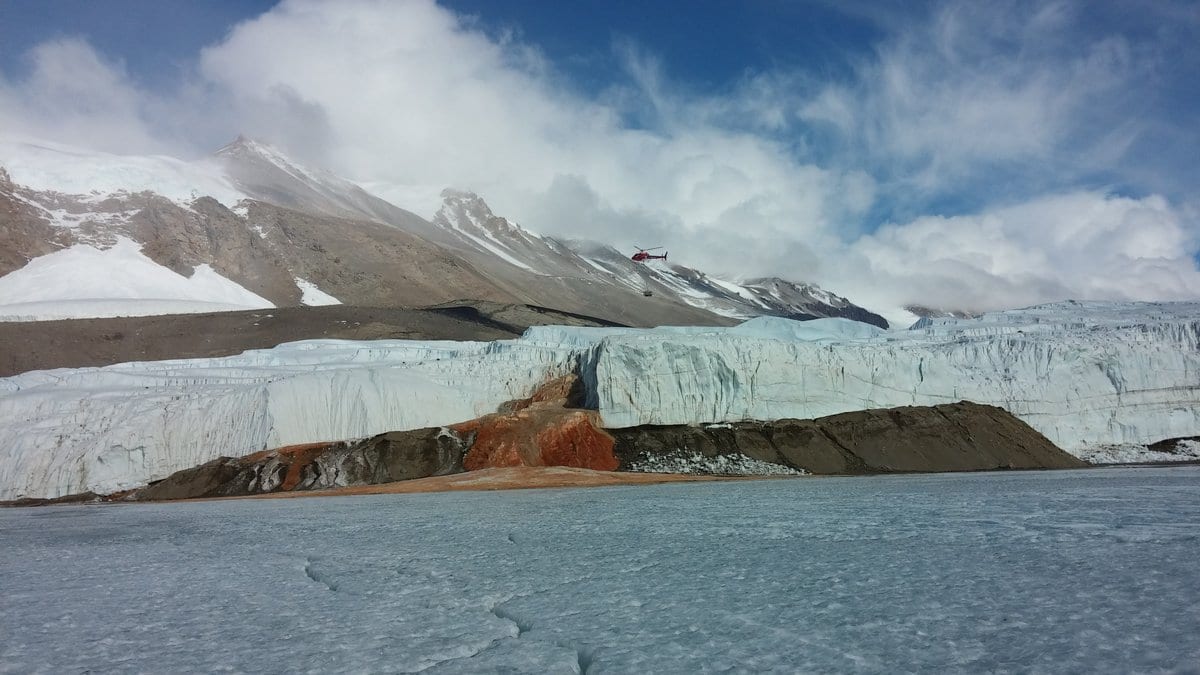
You cannot drill into the thing you want to study. The brine that feeds Blood Falls sits somewhere under hundreds of meters of Taylor Glacier, and what reaches the surface is an intermittent iron-rich seep that stains the ice red. Everything anyone knows about that reservoir has to be inferred from what leaks out of it. And the inference is harder than it looks, because Antarctica is windy. Diatom shells travel for hundreds of kilometers on the wind, dead cells leave DNA behind, and a sample of frozen mud full of marine-looking organisms proves almost nothing on its own.
So a team led by Angela Zoumplis, with Andrew E. Allen of the Scripps Institution of Oceanography and the J. Craig Venter Institute as last author, built the inference out of three independent tests rather than one. Their results appeared in Nature Geoscience on August 3, 2026, with Jill A. Mikucki and Diane M. McKnight, who have worked the Taylor Glacier brine and the Dry Valleys for decades, among the co-authors. The paper spent nearly four years in review; it was received in September 2022 and accepted in June 2026.
The first test is the sampling design, and it carries more weight than it appears to. The team collected 167 samples: water, sediment, and aeolian material, which is to say the dust that blows across the valleys and settles on everything. Those wind samples are not padding. They are the control for the most obvious rival explanation, which is that marine microbes at the glacier's snout got there recently, by air. The set also reached out to marine reference sites, so the ocean's own community could be compared directly rather than assumed.
The first question was simply who lives where. Sequencing the single-celled eukaryotes across the whole set turned up a distinct marine assemblage, with indicator species from four separate groups: diatoms, haptophytes, dinoflagellates and ciliates. What makes that finding usable is not that the organisms are marine but where they are. The assemblage was restricted to the red-hued ice, mud and sediment at the Taylor Glacier terminus, and it did not show up in the rest of the Dry Valleys. Reporting of the study puts the overlap with ocean samples at 9.34% of eukaryotic taxa at the terminus, against 1.15% elsewhere in the valleys; those figures sit in the results rather than the abstract.
The second test is where the RNA comes in, and it answers a different question. DNA is durable. It survives the death of the cell that carried it, which means a DNA survey tells you what has passed through a place, not what is living there now. Messenger RNA is the opposite: it is made continuously by cells that are working and degrades quickly when they stop. Sequencing all of it at once, an approach called metatranscriptomics, returns a snapshot of active metabolism. At the terminus, those profiles showed transcriptionally active phototrophs, with the enriched pathways you would expect of organisms holding on in a cold, salty, iron-loaded film: photosynthesis, osmotic stress responses, and cellular repair. The community is not a fossil assemblage. It is running.
The third test is the one that does the historical work. Within a single species of diatom there are small variations in sequence, called haplotypes, and populations that keep exchanging members keep their haplotypes mixed. Populations that stop exchanging drift apart. The team built haplotype networks for diatoms from the Taylor Glacier terminus and compared them with the same lineages in McMurdo Sound, the nearest open ocean. The two sets had diverged along their own separate lines. That is the pattern isolation predicts and the pattern wind cannot fake: cells blown in from the coast last season would carry the coast's current haplotypes, not their own.
Stack the three and the argument closes. A marine community that is confined to the seep, metabolically active, and genetically divergent from its nearest ocean relatives is not a contamination artifact. The paper's conclusion is stated carefully: the subglacial brine-fed system at the terminus retains marine-derived biological signatures long after physical separation from the ocean. As for how the separation happened, the study leans on the geology already established for the site. Seawater flooded Taylor Valley during warm climatic intervals, and the brine was then sealed in beneath the advancing glacier.
Nobody sampled the reservoir. What was sampled is the ice, mud and sediment at the terminus, which is to say the outflow, and the community described here is the community that survives in that outflow. Allen's own framing is that the periodic escape of brine creates a habitat where marine microbes can persist, and he has described the site as effectively a marine oasis in a polar desert, more than 20 miles from the ocean. Whether the sealed brine below holds the same organisms in the same proportions is a separate question, and it needs a drill.
The icy-moon comparison will come up, and it deserves care. Blood Falls has been discussed as an accessible analogue for the buried oceans of Europa and Enceladus for well over a decade, including by Mikucki herself, and none of that framing appears in this paper's abstract. What the new work adds to it is method rather than conclusion. If a spacecraft ever samples what leaks from an ice shell elsewhere in the solar system, it will face the same three questions: where exactly does this community sit, is any of it alive, and has it been cut off long enough to have changed.
The evidence is one peer-reviewed study, and a slow one: nearly four years from submission to acceptance, which in a field this small usually means the reviewers asked for more. There is no replication. The molecular result does not stand alone, though, because the marine-origin hypothesis already had independent geochemical and isotopic support, which the paper acknowledges; what has changed is that a completely different kind of evidence now points the same way. The full text is not openly reachable, so the percentages quoted above are read from reporting of the paper rather than from the paper itself.
Allen has said he would like to know what these lineages are doing with all the iron around them. Answering that means going back with different sequencing and, eventually, going through the ice.
Sources
- Nature GeosciencePeer-reviewed