A Swallowed Planet Could Explain Two Long-Standing Puzzles About the Sun
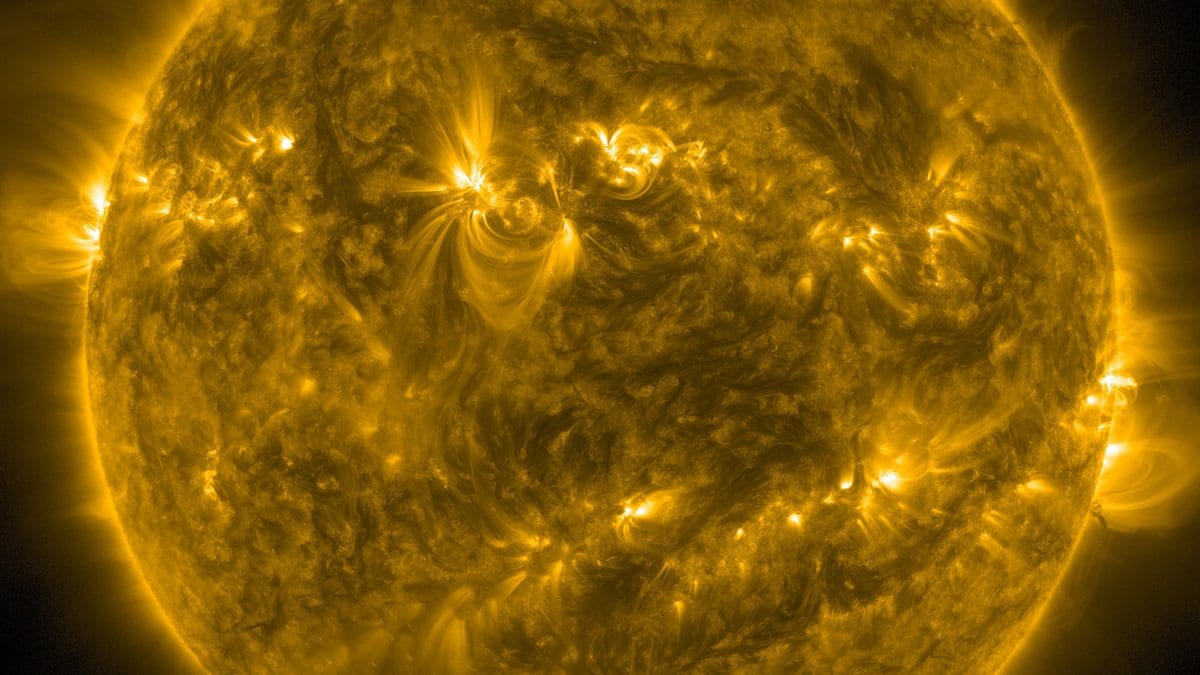
Stellar evolution models in which the young Sun swallowed a rocky planet about five times the mass of Earth match measurements of the Sun's interior better than standard solar models do, Mutlu Yıldız of Ege University in İzmir, Turkey, reports in Monthly Notices of the Royal Astronomical Society. The result comes from modeling, not from an observation of a lost planet.
Solar models disagree with the Sun itself in two ways. The speed of sound inside it and the depth of its churning outer layer, both measured from vibrations of the solar surface, differ from what models predict, and the surface holds far less lithium than they call for. The study, published Sept. 10, asks whether one event early in the Sun's life explains both.
Yıldız modeled a young Sun taking in metal-rich material standing in for a swallowed planet, then metal-poor gas from its planet-forming disk, using the stellar evolution code mesa. The best-fitting model favors a planet of about 5.6 Earth masses, with related models favoring 5 to 10. The Sun's missing lithium is reproduced if the swallowed planet was itself lithium-poor and weighed between 4.6 and 5.8 Earth masses.
In the models, the dissolved material settles just below that churning layer, leaving a band enriched in heavy elements that changes how the interior absorbs radiation and how its layers sit. Helioseismology, the reading of the Sun's surface vibrations, could go looking for that change.
Control models without a swallowed planet, tuned instead with adjustable mixing, improved the agreement only partly. A Bayesian Information Criterion test, which penalizes a model for having more adjustable parts, indicates the improvement is not explained by that flexibility alone.
The paper also checks whether such a planet could survive the plunge: from calculations of tidal breakup, structure under pressure and aerodynamic drag, it finds a compact rocky planet could cross the Sun's outer envelope losing almost no mass, which Yıldız calls independent support for the scenario. Thousands of known planets orbiting close to their stars suggest such engulfments may be common. The paper is open access.
Sources
- Monthly Notices of the Royal Astronomical SocietyPeer-reviewed