Simulations Reproduce the Fading Flares of Stars That Survive a Black Hole
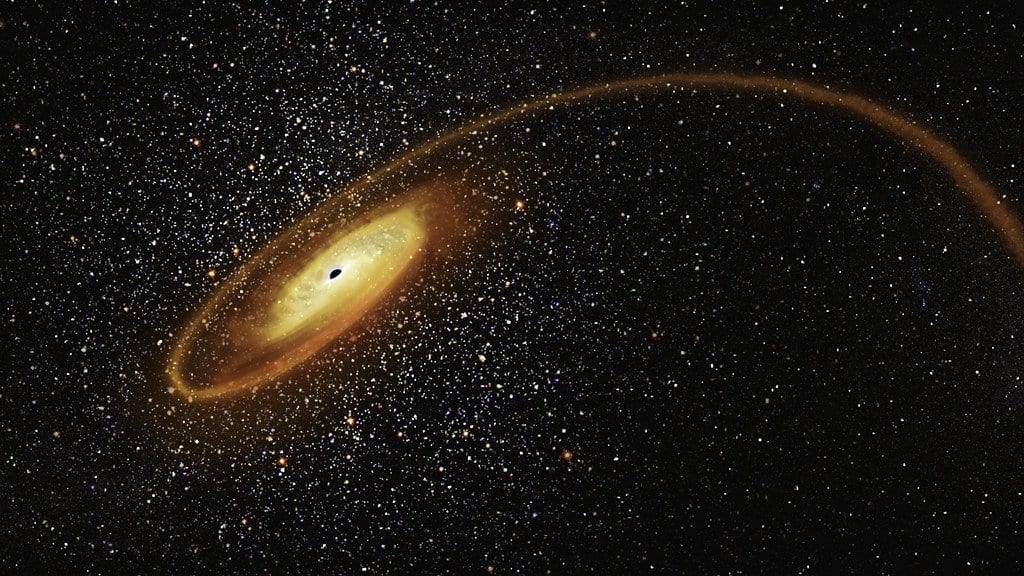
Simulations of a star repeatedly stripped by a supermassive black hole reproduce a pattern astronomers have observed but models had not, provided the star was already spinning rapidly before its first close pass. The study, by Ananya Bandopadhyay of Syracuse University and five co-authors, was published Aug. 18 in The Astrophysical Journal.
The pattern is a fading one. In a repeating partial tidal disruption event, a star passes close enough to a supermassive black hole to lose part of its mass without being destroyed, and the debris falling back lights up as a flare, with the passes months to years apart. Of the roughly 10 repeating systems identified so far, four have flared progressively more faintly.
Earlier models did not produce that fading. Previous work indicated that each pass physically twists the surviving star and spins it up, meaning the shrinking amount of stripped material returns over a shorter time and the predicted flare stays about as bright.
The new models follow main-sequence stars of at least one solar mass, repeatedly and partially disrupted by a black hole of a million solar masses. Successively dimmer outbursts occur for stars already spinning at tens of percent of their breakup speed in the same direction as their orbit. That rotational head start keeps the black hole from spinning the star up much further.
The initial spin is connected to how such a star reaches so tight an orbit. Under the Hills mechanism, a black hole tears apart a close pair of stars, ejecting one and capturing the other; in a tight enough binary, the two are tidally locked and already turning quickly. The new results provide strong indirect evidence for this mechanism seeding these stars, an inference drawn from the match between simulation and observation rather than from any direct measurement of a star's spin.