A Lumpy Gas Cloud Can Explain Orion's Overlapping Chemical Layers
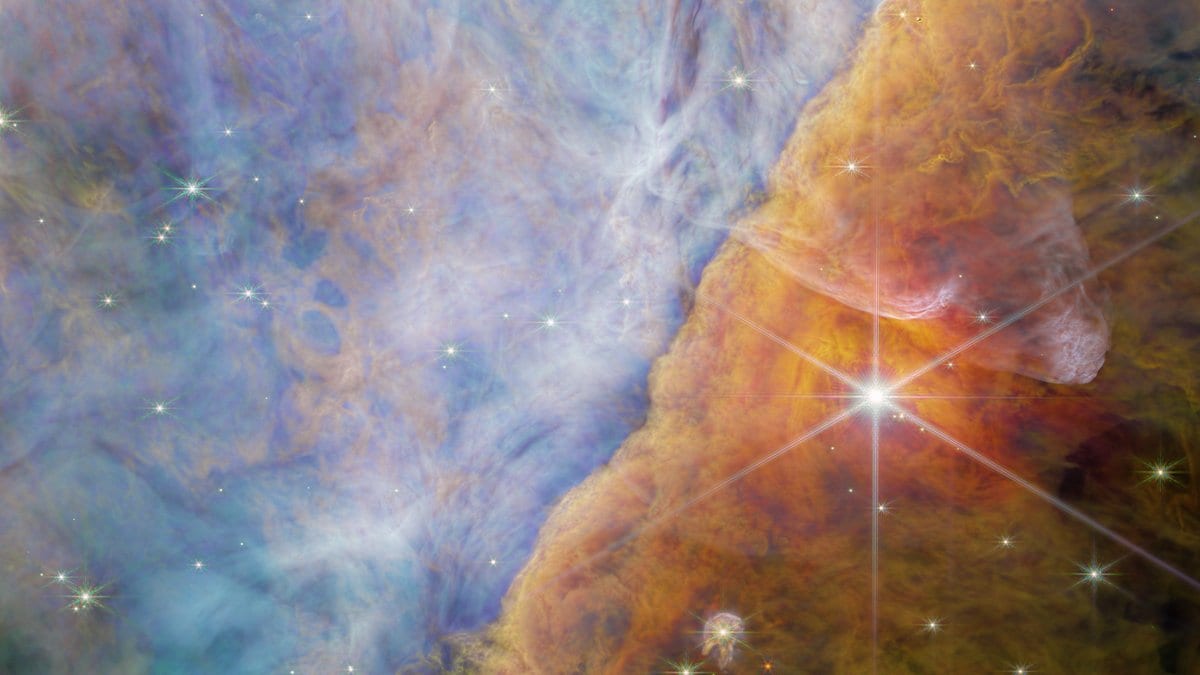
A three-dimensional computer model of a clumpy interstellar cloud reproduces the overlapping chemical boundaries that the ALMA radio array and the James Webb Space Telescope have recorded in the Orion Bar, Brandt A. L. Gaches of the University of Duisburg-Essen and colleagues report in a paper published Oct. 16, 2026, in the journal Astronomy & Astrophysics. The model agrees with those observations; it is not a new measurement of the cloud.
The Orion Bar is the textbook example of a photodissociation region, a cloud edge where ultraviolet starlight breaks molecules apart. The authors write in their paper that its nearly edge-on view from Earth opens a unique window on the shift from atoms to molecules in interstellar gas, and that its photochemistry has to be understood to interpret observations of similar dense regions.
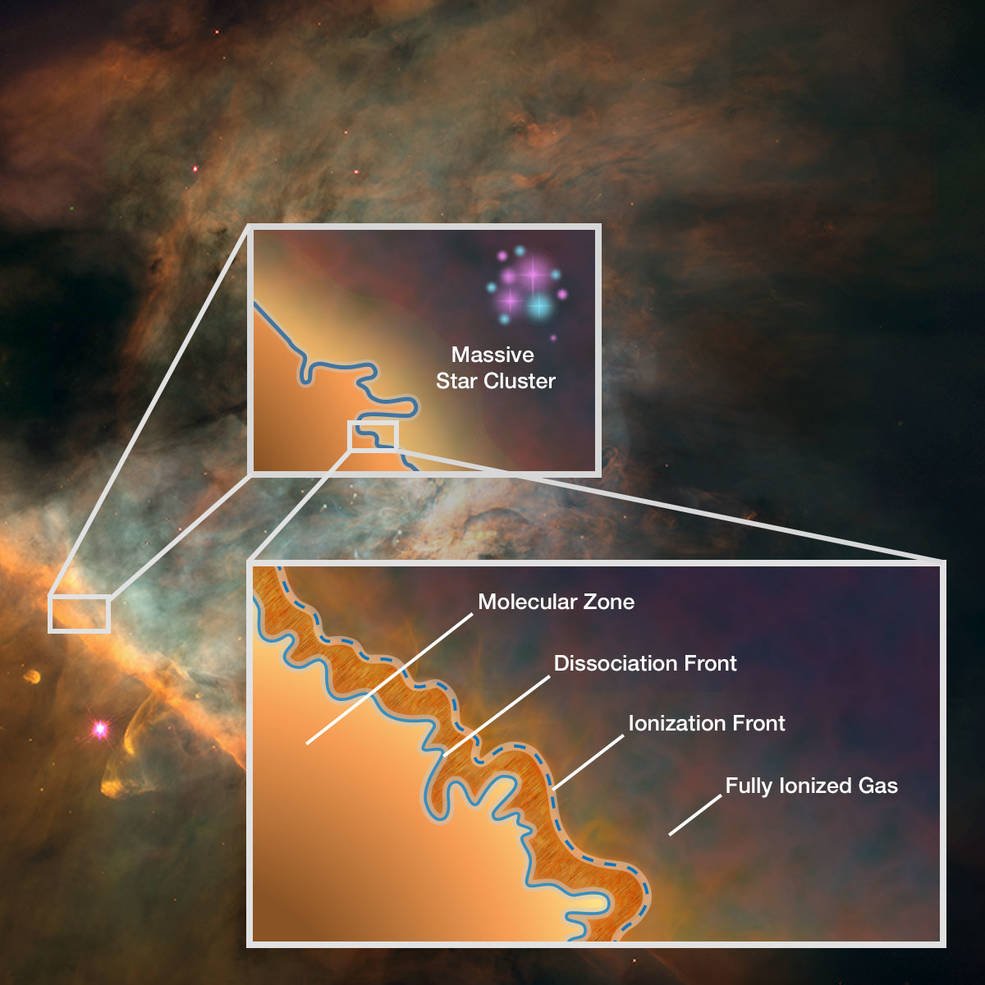
Models of these regions have generally relied on simplified geometry, and the authors report that such approaches struggle to reproduce the emission structure telescopes actually see. Theirs follows the chemistry through a realistic three-dimensional distribution of gas, using an upgraded steady-state code called 3D-PDR that treats the starlight as arriving in a flat front and tracks the energy levels of molecular hydrogen without assuming they have reached thermal balance. The group describes the result as the first fully three-dimensional high-resolution model of an Orion Bar analog that resolves the chemical fronts in question.
In the model, the hydrogen dissociation front, the surface where that starlight splits hydrogen molecules apart, forms a complex surface rather than a smooth sheet, and it overlaps the front where ionized carbon recaptures electrons. ALMA and JWST had already shown the two overlapping at their resolutions. The model also reproduces the arc-like and filament-like shapes of hydrogen emission in those observations. The authors attribute both the overlap and those shapes to the three-dimensional structure of the gas, where dense clumps shadow and shield the gas behind them.
The paper appears in Astronomy & Astrophysics volume 714 as article A295, open access under a Creative Commons Attribution license.
Sources
- Astronomy & AstrophysicsPeer-reviewed