Skip to content
See the World Through ScienceA project of ALLATRA
Source: PreprintarXiv1 source

Astronomers Find No Chemical Link Between Stars and the Planets They Host
Space

Republish this story

Our work is licensed under Creative Commons BY-NC 4.0. You may republish this piece for free — with credit to ALLATRA Media and a link to the original, unedited beyond length trims, and not for commercial use.

Read the full license

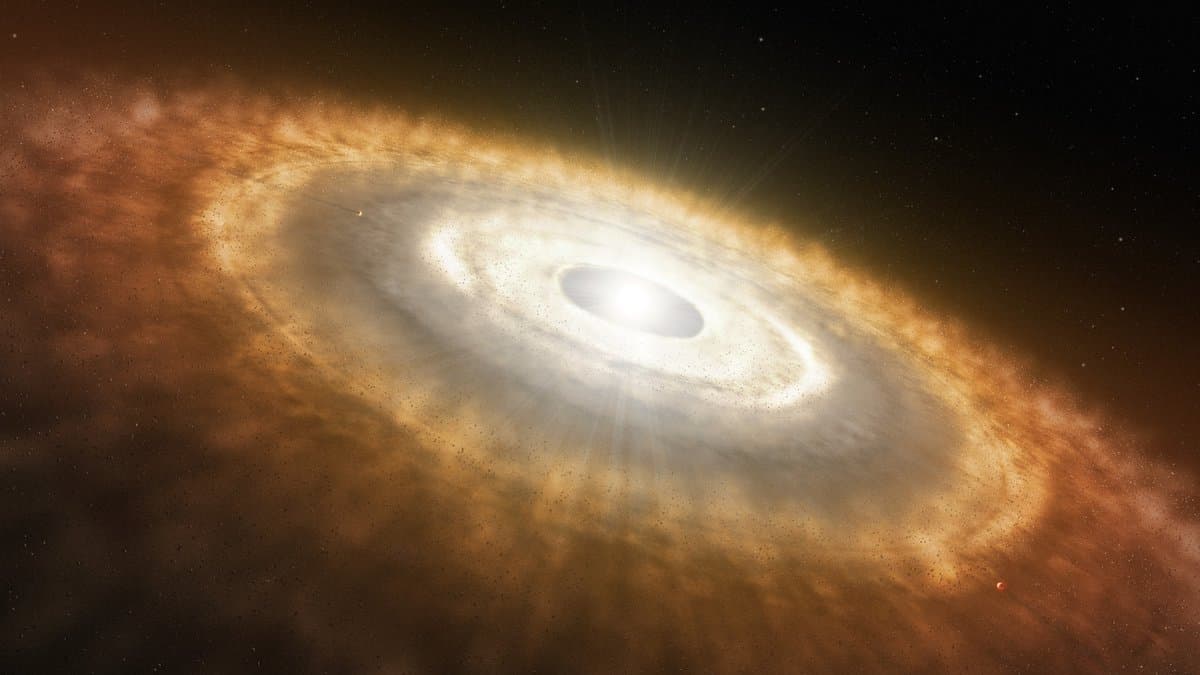
Artist's impression of a young star surrounded by a thick, glowing disk of gas and dust seen almost edge on against a starfield.
A young star still wrapped in the disk of gas and dust its planets form from, the shared material that makes a star's chemistry a stand-in for its planets' interiors (artist's concept; illustrative)."Artist’s Impression of a Baby Star Still Surrounded by a Protoplanetary Disc" by ESO/L. Calçada, via wikimedia, CC-BY-4.0 · CC-BY-4.0

A team led from the University of Birmingham re-analyzed 45 iron-poor stars and the 64 planets orbiting them and found no statistically significant correlation between a star's chemistry and what its planets are made of. The paper, by Daisy A. Turner and colleagues, has been accepted for publication in Monthly Notices of the Royal Astronomical Society and was posted to arXiv on Sept. 15.

Nobody can sample the inside of a planet in another star system, so models work back from the host star. The two form from the same cloud of gas and dust, and the star's surface chemistry stands in for the raw material the planets were built from. The study tests how far that stand-in holds for stars whose chemistry is nothing like the Sun's.

The team picked hosts that are poor in iron, among the most chemically unlike the Sun. Every star and planet in the sample was then measured the same way: how much of each element the star carries, a fresh mass and radius for the planet, and a model of what the planet is made of all the way through. The 64 planets are super-Earths and sub-Neptunes, sizes between Earth and Neptune that the Solar System does not have.
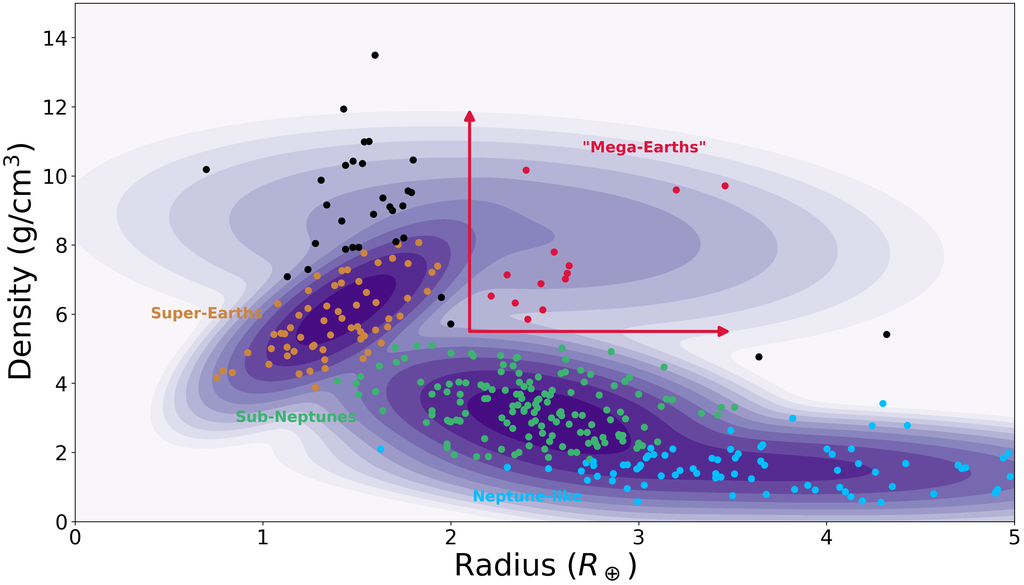
Scatter plot of planet density in grams per cubic centimeter against radius in Earth radii, with super-Earths, sub-Neptunes, Neptunes and mega-Earths marked as separate colored groups.
Planet density plotted against radius, with super-Earths and sub-Neptunes falling in separate groups. A planet's measured mass and radius are what a model of its interior is built from (illustrative). — "Mega-Earth radius-density plot 2026" by Maxwell A. Kroft et al. (2026), via wikimedia, CC-BY-4.0

The authors say the result is not proof that no relation exists. The finding is driven mainly by the large uncertainties on both sides of the comparison, which may be hiding a real relationship, and measuring those uncertainties properly is a step earlier studies have not fully addressed.

A relation is expected on physical grounds, and the paper points to the Solar System, where Earth, Venus and Mars all have magnesium-to-iron ratios close to the Sun's.

Even with sharper measurements a relation may show up only once other factors are brought into the comparison, such as how hot the planet is.

Sources

Spot an error?

Spot an error?

Report an error

Spotted a mistake on this page? Tell us what's wrong and our editors will take a look.

What kind of problem?

Only if you'd like us to be able to follow up. We won't use it for anything else.

We correct mistakes openly. Select any text to flag it. Fixes are logged under our Corrections Policy.

Report an error

Reporting on

Astronomers Find No Chemical Link Between Stars and the Planets They Host

What kind of problem?

Only if you'd like us to be able to follow up. We won't use it for anything else.

We read every report. Corrections are logged publicly.