Swift Will Stay on Its Decaying Orbit After LINK Runs Into Trouble
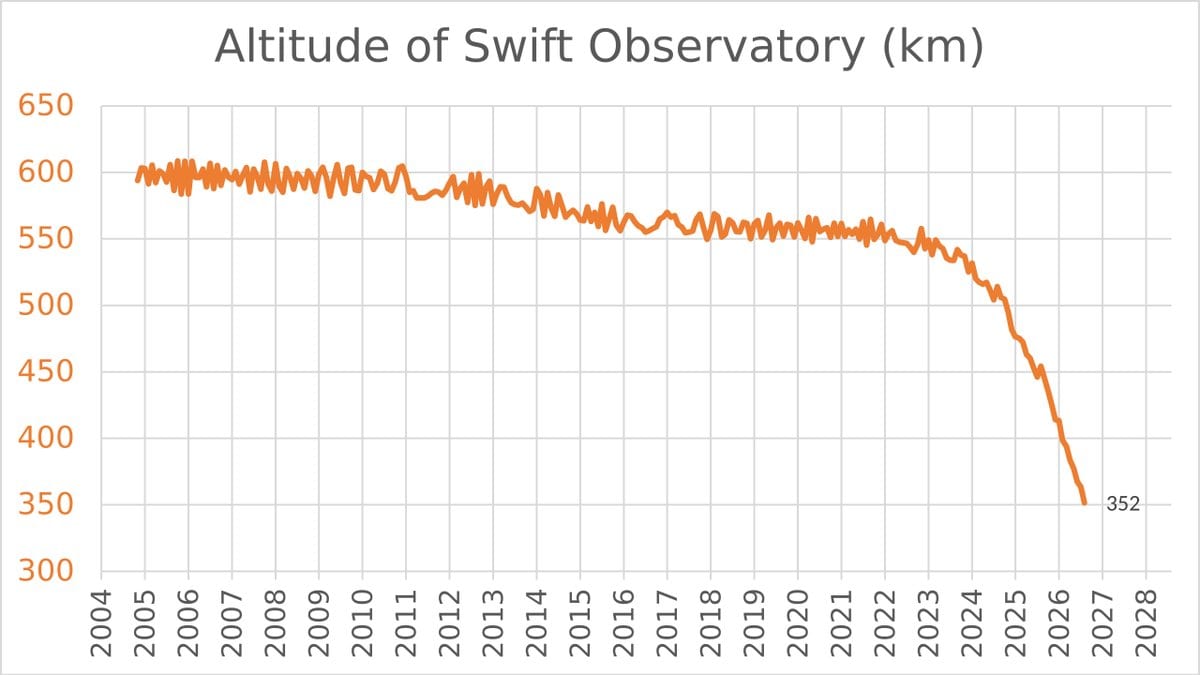
NASA and Katalyst Space will not attempt to raise the orbit of NASA's Neil Gehrels Swift Observatory, the agency announced Aug. 19, citing an ongoing attitude-control problem on Katalyst's LINK spacecraft. Without a boost, NASA said, it expects Swift to re-enter Earth's atmosphere later this year.
LINK will still try to rendezvous and conduct proximity operations near Swift to demonstrate capabilities for future satellite servicing, according to the release. NASA and Katalyst are "working closely to assess next steps for rendezvous and gather as much data as possible to inform future satellite servicing operations," the agency said.
LINK launched July 3 on a Northrop Grumman Pegasus XL rocket from Kwajalein Atoll in the South Pacific, per NASA. Teams established communications and ran in-orbit checkouts over the following weeks, and the spacecraft then developed the attitude-control problem.
Swift launched in 2004 to study gamma-ray bursts and was built for a two-year prime mission. After 21 years of science operations its low Earth orbit began to decay rapidly because of increased solar activity, NASA said, and the agency awarded Katalyst a contract in September 2025 to mount a robotic servicing mission in less than a year.
"This is not the outcome we were working toward, but it does not change why this mission was worth attempting," NASA Administrator Jared Isaacman said in the release. Shawn Domagal-Goldman, who directs NASA's Astrophysics Division, called it "a high-risk, high-reward mission" and said, "We were all hoping for more science from Swift."
NASA said it will keep looking for new ways to respond quickly to cosmic events as part of its earlier planning for Swift's end of life, using current missions to fill the gap in the meantime. Updates on the rendezvous attempt are being posted to NASA's Swift blog.