Giant Exoplanets Are Late to Make Methane, JWST Spectra Show
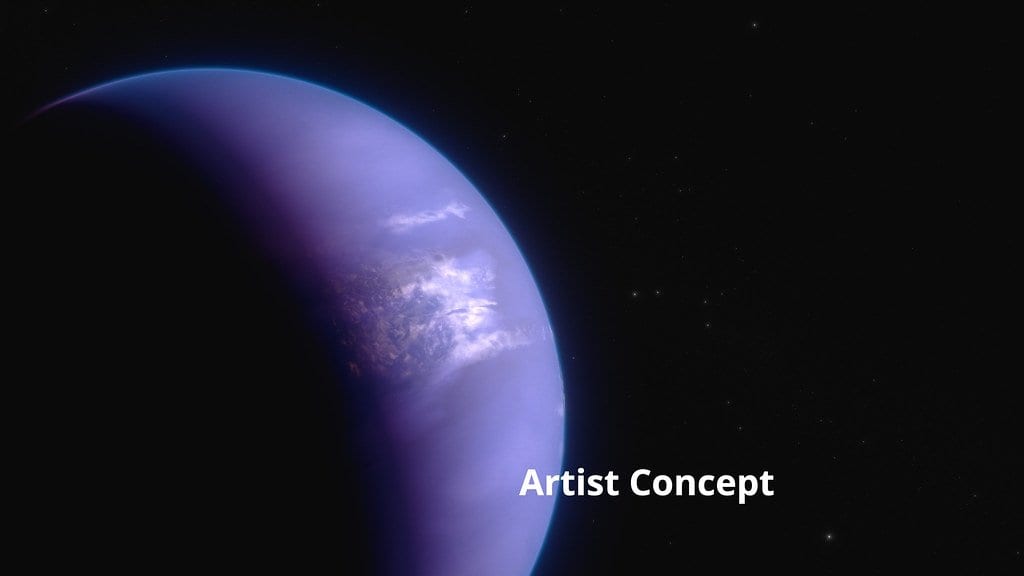
Thirteen transiting giant exoplanets observed by JWST fall on the same color-magnitude sequence as free-floating brown dwarfs at similar temperatures, and the methane expected in the planets' atmospheres appears later than it does in those objects, a team led by Guangwei Fu reports in a paper posted to arXiv on Aug. 26. The paper has been accepted for publication in the Astronomical Journal; the version now public is the preprint.
A color-magnitude diagram plots brightness against color and is how astronomers sort stars and brown dwarfs. Fu and six co-authors compiled JWST dayside emission spectra for the 13 planets, 57 self-luminous substellar objects and one irradiated brown dwarf, spanning roughly 350 to 2,600 K, and then added about 2,150 ultracool dwarfs from SPHEREx. They converted it all to synthetic photometry in two 2MASS near-infrared bands and five NIRCam medium bands chosen to isolate water, methane, carbon dioxide and carbon monoxide.
On the diagram, the transiting planets follow the L-dwarf sequence, the warmer of the two main brown-dwarf classes. WASP-80 b, at an equilibrium temperature near 800 K, shows none of the turn toward bluer color that marks the L-to-T transition in field brown dwarfs, where methane takes over the near-infrared spectrum. The authors write that this suggests a delayed or suppressed transition in irradiated, low-gravity atmospheres.
Their cloudy radiative-convective models point to low surface gravity and heat trapped under high-altitude clouds as pushing the chemistry toward carbon monoxide and away from methane. The sample's one old, high-gravity, strongly irradiated object, the brown dwarf ZTF J0038+2030 B at a dayside temperature of 1,049 K, does show a deep methane band like a field T dwarf's. That contrast, the authors argue, implicates gravity rather than irradiation as the dominant control.
Transiting planets and directly imaged companions also show stronger carbon dioxide absorption relative to carbon monoxide than field brown dwarfs, which the authors call consistent with metallicity enhancement from planetesimal accretion. They describe the sequences as a "unified, model-testable map," and released code, data and an interactive spectrum browser with the paper.
Sources
- arXivPreprint