Simulation Traces the Iron in Tiny Galaxies to the First Stars' Explosions
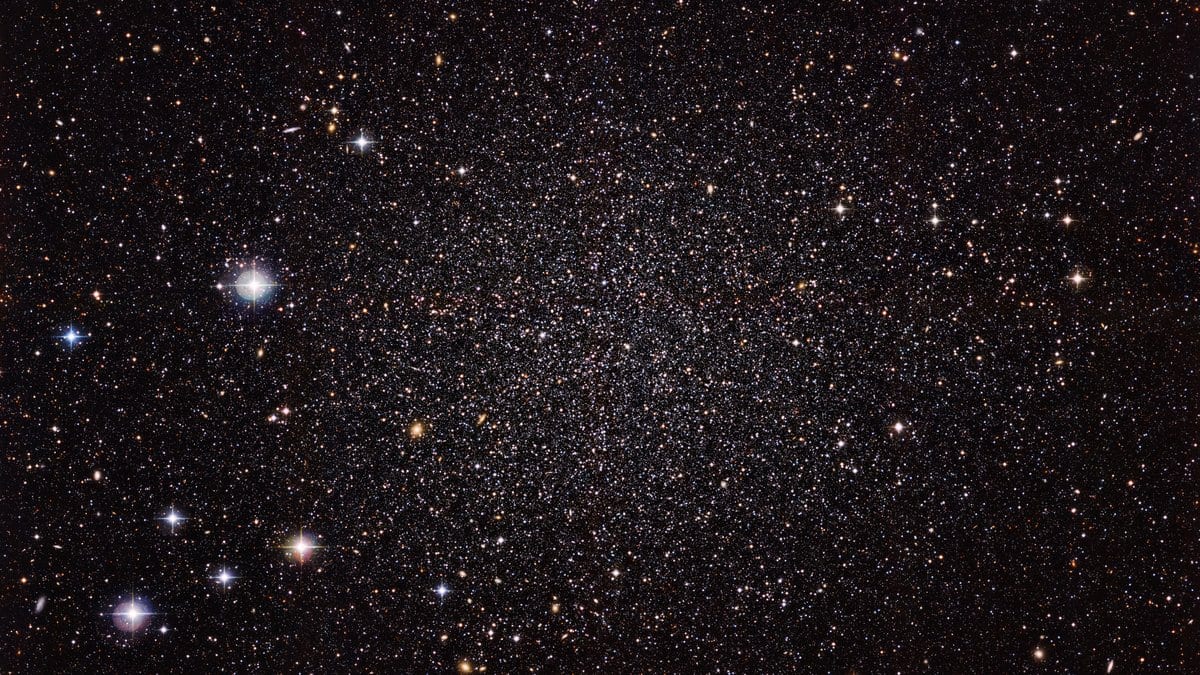
A new cosmological simulation reproduces a pattern astronomers have already measured in the Milky Way's faintest companion galaxies, and its authors attribute that pattern to the explosions of the universe's first stars. It is a proposed explanation for something already observed, not a new measurement.
Martin Rey, Harley Katz and colleagues report the result in The Open Journal of Astrophysics, published Sept. 30, 2026. They set out to explain a flat stretch in the relation between a dwarf galaxy's total stellar mass and how much iron its stars contain. Where a dwarf galaxy's stars total 100,000 solar masses or less, the iron stops falling with mass and settles at a common level roughly 300 times lower than the Sun's, measured against hydrogen. The authors tie that plateau to pair-instability supernovae, explosions among the universe's first generation of stars that destroy a star completely.
The simulations, named MEGATRON, follow galaxy formation up to a redshift of about 8 in a patch of the early universe that ends up as a Milky-Way-like galaxy today. They track both the first generation of stars and their successors, along with the elements they scatter when they die. A strong ultraviolet glow from the galaxy taking shape nearby, known as the Lyman-Werner background, means the first explosions happen only inside clumps of matter of around 10 million solar masses, heavy enough to keep the debris.
The same run makes one prediction the authors have not observed: about 20% of these dwarf galaxies should fall below the plateau, with a thousandth of the Sun's iron or less. Surveys of the small galaxies bound to the Milky Way can test that figure. The authors report that both the plateau and the tail hold up under large changes to their assumptions about how later generations of stars heat and stir their surroundings. Both also survive in the satellite galaxies still orbiting the central galaxy today.
The paper is free to read in The Open Journal of Astrophysics under a CC BY license.
Sources
- The Open Journal of AstrophysicsPeer-reviewed