NASA's Twin Mars Probes Fired Their Engines in a Slingshot Past Earth
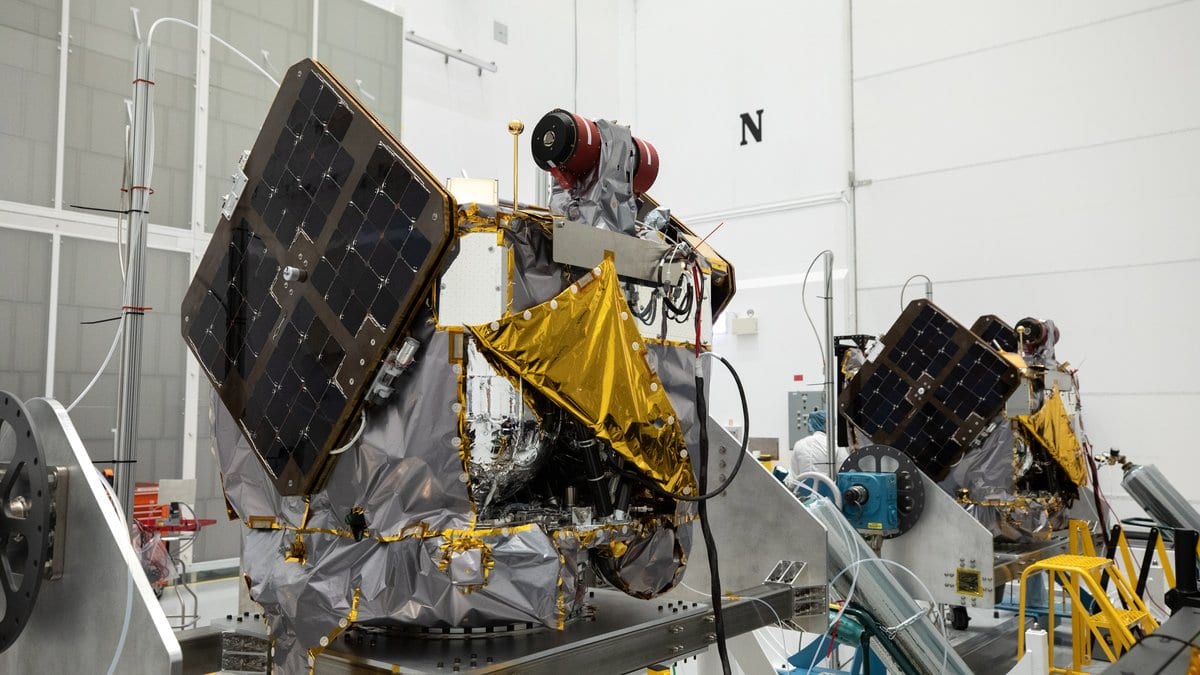
NASA's two ESCAPADE spacecraft have each swung past Earth and fired an engine on the way through, using the planet's gravity together with a sustained burn to throw themselves onto a course for Mars. The agency said the first spacecraft made its close approach on Nov. 7, 2026, about 1,000 miles above the surface, and the second followed two days later, on Nov. 9, 2026, about 650 miles up, with each burn lasting roughly nine minutes.
Most Mars missions launch straight at the planet inside a window that opens only when Earth and Mars are favorably aligned. ESCAPADE launched outside one. "This method provides the flexibility to launch almost anytime and then use Earth's gravity to get a boost to Mars, rather than waiting every two years to launch there directly when the planets are aligned," said Jeff Parker of Advanced Space, the lead mission designer.
In NASA's release on the maneuvers, Asal Naseri, acting associate flight director for the Heliophysics Division at NASA Headquarters, said, "This is the first time NASA has used a powered Earth flyby to propel a spacecraft toward Mars, and we've now executed this maneuver twice, flawlessly, in just two days."
The two spacecraft launched from Cape Canaveral Space Force Station in Florida on Nov. 13, 2025, when Earth and Mars were on opposite sides of the Sun. Instead of heading for Mars, they spent the year looping around Lagrange point 2, a gravitational balancing point about a million miles from Earth, before returning for the flyby.
Both are now on a 10-month cruise, with the burns that will place them in orbit around Mars planned for September 2027. The agency said the pair will then fly in formation to study how the solar wind, the stream of material flowing from the Sun, drives the loss of the Martian atmosphere, and that science operations are expected to begin in June 2028.