Skip to content
See the World Through ScienceA project of ALLATRA
Source: Peer-reviewedAstronomy & Astrophysics2 sources

Radio Telescopes Weigh Two Nearby Stars to Within 0.16%
Space

Republish this story

Our work is licensed under Creative Commons BY-NC 4.0. You may republish this piece for free — with credit to ALLATRA Media and a link to the original, unedited beyond length trims, and not for commercial use.

Read the full license

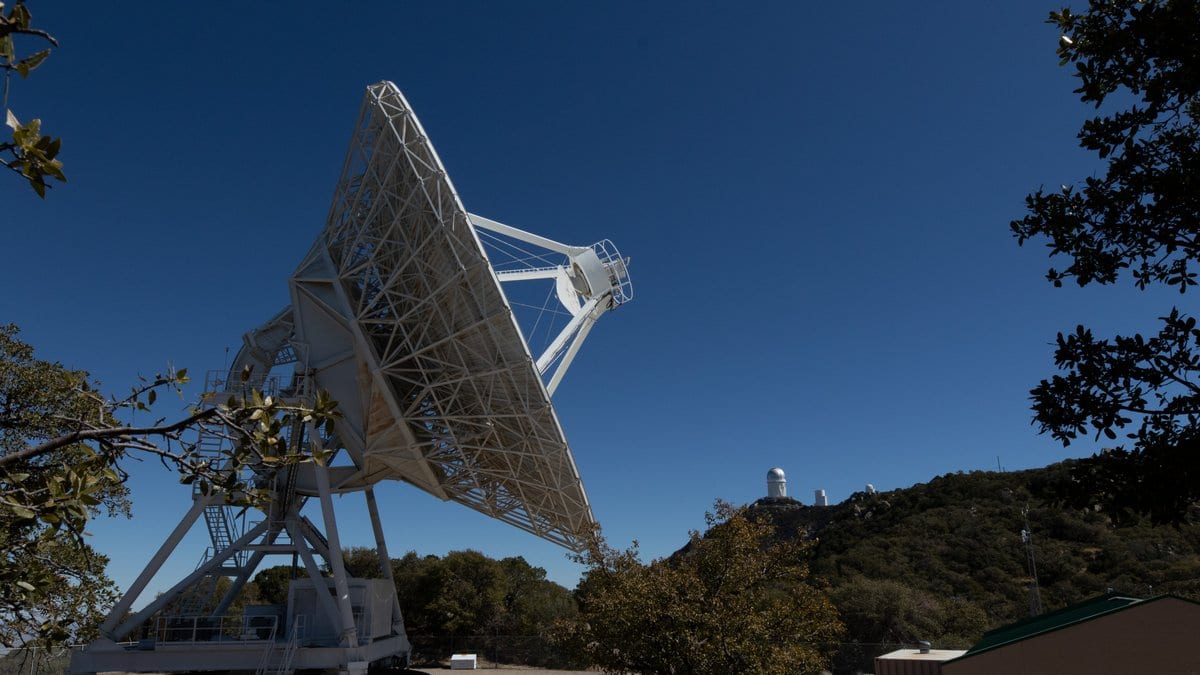
A large white radio telescope dish tilted toward a deep blue sky on a desert mountaintop, with a domed optical observatory on the ridge behind it.
The Kitt Peak station in Arizona is one of ten dishes across the United States that observe together as a single instrument, and sessions with the array from 2007 to 2025 produced the 27 positions behind the DG CVn orbit. Photographed Aug. 23, 2022."Very Long Baseline Array Antenna Side (3S8A8137)" by Kitt Peak National Observatory/NOIRLab/NSF/AURA/P. Marenfeld, via Wikimedia Commons, CC BY 4.0

Astronomers have measured the orbit, distance and masses of DG CVn, a pair of small red stars about 59.3 light-years from Earth, by following each star separately for 18 years with the Very Long Baseline Array. A team led by Paul Boven of the Joint Institute for VLBI ERIC (JIVE) and Leiden Observatory found that both stars give off radio waves strongly enough to track individually, and fixed their masses to a precision of 0.16%.
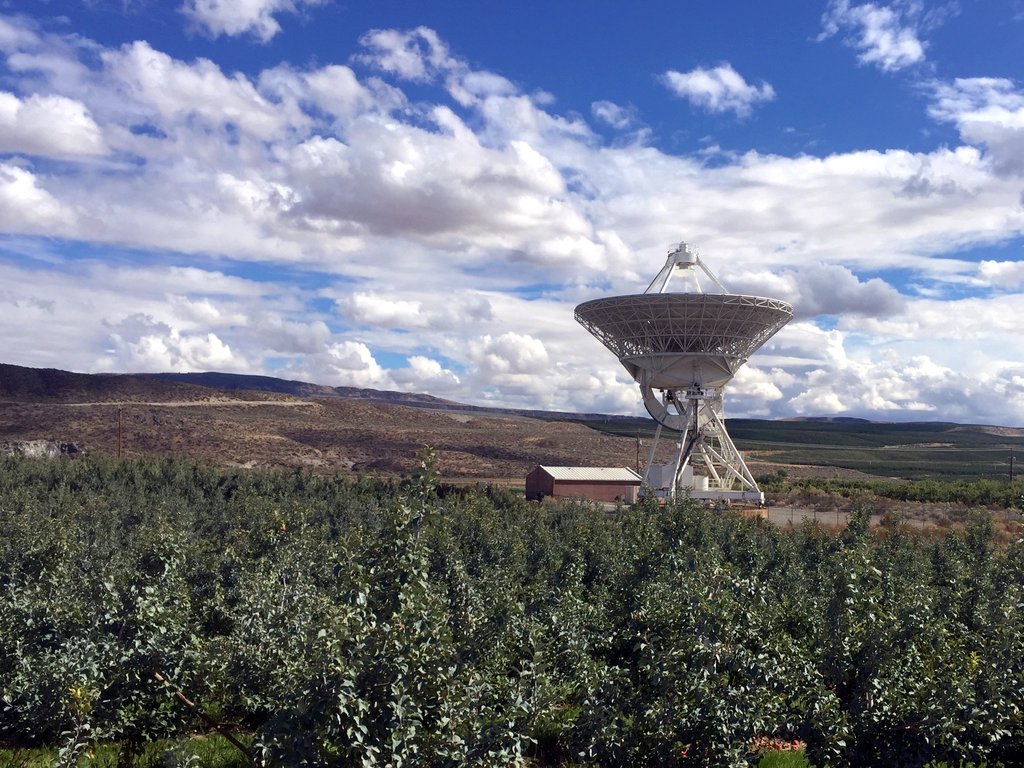
A radio telescope dish standing in a green orchard under a cloudy sky, with dry hills in the distance.
The array's ten dishes run from Hawaii to the Virgin Islands, and this one shares an orchard with the fruit trees of north-central Washington state. That spread is what lets the network pick apart a pair of stars no single telescope resolves. Photographed Sept. 16, 2018. "VLBA antenna in Brewster, Washington 1" by Christopher Thomas, via Wikimedia Commons, CC BY-SA 4.0

The authors say the result shows what can be gained by combining decades-old radio position measurements with recent ones, and that the same approach can look for the slight wobble a planet produces in the star it orbits. Their paper was published Nov. 17, 2026, in Astronomy & Astrophysics.

The work rests on very long baseline interferometry, which links radio telescopes thousands of miles apart so they act as one instrument. The authors report an orbit of 1647.647 ± 0.027 days, a little over four and a half years, and a distance of 18.1851 ± 0.0033 parsecs, set by parallax: the tiny shift in a nearby star's apparent position as Earth travels around the Sun.
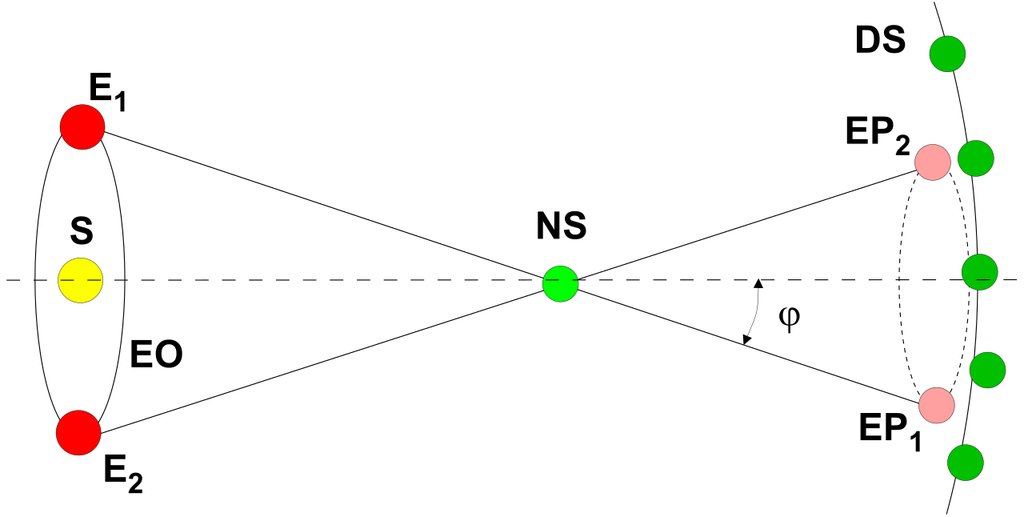
A geometric diagram showing Earth at two opposite points of its orbit, with sight lines to a nearby star crossing and projecting it onto two different positions among distant stars.
Parallax geometry: viewed from opposite sides of Earth's orbit, a nearby star shifts against the more distant background, and the size of that shift gives its distance. Radio tracking placed the pair at 18.19 parsecs, about 59.3 light-years (illustrative). "StellarParallax3" by HHahn, via Wikimedia Commons, CC BY-SA 3.0

The release from the U.S. National Science Foundation National Radio Astronomy Observatory, which operates the array, puts the heavier star at about 39% of the Sun's mass and its companion at about 36%. The system is young, and at least one of the two flares hard enough to brighten in radio after an X-ray outburst, the observatory said.

One of the pair is a complex periodic variable, or CPV: a young, small star whose brightness repeats a pattern of changes nobody has yet explained. The authors report this as the first time masses have been measured from orbital motion for a binary containing such a star. Which of the two stars produces the pattern, and which the flares, is not yet settled, the release said.

The 18-year record combines archival observations from the array and the NSF Green Bank Telescope with new array sessions run between 2023 and 2025.

Sources

Spot an error?

Spot an error?

Report an error

Spotted a mistake on this page? Tell us what's wrong and our editors will take a look.

What kind of problem?

Only if you'd like us to be able to follow up. We won't use it for anything else.

We correct mistakes openly. Select any text to flag it. Fixes are logged under our Corrections Policy.

Report an error

Reporting on

Radio Telescopes Weigh Two Nearby Stars to Within 0.16%

What kind of problem?

Only if you'd like us to be able to follow up. We won't use it for anything else.

We read every report. Corrections are logged publicly.