A Comet's Bare Surface Looks Like an Asteroid's but Does Not Reflect Like One
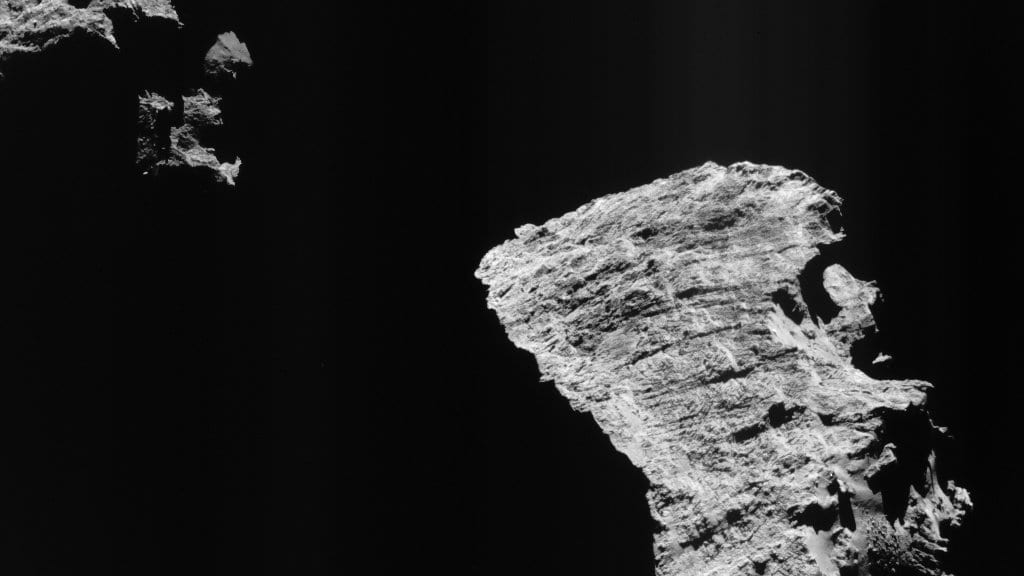
Astronomers have measured the naked surface of comet 28P/Neujmin from more than 10 astronomical units out, and report that it reflects light differently from the asteroids whose color it otherwise matches. The study, led by Takafumi Ootsubo of the University of Occupational and Environmental Health, Japan, was published Aug. 25 in Publications of the Astronomical Society of Japan.
That is more than ten times Earth's distance from the Sun, far enough that a comet's coma, the envelope of gas and dust that normally hides its solid body, largely shuts down. The paper states that at that distance "coma contamination is effectively minimized," which is what allowed the team to measure the nucleus itself.
Using Hyper Suprime-Cam on the 8.2-meter Subaru Telescope in the g, r and y bands, they measured colors of g − r = 0.67 ± 0.17 and r − y = 0.41 ± 0.19. Those yield what the paper reports as a spectral index of 8.8 ± 4.2 percent per 100 nanometers, a measure of how much redder the surface looks at longer wavelengths, and comparable to the value for D-type asteroids, a dark reddish class common in the outer asteroid belt.
The team also caught 28P at a phase angle of 0.334 degrees, meaning almost exactly opposite the Sun as seen from the telescope, and combined that point with earlier observations to derive the nucleus's brightness curve. They confirm an opposition surge, the sharp brightening small bodies show when viewed at near-zero phase angle. The paper is explicit that the size of the surge "depends on the adopted phase coefficient, which is uncertain," but reports that even under conservative assumptions it implies more coherent backscattering, light bouncing between surface grains and returning toward the observer, than C- and D-type asteroids typically show.
The authors read that as a sign that the nucleus's surface microstructure differs from those asteroids even where its color matches, and write that settling the mechanism will need observations spanning a wide range of phase angles in one apparition, plus polarimetric measurements.
Sources
- Publications of the Astronomical Society of JapanPeer-reviewed