A Solar Eruption Forecast to Miss Earth Reached It Anyway
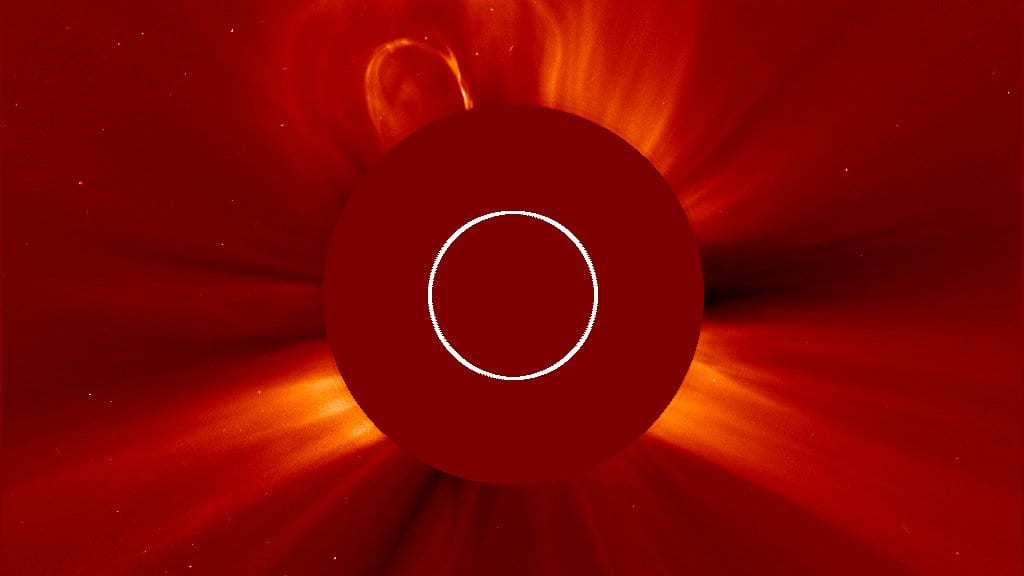
Researchers reconstructed a December 2024 solar eruption from the records of 17 spacecraft across the inner solar system and found a component that traveled toward Earth invisible from the Sun-Earth line and absent from operational forecasts. The study appeared Aug. 19 in Science Advances, from Adrienn Luspay-Kuti of the Johns Hopkins University Applied Physics Laboratory and 30 co-authors.
The detection came from NASA's Europa Clipper, launched Oct. 14, 2024 and bound for Jupiter. On Dec. 19, 2024 it was 1.19 astronomical units from the Sun, outbound toward Mars. A one-hour checkout of its Plasma Instrument for Magnetic Sounding recorded solar wind of about 530 to 570 kilometers per second, thinner and hotter than normal, which was traced back to the wake of a complex coronal mass ejection.
Coronagraph images along the Sun-Earth line showed the eruption heading south, away from Earth. From STEREO-A, about 29 degrees west of that line, it separated into two components, one directed at Earth. "Without that vantage point, the Earth-directed CME could not have been forecasted," the authors write.
Other spacecraft caught the eruption in sequence: BepiColombo near Mercury on Dec. 16, then Wind, ACE and DSCOVR at the first Sun-Earth Lagrange point on Dec. 17. STEREO-A, at a similar distance from the Sun but a different longitude, saw the shock about 25 hours later. Average transit speeds from the corona were calculated at about 840 kilometers per second toward Earth and 534 kilometers per second in the Mercury sector, indicating two lobes, one fast and one slow.
NOAA's Daily Solar Geophysical Activity Report and Forecast did not mention the CME or the filament eruption behind it and a discussion from its Space Weather Prediction Center issued Dec. 15, 2024 described a large, southward-directed CME expected to miss Earth. The Earth-directed component "was neither forecasted nor recognized in operational analyses," the authors write, and they argue such a miss could endanger a crewed mission.
Europa Clipper completed its Mars gravity assist on March 1, 2025 and is due to fly past Earth on Dec. 3, 2026.
Sources
- Science Advances (vol 12, issue 34, eaed9960)Peer-reviewed