84 Faint X-Ray Objects Could Help Catch Supernovas Before They Blow
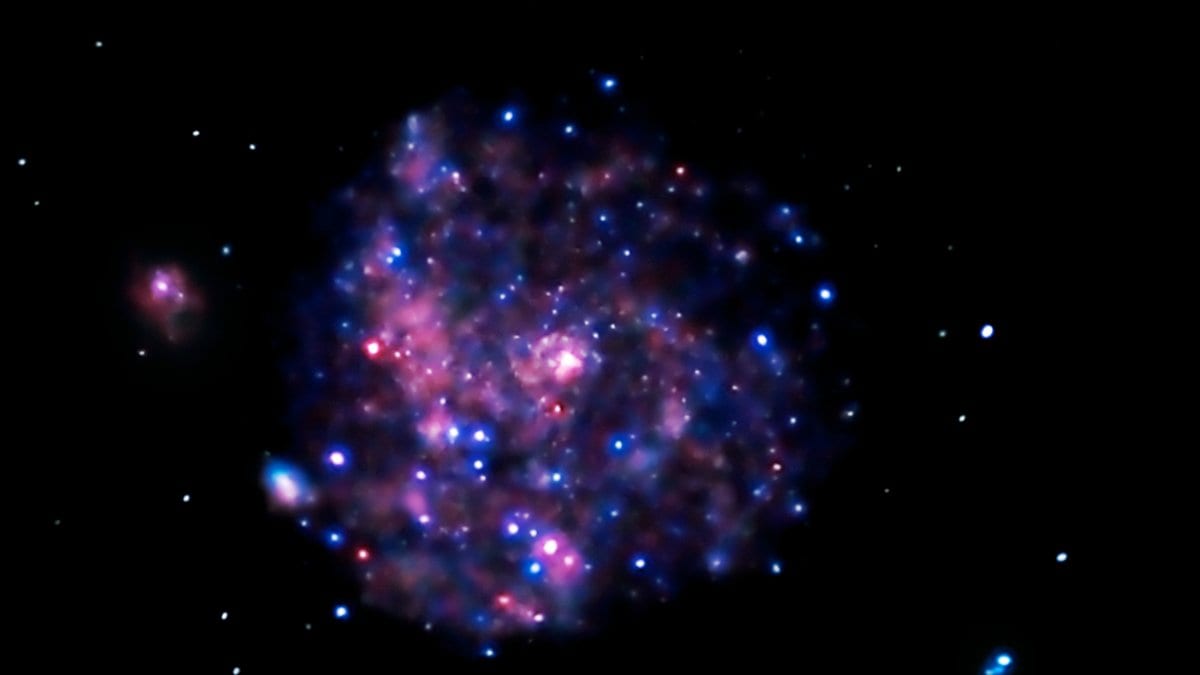
Astronomers combing NASA's public Chandra X-ray Observatory archive have picked out 84 objects in six galaxies that glow in the faintest X-rays and then vanish from images taken at higher energies. What they are is not settled.
The team calls them hypersoft X-ray sources and says they may bear on two long-standing questions. One is what kind of star system blows up as a Type Ia supernova, the stellar explosion astronomers use as a yardstick for the expanding universe. The other is what strips electrons from the gas between stars, a process that affects how fast new stars form. The paper appeared Sept. 9, 2026 in Nature Astronomy.
Mustafa Muhibullah of the University of Alabama led the study. His co-authors are Jimmy Irwin, also at Alabama, and Rosanne Di Stefano of the Center for Astrophysics | Harvard & Smithsonian. NASA's Chandra X-ray Center, which announced the result, said the sources turned up in two spiral galaxies, Andromeda (M31) and the Pinwheel (M101), and in four elliptical galaxies. They appear both where new stars are forming and where the stars are old.
They found the objects by looking for sources that show up in Chandra images at the lowest X-ray energies and drop out at higher ones. Because those X-rays sit next to ultraviolet light on the spectrum, the researchers concluded the sources are pouring out ultraviolet as well. Their leading explanation is a binary: a black hole, neutron star or white dwarf pulling material off a companion star and heating it until it glows in X-rays. Pairs like that are already known, but not with this combination.
Two things had kept the objects out of reach, according to the center's announcement. Low-energy X-rays are very hard for X-ray telescopes to detect at all. The ultraviolet is soaked up by the hydrogen and helium that fill the space between stars. "By combing through the Chandra archive, we were able to eliminate what used to be a blind spot for telescopes," Di Stefano said. The observations the team searched are in the Chandra archive, open to anyone.
Sources
- Nature AstronomyPeer-reviewed
- Chandra X-ray Observatory