A Cloud on Mars Appears to Form With No Dust for Its Ice to Grow On
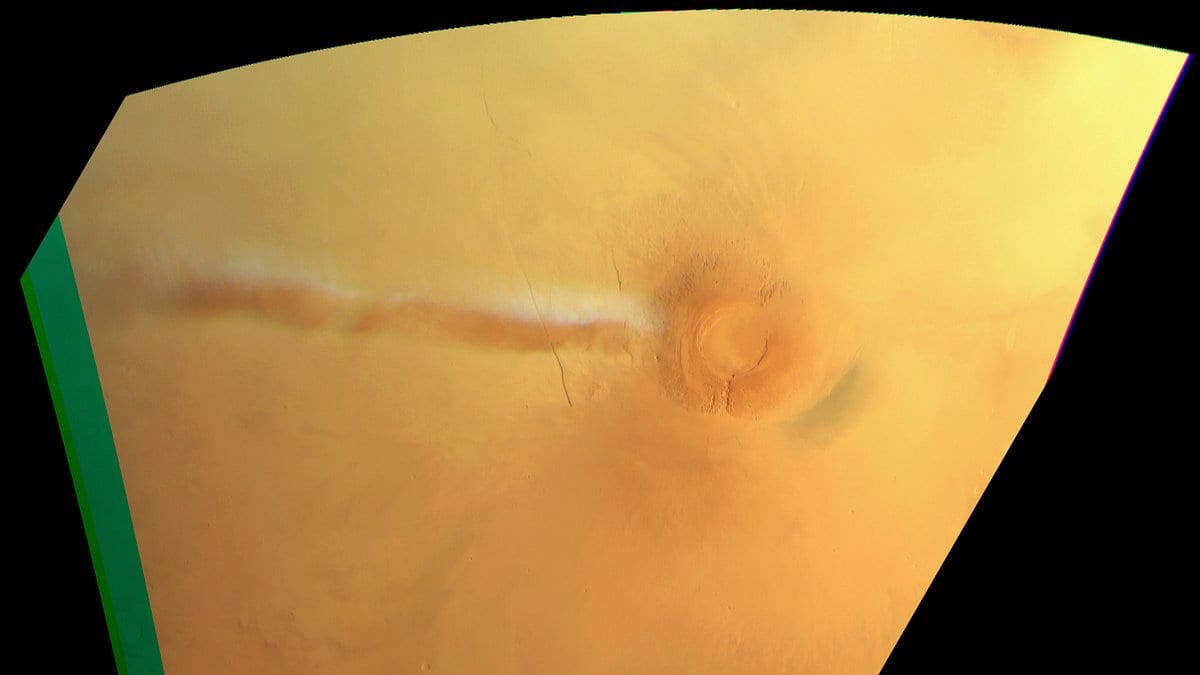
Researchers using Europe's Mars Express orbiter report that their Mars weather model could reproduce a long water-ice cloud over a Martian volcano only once they allowed water vapor to freeze straight into ice crystals, with no speck of dust to condense onto. It is a process they say has not been seen before in a planetary atmosphere.
Jorge Hernández-Bernal of LMD/CNRS/Sorbonne Université in Paris and colleagues published the work Oct. 7, 2026, in Nature Geoscience, the same day the European Space Agency announced it. ESA says the freezing would require relative humidity more than 100,000 times what is usually experienced in daily life on Earth, a level not previously recorded on Mars. "We've not seen these conditions on Mars before, but our finding now strongly suggests that the planet's humidity can indeed reach these extreme levels," Hernández-Bernal said in the agency's release.
ESA says the cloud, named the Arsia Mons Elongated Cloud, appears in Mars's southern spring and summer, streaming downwind of the 20-kilometer-tall Arsia Mons volcano. It forms, grows and fades each morning for several months, stretching up to 1,800 km (nearly twice the length of the UK) before evaporating.
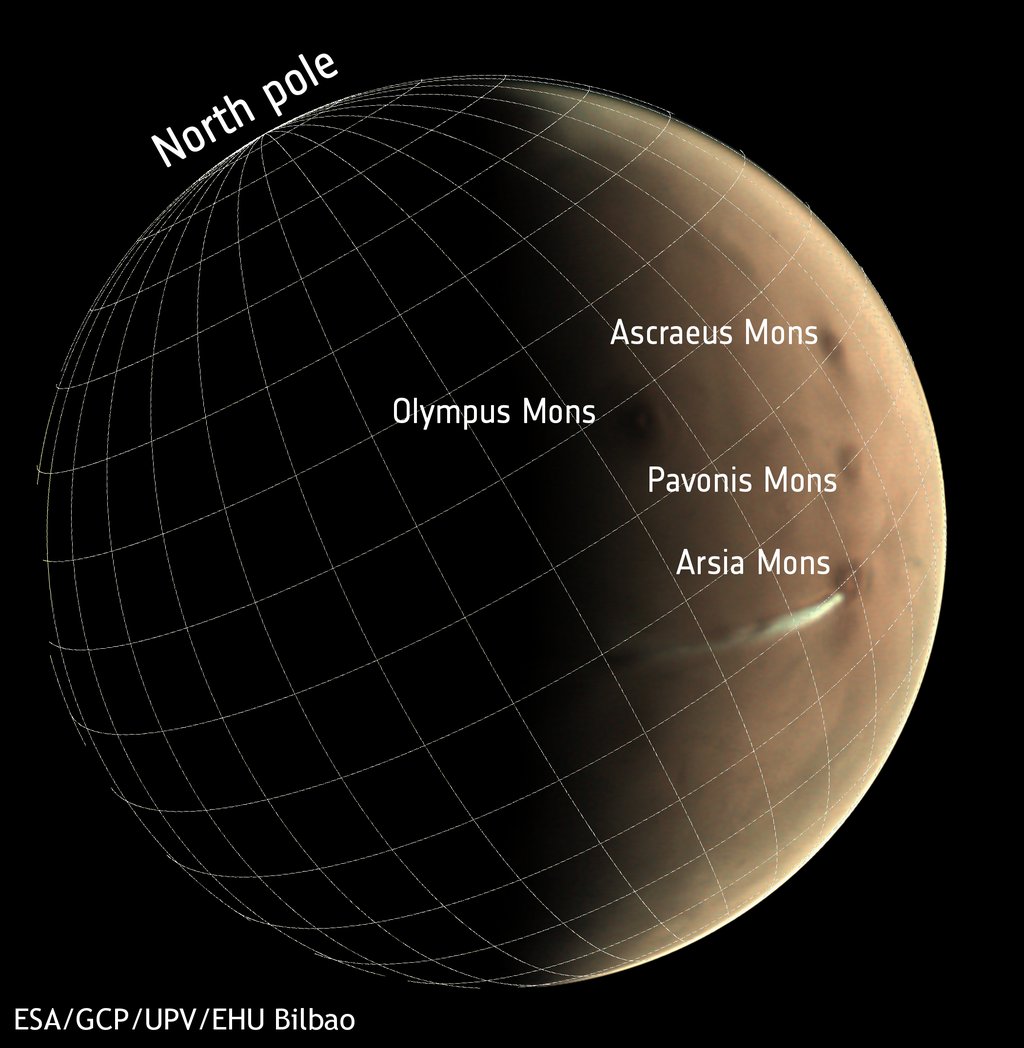
Clouds usually need dust, salt, soot or pollen for vapor to cling to. Winds flowing past Arsia Mons instead trigger a wave that lifts moist air several kilometers in a few minutes. Temperatures drop by 30 degrees in 10 minutes and humidity spikes, after which the vapor appears to freeze on its own. The researchers call that homogeneous nucleation. The paper's title presents it as suggested by the clouds rather than observed, and ESA says some aspects of the modeled cloud do not exactly match the images.
Mars Express first revealed the cloud in 2018 and has viewed it repeatedly since. The agency says its announcement is the first ESA release to carry imagery from the orbiter's High Resolution Stereo Camera; earlier ones used a lower-resolution camera.
Sources
- European Space Agency
- Nature GeosciencePeer-reviewed