Warm Water Turns This Eel Male, and Researchers Say They Found the Switch
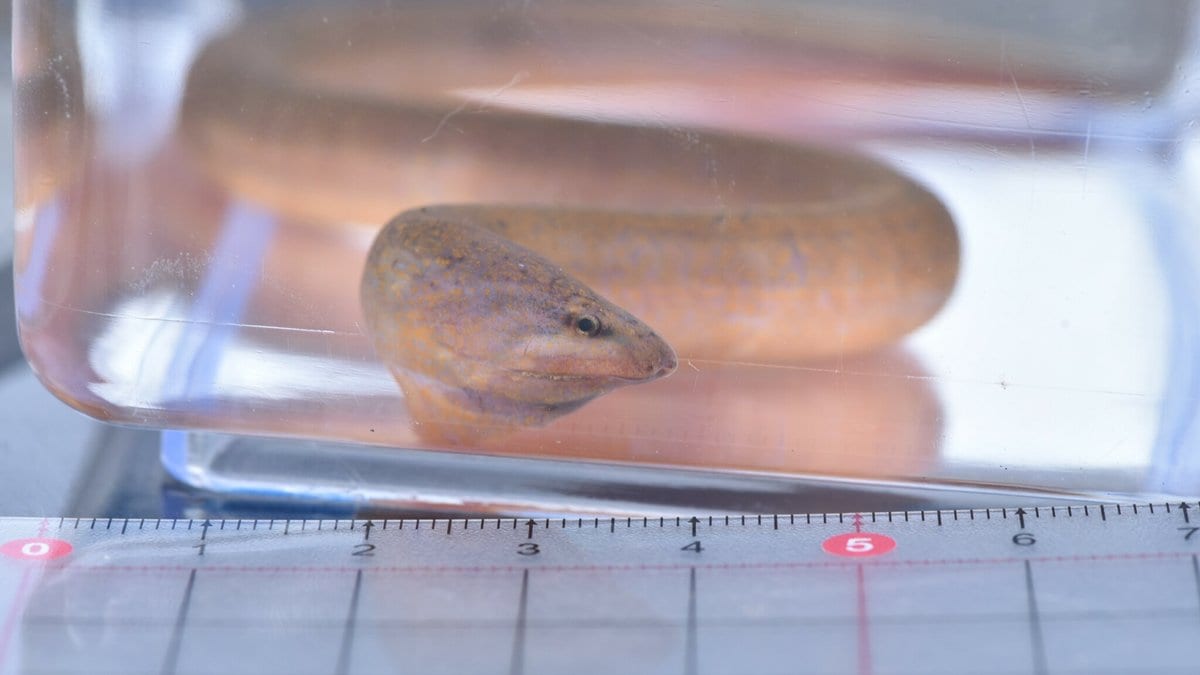
Warm water pushes the ricefield eel from female to male through a single temperature-sensitive protein in the ovary, researchers report in eLife. The paper, published on September 7 by Zhi Yang, Yuhua Sun and colleagues at the Institute of Hydrobiology, Chinese Academy of Sciences, names that protein as Trpv4, a channel that lets calcium into ovary cells and responds to the temperature around them.
The ricefield eel is a freshwater fish farmed across China, and it starts life as a female before turning male with age. That pattern leaves far more females than males at spawning and holds back production, and the authors write that their results "will be useful for sex control in aquaculture."
The paper reports three experiments, run in opposite directions. In females kept in cool water, injecting into the ovaries a chemical that opens Trpv4 raised the activity of male-pathway genes. In females kept in warm water, a chemical that blocks Trpv4 shut that response down, and so did siRNA, a molecule that stops a cell from making the channel in the first place.
From there the authors propose a chain. Trpv4 acts through a protein called pStat3, which switches on kdm6b, which in turn activates dmrt1, one of the main genes that steer a gonad toward becoming a testis. Blocking pStat3 or kdm6b in the ovary prevented warm water from raising male gene activity.
eLife's published assessment of the study calls the findings useful and the evidence incomplete, and says the protein measurements behind them need more rigorous methods.
Beyond the lab, the paper also reports a field observation from wild fish. Among two-year-old eels caught near Wuhan in central China, fewer than 5% were mid-transition, against roughly 24% of those caught on the southern island of Hainan, where average temperatures are higher.
Sources
- doi.orgPeer-reviewed